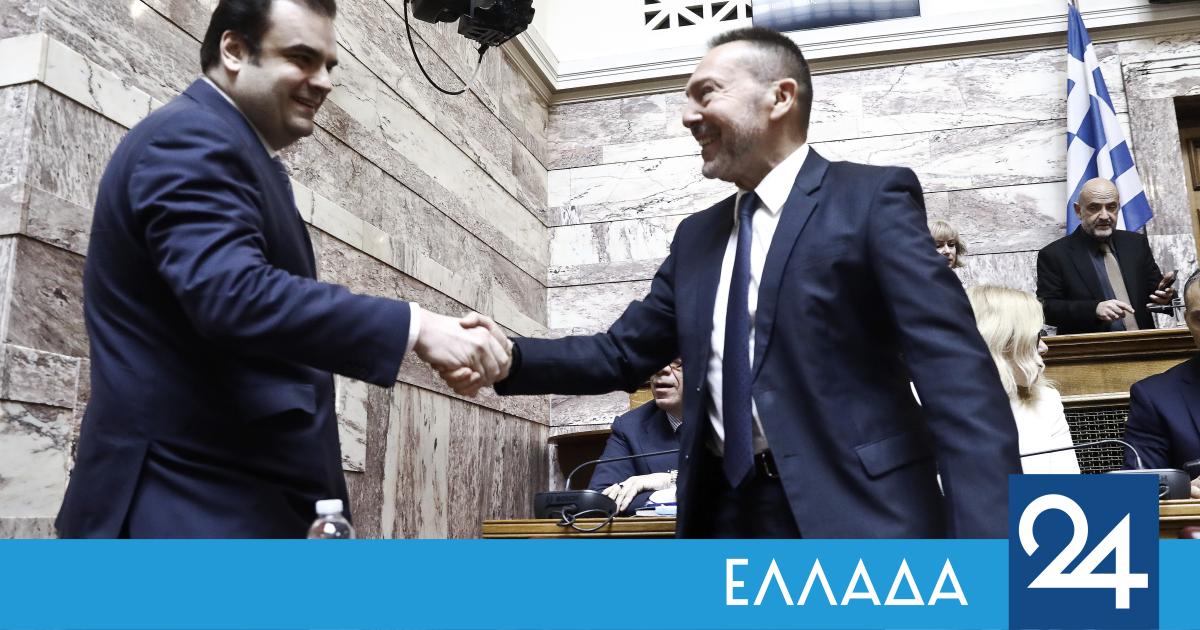
“The Greece of the crisis is now a thing of the past. Greece has to play a leading role in this new era,” said the Minister of Economy and Finance, Kyriakos Pierrakakis, recommending the reappointment of Yannis Stournaras as Governor of the Bank of Greece to the Committee for Public Enterprises, Banks, Public Utilities and Social Security Institutions.
Pierrakakis, during the hearing of Mr. Stournaras, noted: “It is with a great sense of responsibility that I recommend the renewal of the term of office of Yannis Stournaras as Governor of the Bank of Greece.
The minister stressed that with “the renewal of Mr. Stournaras’ term of office, he becomes the first governor of the Bank of Greece with three consecutive terms of office,” historically surpassing the term of office of Xenophon Zolotas, whose terms of office were not consecutive. “Institutional continuity for us becomes particularly important at times when stability and credibility are strategic advantages for any country, let alone ours,”
Talking about Stournaras’ experience, he noted that “at the most critical moments in the country’s modern economic history, he was present. His public career is linked to the major turning points in Greece’s economic course. With European convergence and the country’s preparation for its participation in the hard core of Europe. With the difficult period of the debt crisis, when Greece fought to remain standing within the Eurozone. And with the restoration of the stability of the banking system and the credibility of the economy after a decade of deep doubt.”
According to the Minister, Yannis Stournaras “has never been a convenient central banker. He spoke when he thought he should speak. He defended difficult positions even when it came at a political cost. This is the true content of institutional independence. Their credibility.”
Underlining that “Greece is at the forefront of this great debate on the future of Europe’s competitiveness, financing and strategic autonomy”, Pierrakakis said that “together with Yannis Stournaras, we participate daily in these crucial European battles, each in his or her own capacity.” “This is where the deeper significance of today’s selection (for the reappointment of Mr. Stournaras to the position of Governor of the BoE) lies. As Greece needs people with knowledge, experience and international prestige, who can represent the country with seriousness and credibility in a constantly changing European and international environment.”
He also stressed that “the next decade will be judged not only by the growth of economies, but also by the credibility of each country’s choices and strength within Europe”. On the situation in the Middle East, he noted: “We hope that the ongoing peace efforts in the Middle East will pay off and lead to greater stability in the region. However, in recent years we have become aware in the most difficult and characteristic way that we are living in a time of great upheaval. “The war in Ukraine has overturned decades of security and energy data. The crisis in the Middle East underlined how fragile global stability remains. Inflation has returned violently to the global economic system. And Europe now has to finance its defence, the green transition, its technological autonomy and its competitiveness at the same time,” he said, adding: “In this environment, states are obviously assessed through their economic indicators. However, they are also judged by the quality of their institutions, the seriousness of their choices and the people who represent them in European and international decision-making centres.”
In this context, the economic indicators of the European Union are often judged by the quality of their institutions, the seriousness of their choices and the people who represent them in European and international decision-making centres.
Pierrakakis set the tone for where the economy and the banking system are today: “Greece has now regained investment grade status. And this means a change in the country’s position on the global economic map. Today Greece is borrowing on terms that a few years ago would have been considered unthinkable, not self-evident. The restoration of this credibility is now also reflected in the banking system. In 2019, credit expansion to the private sector was negative, at around -0.4%. Today, financing to businesses is recording strong growth rates. Based on official data from the European Central Bank, over the period 2022-2025 Greece recorded an average annual rate of credit expansion to non-financial corporations of 10.9%, one of the highest in the euro area. At the same time, non-performing loans, which in 2016 exceeded 48% of banks’ total portfolios, have now been reduced to 3.3%, the lowest level in more than two decades. This is the difference between a banking system struggling to survive and a banking system that can once again support the productive economy.”
But he stressed that “there should be no complacency. The Greek economy needs even more credit expansion and more financing for innovation, investment and extroversion. Because what is at stake now is not only the stability of the banking system. It is its ability to support more dynamically the new productive model of the country and the growth we will need in the next decade.”
The need for more stability and more growth is not only important for the banking system, but also for the economy.
Pierrakakis said that “Greece is now being treated differently by the international markets, and this is reflected in international confidence in the banking system.” “UniCredit’s strategic partnership with Alpha Bank has been one of the most important votes of confidence in the Greek economy in recent years. At the same time, we see Greek banking groups gaining greater extroversion and a greater regional presence, something that would have seemed unthinkable a few years ago. But this is precisely why the demands of the next period are becoming even greater,” he noted and stressed: “Here lies a great challenge not only for our country, but also for Europe more broadly. We have huge savings, know-how and human resources in Europe. And yet, much of these resources continue to finance investment outside Europe. That is why the Savings and Investment Union is perhaps the biggest strategic gamble for Europe and all its Member States. Greece is at the forefront of this great debate on the future of Europe’s competitiveness, financing and strategic autonomy. Together with Yannis Stournaras, we are participating daily in these crucial European battles, each in our own capacity. And here, let me say, lies the deeper significance of today’s election. Greece needs people with knowledge, experience and international prestige, who can represent the country seriously and credibly in a constantly changing European and international environment.”
Greece needs people with knowledge, experience and international prestige who can represent the country seriously and credibly in a constantly changing European and international environment.
The meeting continues.