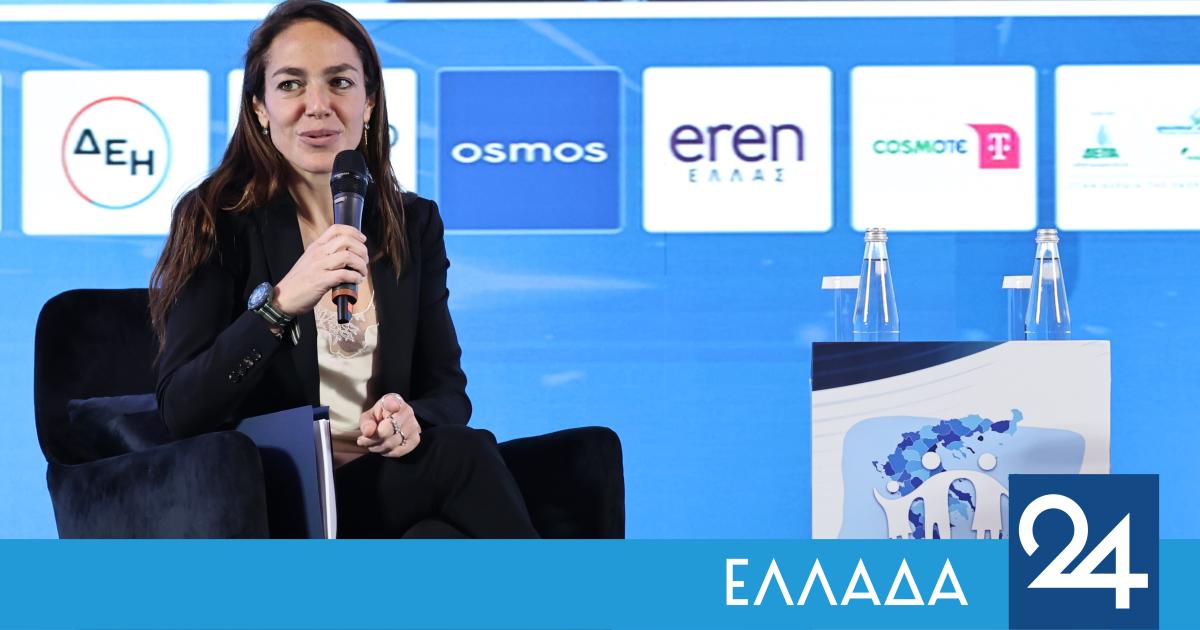
“A marathon that we have to run at a sprint pace”, said the Minister of Social Cohesion and Family, Domna Michailidou, describing the measures and policies to address the demographic issue, which, she said, is a priority for the government, in a conversation with journalist Nikos Hadjinikolaou at the “Demographic 2026” conference.
Michailidou noted that the initiatives of the government and the ministry she heads do not have a time horizon of the next elections, as was the case in previous decades, they need time to pay off, while she said, as Prime Minister Kyriakos Mitsotakis had previously said, speaking at the same conference, that there are also immediate interventions, such as the special allowance of 150 euros per child, which will be added to the existing child allowance.
According to her, under-birth rate is a common problem in almost all developed countries and certainly in Europe, citing as a typical example South Korea, where the fertility rate has reached 0.6, or strong social states such as Norway and Sweden, which are at 1.5 children per woman, while Greece is at 1.34. In fact, in response to a remark by Hatzinikolaou about the lack of a European commissioner for demography, the Minister argued that responsibilities are spread among various commissioners and that Europe, despite the seriousness of the problem, has not yet tackled demography with the required intensity and pressure and that the greatest burden of policies remains at the national level.
On top of that, he added that there is also a mindset issue, as families that increase their income often choose to invest more resources in their existing children rather than having more, proving that the issue is not only economic, but also social and cultural, and the aim is to change the perception around family and parenthood.
The Minister stressed that the government’s policy is based on three pillars: Direct financial support, tax incentives and strengthening social services and structures. In addition to benefits, she added, the government is making interventions in tax relief and labour policy to reduce the barriers to family formation. In this context, he referred to tax exemptions linked to the number of children, as well as work support policies for parents and large families.
Michailidou referred to the gap between work and motherhood, which has begun to narrow, recalling the maternity allowance for freelancers and farmers, paternity leave, but also special interventions to support workers in remote areas, while she described the wave of young people leaving the country during the period of the great economic crisis as a burden.
Finally, the minister also spoke about the role of technology and developments in medicine, noting that new possibilities can help women have children at older ages, but this does not mean that the problem can be solved solely through technology. “We cannot take for granted that technology alone will solve the demographic problem,” he added, stressing that a total change in policies, infrastructure and social perceptions is needed.