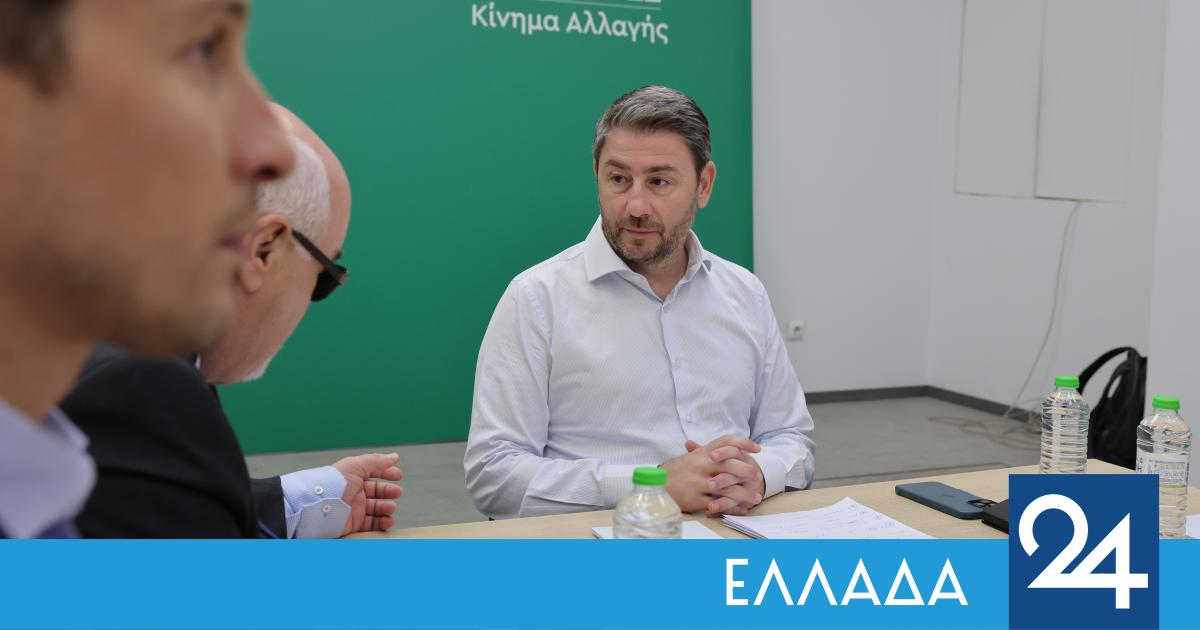
The closed session of the Committee on Institutions and Transparency was not very closed after all, with PASOK proceeding to informally brief and leak points of Nikos Androulakis’ intervention to the commander of the National Intelligence Service, Themistocles Demiris.
A move that causes strong reactions, as this is a meeting of a confidential nature, where the disclosure of dialogues and positions is considered institutionally problematic and contrary to the logic of the Commission’s operation.
The President of PASOK launched a fierce attack against both the National Intelligence Service and the prosecutor of the Supreme Court, citing a refusal of accountability, non-compliance with decisions of the Council of State and the country’s international exposure. At the same time, he brought the surveillance case back to the forefront, taking personal jabs at the EIA commander and even warning of legal action against him.
The release of content from a closed parliamentary procedure, however, opens a new debate on the limits of political debate and respect for institutional rules, because it is an unprecedented practice that affects the authority of the Committee on Institutional Affairs and Transparency.
The *informal briefing by Nikos Androulakis:
Points of intervention by the President of PASOK-Chile of Change at the meeting of the Parliament’s Committee on Institutions and Transparency
Mr Demiris,
You did what your duty as the Commander of the NSA dictates and attended the committee, unlike the Prosecutor of the Supreme Court, who we are told is not attending on the grounds of separation of powers.
Of course, this refusal is totally unjustified for a supreme state official, who has a duty not only to protect the independence of judicial judgement but also to contribute to the functioning of Parliament and the representatives of the people, in whose name, after all, justice is administered.
Mr. Tzavellas, who signed wiretaps himself, instead of declaring his abstention from the case of illegal wiretapping, preferred to abstain from accountability before the Greek Parliament’s Institutions and Transparency Committee.
So the judges are judged. However, Mr Demiris, your refusal to comply with the unanimous decision of the plenary of the Council of State 465/2024 is a cause for concern – first and foremost to me as a monitoring target. There it was held that ‘where a decision to restrict the confidentiality of communications is granted on the basis of a reasoned and detailed request by the competent national authorities, it must be ensured that the persons intercepted can have access not only to the granting of the authorisation but also to the request of the authority which requested the authorisation, so that they are able to understand the reasons invoked for granting it’. In my case, however, the DPA only disclosed to me the order number and not the rest of the case file, which your agency refused to provide and at your personal risk.
So the questions are clear: Why are you not complying with the decision of the Council of State? I urge you to immediately provide the file with the evidence accompanying the order to lift the confidentiality of communications as you owe it. And be clear about the existence of this file and not just give and take. Besides, the Prime Minister himself has stated before me in the 2023 teleconference that no national security reason existed for my surveillance.
So what is the reason for secrecy that you invoke when your political boss, Mr Mitsotakis, says there is no reason?
Mr Demiris, you come from the diplomatic corps and throughout your career you have served the national interest and legitimacy, now why don’t you comply with the explicit judgment of the Council of State? Why are you exposing the country internationally? Are you not aware of the damage this is causing to national interests?
Are you surely aware that you are forcing me to take legal action against anyone responsible, not excluding yourself? You are forcing me to do something unprecedented in Greek and European times.
As the leader of the opposition, I have to take legal action against the Commander of the National Intelligence Service. Finally, after listening to your introductory statement, I have two points to make: You said that you took over a new NSI and you took over a situation in difficult circumstances, explain to us exactly what you mean. What are those difficult circumstances that forced you to do a new EIS?
Secondly, you mentioned that in times of great challenges you want to create a framework to protect the communications of the country’s officials. I want to remind you that after you took office, I called for the mobile phones of ministers, MPs and all officials to be checked to protect them from illegal software. You did nothing. So, I see more hypocrisy than concern to protect national security.
Source: tomanifesto.gr