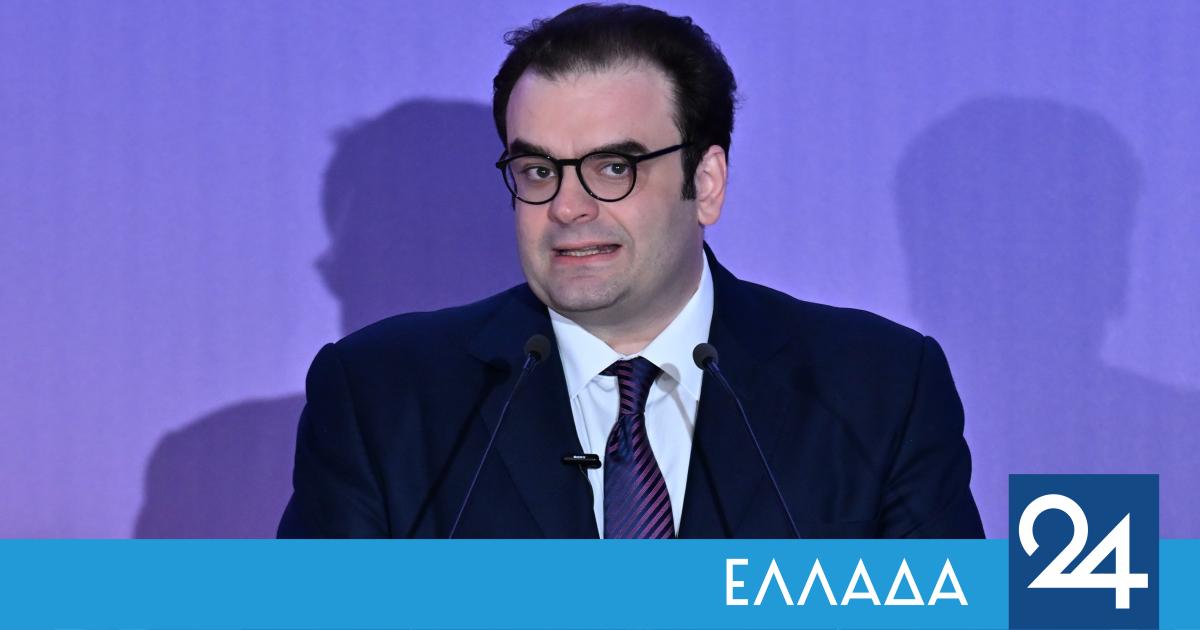
A new energy and inflationary pressure has been described as the biggest immediate risk for the European economy due to the crisis in the Middle East by Kyriakos Pierrakakis, Minister of Economy and Finance and President of the Eurogroup.
In an interview with Cyprus’ “Phileleftheros tis Kyriakiaki”, the minister pointed out that energy, transport and ultimately the cost of living of citizens are already being affected and said that Europe must now go on the offensive, without remaining dependent on the decisions, production and technologies of others. As he said, “Europe must step up a gear. We need a common energy strategy, more investment in technology, artificial intelligence, innovation and defence. We need a real Savings and Investment Union that turns European savings into European production, European technology and European power.”
Asked about the Greece-Cyprus electricity interconnection, Mr. Pierrakakis replied that the creation of a new energy highway in the Eastern Mediterranean, the Greece-Cyprus-Israel (GSI), is a project of strategic importance not only for Greece and Cyprus, but for the whole of Europe. It is a project that enhances energy security, geopolitical stability and strategic autonomy for Europe at a time of great international turbulence. For Cyprus, he added, the interconnection enhances the stability and security of its electricity system and creates conditions for lower energy costs for households and businesses. For Greece, it reinforces its role as a strategic energy hub, creating new investments and infrastructure. And he described it as a win-win project for Greece, Cyprus and Europe.
The full text of the interview is as follows:
-The Greek government cites indicators showing growth and improvement in the country’s economic performance, but many citizens and institutions say they see no real improvements in daily life. In your opinion, what is the real situation of the Greek economy and how will the problems of a new rise in inflation be addressed?
“The Greek economy today is clearly stronger than it was a few years ago. The country is growing at close to 2%, investment has risen from 11% to 17% of GDP and public debt is recording the fastest rate of decline in the world. This is real progress. It is proof that Greece is turning a new page and becoming a European example of transformation, resilience and credibility.
But there is a second truth that must be spoken clearly. Indicators often improve faster than the daily life of the citizen. People measure the economy by the cost of living, rent, supermarket and energy. That’s why the battle against accuracy remains an absolute priority.
The government in Greece has already allocated €800 million to support citizens against inflationary pressures. But the permanent response cannot be only temporary measures. The real answer is an economy that is more productive, more competitive and more outward-looking. An economy with more investment, better jobs and greater involvement of technology, innovation and artificial intelligence in production.
Greece’s big gamble is for growth to reach society even faster. To be transformed into a real improvement in the lives of citizens. And there are now good reasons for optimism that the country in the coming years can achieve this.”
-The housing problem is a major issue in Europe and is a major concern in Greece and Cyprus. What would you as finance minister say to a 25-year-old with a salary of about 1,000 to 1,200 euros who is worried that he will never have his own home? What can the state or Europe do about this hot problem?
“I would say first of all that we completely understand his anguish. It is a question of dignity, independence and life prospects. And it is not just about Greece or Cyprus. It is now one of the biggest social issues in the whole of Europe. That is why we put the housing issue on the agenda of the Eurogroup hosted in Nicosia. We need to discuss what concerns citizens and look for solutions to the big problems.
In Greece we are trying to address the issue as a whole. We are increasing the supply of housing, giving incentives to bring thousands of closed houses back to the market and setting rules for short-term rentals in areas of very high pressure. At the same time, we are directly supporting young people through rent subsidies and the My House I and My House II schemes so that around 30,000 people can own their own home.
There are no easy solutions. But there is an obligation to treat housing as a central social priority for the next decade.”
-If a young person or a couple is thinking about going abroad for work, such as coming to work in Cyprus or other EU countries, as Finance Minister what would you say or what arguments would you put forward in the debate to prevent economic migration of young people?
“Fortunately, today Greece is now on the reverse course from that of the crisis. More than 400,000 Greeks have already returned from abroad, up from around 600,000 who had left. In other words, about two thirds have returned. And this is perhaps the strongest evidence that Greece is changing its tune.
We could not come to terms with the idea that the country would lose its most creative and productive minds. We could not accept that the talent, knowledge and ambition of an entire generation would be exploited outside the country. But today that picture is beginning to change. More and more young Greeks are returning, creating and seeing prospects for their country again.
This is our big bet. To become a country that doesn’t export its future, but keeps it, harnesses it and makes it stronger here.”
-Do you see Europe being driven into new economic instability by the effects of the crisis in the Middle East and what do you see as the biggest risk, inflation, recession, immigration, energy prices?
“The crisis in the Middle East is a reminder that the economy and geopolitical security are now intertwined. The challenge is therefore not to react with fear or panic, but to move quickly, strategically and united.
The biggest immediate risk to the European economy is renewed energy and inflationary pressure. Already energy, transport and ultimately the cost of living for citizens are being affected. And Europe must now go on the offensive without remaining dependent on the decisions, production and technologies of others.
That is why I believe Europe must step up its game. We need a common energy strategy, more investment in technology, in artificial intelligence, in innovation and in defence. We need a real Savings and Investment Union that turns European savings into European production, European technology and European power.
Europe must stop treating each crisis piecemeal and adopt a long-term strategic approach. Right now it faces a historic choice: either act quickly and in a coordinated manner or lose ground in a global environment that is changing faster than ever before.”
-How important is it for Greece to go ahead with the electricity interconnection with Cyprus and to what extent can geopolitical obstacles sideline this major project? What is the importance of the Greece-Cyprus electricity interconnection for the two economies?
“The creation of a new energy highway in the Eastern Mediterranean, that of Greece-Cyprus-Israel (GSI), is a project of strategic importance not only for Greece and Cyprus, but for the whole of Europe. It is a project that enhances energy security, geopolitical stability and strategic autonomy of Europe at a time of great international turbulence.
It is no coincidence that this is a European Union Project of Common Interest (PCI), with €657 million of funding already approved. Recently, the Energy Ministers of Greece and Cyprus, in the presence of the Energy Commissioner, formally instructed ADMIE to submit a funding request to the European Investment Bank, paving the way for even greater participation of investors and European funds.
For Cyprus, the interconnection enhances the stability and security of its electricity system and creates conditions for lower energy costs for households and businesses. For Greece, it reinforces its role as a strategic energy hub, creating new investments and infrastructure.
It is a win-win project for Greece, Cyprus and Europe.
-Is there sufficient coordination between Greece and Cyprus for joint interventions in Europe on economic issues?
“Certainly. And I would say that today there is not just good coordination, but a really strategic cooperation between Greece and Cyprus on major European and economic issues.
The timing is particularly significant as Cyprus holds the presidency of the EU Council and the Greek finance minister was elected to chair the Eurogroup. This creates a strong opportunity for joint interventions and coordination on critical issues for the future of Europe.
With Makis Keraynos there is substantial cooperation in areas such as shipping, energy security, investment, tourism and the competitiveness of the European economy. Especially in shipping, Greece and Cyprus are two of the most important powers in Europe. We therefore have a common responsibility to protect the competitiveness of a sector of strategic importance for European trade and the global economy.
-How can the presence of Greek businesses in Cyprus and Cypriot businesses in Greece be strengthened? Are you generally satisfied with the level of economic cooperation between the two countries?
“The level of economic cooperation between Greece and Cyprus is already very high and reflects the strategic relationship between the two countries. The data confirm this. Cyprus is now Greece’s 3rd largest export market, while Greece remains consistently one of Cyprus’ most important economic partners. This shows that our relationship has real economic depth.
.
The challenge now is to move to an even more ambitious level of cooperation. There is huge potential in energy, shipping, banking, technology, services, infrastructure and innovation. Greece and Cyprus can function even more as a single space for investment, entrepreneurship and growth within Europe.
The opening of the National Kapodistrian University of Athens in Cyprus and the University of Nicosia in Athens also shows that we are investing not only in the economy, but also in knowledge, research and human capital. Because the real strength of Greece and Cyprus in the coming years will be judged in technology, innovation and the new generation.
So yes, we are satisfied with what has been achieved. But I believe that the potential of Greece and Cyprus is even greater than what we have seen so far.”