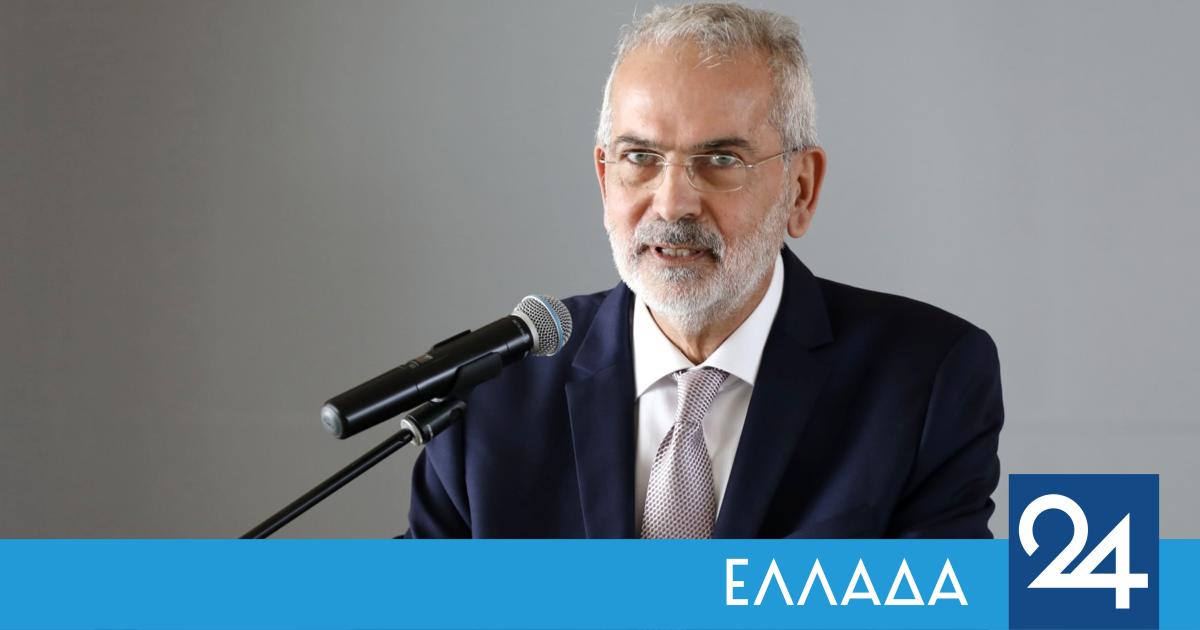
Former President of the Council of State and serving Prime Minister in 2023, Ioannis Sarmas, speaks to Liberal.gr and explains the low acceptance rates of Justice in society, explains the limits of the powers of the European Public Prosecutor’s Office and sees that the only useful change in the way the Justice leadership is elected is the constitutionalisation of what is currently in force. He expresses his concern about the way in which political figures attribute malicious intentions to judicial officials and gives a legal explanation of the reasons that led the Supreme Court prosecutor Mr. P. Tzavela to the decision not to withdraw the case of the wiretapping from the file.
Interview with George Kakousis
Mr. President, in recent years, on various occasions, justice has been the subject of political debate. Do you think this has led to the suspicion that polls have recorded about the institution?
The public’s trust in the judicial institution appears low in the polls. The blame, however, lies not with the judicial manipulations themselves, but with the way they are interpreted by agents who systematically attribute malicious intentions to judicial officials whenever their decisions deviate from the views of these agents.
The criminal law has become a tool of political debate. The accusations made – mainly against government officials – are presented as unquestionable guilt. Thus, when no prosecution is brought, the judge who acquitted is automatically identified with inadequate investigation or, worse, with complicity in evaded responsibility
The latest decision that has been much discussed is the decision of the Supreme Court prosecutor Panagiotis Tzavela not to withdraw the wiretapping case. What is your legal assessment?
I assess this decision solely as a legal document.
The criminal justice system does not start from an alleged guilt seeking its verification; it investigates the merits of charges in light of the presumption of innocence. This was the logic that the Supreme Court prosecutor appears to have followed in deciding not to lift the quasi-precedent of the original prosecution’s decision to file the case.
The relevant provision of the law grants him wide discretion. However, he committed himself by setting specific criteria: that there be clear evidence of guilt – not speculation, suspicion or weak evidence – and that the persons involved prove a real link to the interceptions.
On a case-by-case basis, his judgment was as follows: some persons were merely software developers or partners in an involved company; others ran a company that marketed data analysis software, but not Predator; a third person whose prepaid card was used by an unknown third party for trivial purchases was not shown to be connected to the case. Finally, the only new evidence related to the crime of espionage was found insufficient to establish relevant intent.
In conclusion, criminal procedure is not intended to solve “mysteries”; although there are dark spots in the case, it has not been possible to link them to specific persons in order to establish an accusation against them and, consequently, to conduct a judicial investigation.
Some of the political nervousness about justice has been created by the legislative initiative to speed up the procedures for cases involving MPs. Was such an initiative needed?
The need for such an initiative is unquestionable: there is a clear public interest reason to resolve charges against the nation’s representatives in a timely manner. The question, however, is different: whether the Greek legislature can regulate the way in which the European prosecutors appointed can exercise their functions.
.
The EU Regulation on the European Public Prosecutor (Article 30) gives these prosecutors seven investigative powers – investigations, seizures, surveillance, etc.etc – which they exercise as EU institutions, without the possibility of their being curtailed at national level, and certainly not replaced by a national body on the basis of a national provision. However, the procedures for taking these measures are governed by national law.
The crucial Article 35 states that the investigation is closed when the designated prosecutor “considers” that it has been completed. The word ‘considers’ is crucial: if the prosecutor considers that his investigation is incomplete, he is not entitled to terminate it, and the relevant supervision is the responsibility of the competent EU institution, which will assess whether the investigative function is being carried out properly and proportionately. Setting a deadline for completion, and especially by national legislation, can only be seen as a plea for a speedy completion.
.
The European Public Prosecutor’s Office investigations are viewed critically by some who believe that their piecemeal handling and sending to Parliament creates issues of impressions and political hostage-taking of those under investigation. Are you also concerned about this management?
The wider problem of easy and premature prosecution is real. The law does not require Greek prosecutors to make a written probable cause finding of guilt with a heightened degree of certainty – a requirement that applies in France, Germany and the UK. As a result, citizens, especially politicians, suffer onerous consequences, a blow to their dignity and privacy.
Mrs. Kovesi very recently demanded a 5-year renewal of her Greek subordinates in a way that created the appearance of a confrontation with the Greek government. Whose responsibility is it to renew their tenure?
Three provisions of the EU’s Regulation on the European Public Prosecutor provide a clear answer. Firstly, the term of office of the Prosecutors Designate is five years and renewable. Secondly, they are appointed by the European Public Prosecutor’s Office on the basis of a proposal from the Member State concerned. Thirdly, for mainly European prosecutors – by contrast – the Regulation explicitly provides for the possibility of an extension of the mandate by the Council of the EU.
.
Since the Regulation distinguishes between “extension” and “renewal”, and does not provide for an extension for designated prosecutors, renewal constitutes a new appointment and must follow the same procedure as the original appointment: proposal by the Member State – in Greece, exclusively by the Supreme Judicial Council of the Supreme Court. The European Public Prosecutor’s Office should therefore have informed the Greek Minister of Justice in good time of the expiry of the term of office, so that he could initiate the procedure through the Supreme Court. The Supreme Court, sovereignly and without being bound by any expression of the European Public Prosecutor’s wishes, would decide on the appointment of new prosecutors or the renewal of the term of office of those currently serving.
Three further observations are imposed: First, this procedure is standard practice in other European institutions – it would be unthinkable for, for example, the European Court of Auditors or the Court of Justice of the EU to unilaterally renew the terms of office of their members. Secondly, the pendency of specific cases cannot be an independent reason for extending or renewing a mandate; at the end of a mandate, pending cases are handed over to the successor or redistributed. Thirdly, any disputes between the European Public Prosecutor’s Office and the national institutions must be resolved in a spirit of good faith cooperation, as required by EU law.
In Ms. Covesi’s letters to the Minister of Justice, there is a clear implication of the need to repeal No. 86. What is your opinion?
Article 29 of the European Public Prosecutor’s Office Rules, which deals with the waiver of privileges or immunities, is quite clear. Where the Constitution of a Member State provides for a privilege or immunity of a person against criminal prosecution, the competence of the European Public Prosecutor is limited to making a reasoned request for waiver. The choice of the verb ‘submit’ in the Rules of Procedure is not accidental: it reflects an attitude of respect. The European Public Prosecutor has no power to demand and obtain lifting – only to request it.
It is worth recalling that even the Court of Justice of the European Union – that powerful and well-established institution – only has the power to rule on the compatibility of national legislation with EU law for the sake of respecting national sovereignty. It is not entitled to annul it or to demand that it be amended. The message is clear: the European Union exercises donor powers, and all its institutions must understand and respect this. The principle of the effectiveness of EU law has its limits.
.
Representatives of judicial organisations are claiming a more decisive or even exclusive role in the election of the leadership of the Supreme Courts. Would this help in the direction of independence among the institutions?
The only plausible institutional improvement would be to constitutionalise the existing statutory provisions: the hearing of nominees by Parliament and voting in the Supreme Court Plenaries. Possibly a further, again constitutional, restriction on the number of candidates based on seniority.
Are you optimistic that something better will come out of the constitutional review process? Is it a process from which substantive improvements could emerge?
The real reform breakthrough would be the establishment of a real Constitutional Court. Such a change would radically transform the country’s institutional landscape and put a definitive end to the problems that have plagued our constitutional life over the years.
*Joannis Sarmas is the former President of the Council of State and served as caretaker Prime Minister in 2023
Source: liberal.gr