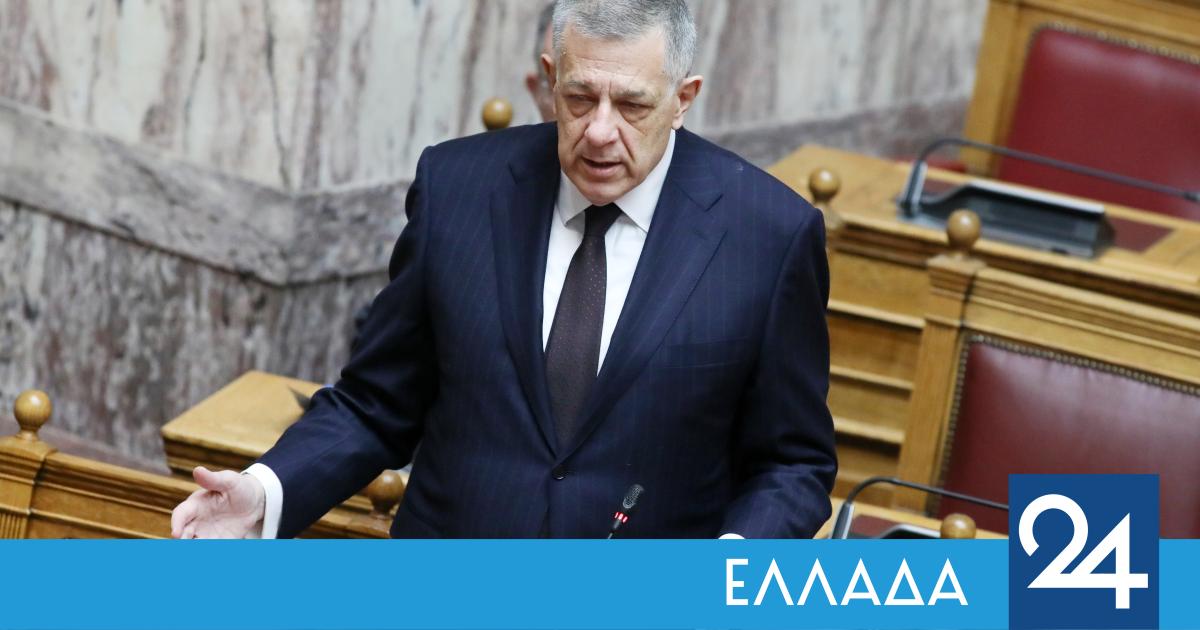
The government’s commitment to provide a definitive and sustainable solution to the issue of water supply in Heraklion and the overall water problem in Crete, was underlined by the Deputy Minister of Infrastructure and Transport, Nikos Tachiasos, from the floor of the Parliament. Responding to a topical question, Nikos Tachiaos spoke of a clear political will of the government to allocate all the necessary resources to provide a solution to the issue and said that coordinated planning with local and regional government is already underway. The Deputy Minister stressed that the issue of water in Crete is a priority, noting that the State is fully aware of the pressures facing Heraklion. He recalled that at the beginning of the week a wide-ranging meeting was held in Heraklion, at the initiative of Prime Minister Kyriakos Mitsotakis, with the exclusive focus on water, in the presence of the regional governor, the mayors and all stakeholders. As he said, “You are knocking on open doors. No one has hidden that there is a problem. On the contrary, we want to provide solutions,” noting that the interventions that will qualify must be technically mature, economically viable and socially acceptable. According to the deputy minister, the central role in this planning is played by the Organisation for the Development of Crete (OAK), which was created on the initiative of Konstantinos Mitsotakis and is responsible for carrying out the necessary studies and formulating a strategic plan for the water supply of Heraklion and the overall management of water resources in Crete.
He noted that this institutional structure allows the coordination of the central government and local authorities so that solutions can proceed with consensus and efficiency. The Deputy Minister also listed the projects already being implemented or maturing for the Aposselemi system and the strengthening of the water supply in the region. These include the projects under execution “Extension of the aqueduct to the reservoirs D1 and D3 of Heraklion”, with a budget of 4.65 million euros and “Hydroelectric power plant unit at the entrance of the EES Aposelemi”, with a budget of 1.18 million euros. and the project under tender “Construction of the intake pipelines in the tourist areas of Sisi, Milatos, Elounda, Neapolis and the settlements of Vrachasi, Nikithiana, Lakes, Chumeriakos, Mesa and Exo Lakonia, Kritsa of Lassithi from the Aposelemi dam”, budgeted at EUR 14.8 million. In addition, the reinforcement of the “Aposelemi” system from the Malia drilling field is under study, with the replacement of the pipeline from the Malia area and its routing via the BOR to the “Aposelemi” reservoir, with an hourly flow capacity of about 350 m3 , in cooperation with DEYA Heraklion, the reinforcement of the reservoir of the “Aposelemi” dam from the karst springs of Almyros in the Municipality of Malevizi and Almyros Agios Nikolaos, with an average annual flow of about 250 million cubic metres, as well as the pumping from the Almyros springs and storage in a reservoir during the fresh water season. He also made special reference to the new alternatives being considered, such as the construction of a dam at Yofyro and a supporting desalination plant at Almyros, as a solution for the water supply of Heraklion and other areas on the northern coastline, at an estimated cost of 65 million euros, including the pipelines of the networks and the refinery, as part of a comprehensive and updated planning that takes into account the data of the climate crisis. Nikos Tachias stressed that hydrological issues cannot be addressed with outdated approaches, as conditions are constantly changing. “Solutions must be well planned, have a time horizon and not create difficulties for citizens in the near future,” the deputy minister said, stressing that discussions on these issues have been going on for many years, before the climate crisis occurred, which dramatically worsened the situation.