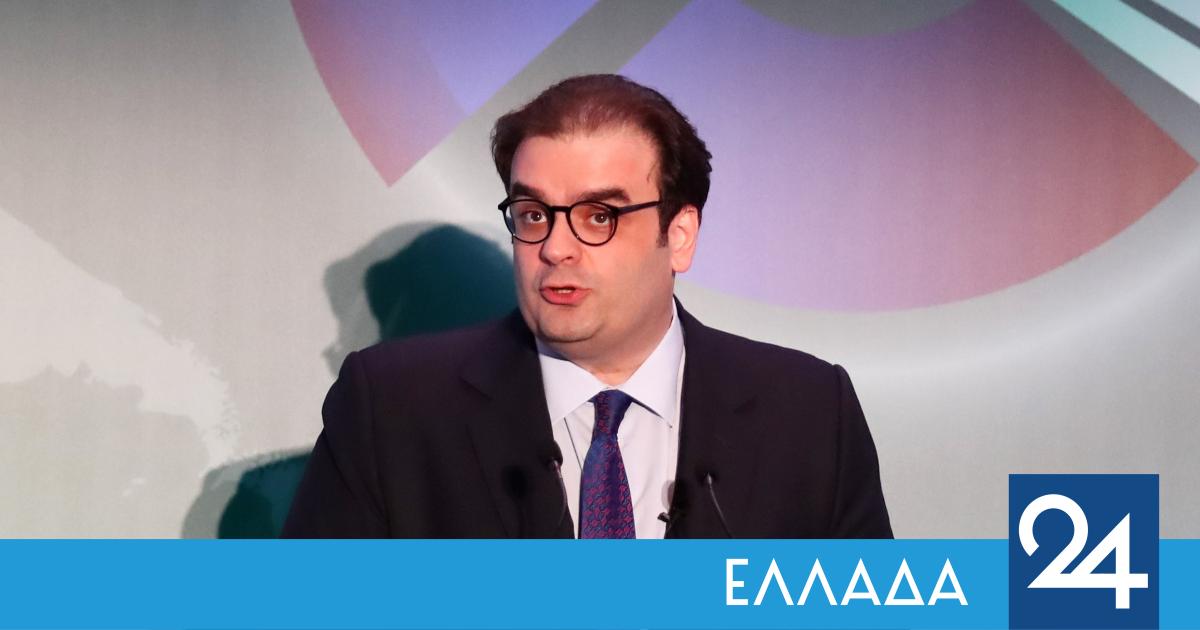
In an interview with the US television network CNBC and journalist Karen Cho, Minister of Economy and Finance and President of the Eurogroup Kyriakos Pierrakakis was interviewed from Washington, DC.
The text of the interview is as follows:
Kyriakos Pierrakakis: The impact is extremely important. The executive director of the International Energy Agency (IEA), Fatih Birol, has described it as possibly the biggest energy crisis in history. Bigger even than the three previous ones combined: the two oil shocks of the 1970s and the Russian invasion of Ukraine in 2022. The evidence confirms this assessment. If we look at the 1970s, for example, the total loss of barrels of oil per day was about 10 million. Today, the loss is 13 million barrels per day. And if we look at natural gas, the curve recorded is steeper than 2022. Then, in terms of billion cubic meters (BCM), we dropped from 155 to 80, a cumulative loss of 75 BCM; if we annualize those figures now, we’re talking about a loss of 110 BCM.
So, if we take all three cases together, we may be facing the biggest energy crisis in history if the Straits of Hormuz do not open soon. And if you add up all the other elements, a third of fertilizers pass through the Straits: sulfur, helium, petrochemicals. All in all, this is a potentially huge risk. Moreover, April may prove to be more problematic than March, because the last shiploads that left on 28 February are expected to arrive by 20 April. Therefore, the impact will be felt more acutely in the markets in the coming period if there is no quick solution.
Karen Cho: I have spoken to Pakistan’s finance minister, who appears optimistic that his country can broker further talks between the US and Iran. If there is a quick resolution soon, it will make a difference in restoring supply;
.
Kyriakos Pierrakakis: It will make a significant difference. The sooner the better. However, it will not be enough to fully return to the previous equilibrium, exactly where we were before. Even under a number of very favourable conditions, it will take at least two months to restore the supply chain to a functioning supply chain, and at lower levels than before. Because if you look at the energy facilities in the Middle East, 80 facilities have been affected so far, 80 energy assets. A third of them have been significantly affected. Overall, there will also be a risk premium that will be reflected in prices in the future. So, overall, it’s a different situation.
With this in mind, the key parameter is the uncertainty as to the duration of the crisis. It’s different if it’s two weeks and different if it’s three months.
Karen Cho: Indeed. And the IMF has already lowered its forecasts. It now expects growth of 1.1% for the euro area this year, down from 1.4% last year. How vulnerable is Europe to the risk of stagflation as inflation rises?
Kyriakos Pierrakakis: First of all, I would say that Europe is less vulnerable compared to 2022 as a whole, given that we are talking about an energy crisis. It is less vulnerable in terms of diversification of energy sources and investment in infrastructure. However, we still import 57% of our energy at European level, which remains a negative fact.
On the other hand, 43% of our electricity production comes from renewable sources. So, from this point of view, we are already strengthening our capacity, but we have to strengthen it even more. We need to invest more in key energy policy parameters: networks, interconnections, storage. This is one part of it.
The other is the macroeconomic impact. Right now we are seeing lower growth and higher inflation. We are not yet in stagflationary conditions; that would be the worst case scenario that could manifest. If we compare the situation with the 1970s, it becomes clear why the duration of the crisis is the most critical factor.
Karen Cho: The ECB is already considering its monetary “response”, closely monitoring the data. What should Europe’s fiscal response be?
What should Europe’s fiscal response be?
Kyriakos Pierrakakis: What I can say is that it should be in sync with monetary policy. Monetary policy is, obviously, independent. The ECB is independent and governments do not comment on its decisions. However, we have a toolbox that we developed in 2022. We have learned from the experience of that period, we know what worked and what did not work. And what the European Commission has set as a framework is that measures should be temporary, targeted and tailored. We need to support the most vulnerable and those most in need. At the same time, this policy has to be consistent with the monetary policy that the ECB will follow, so that there are no negative effects at the end.