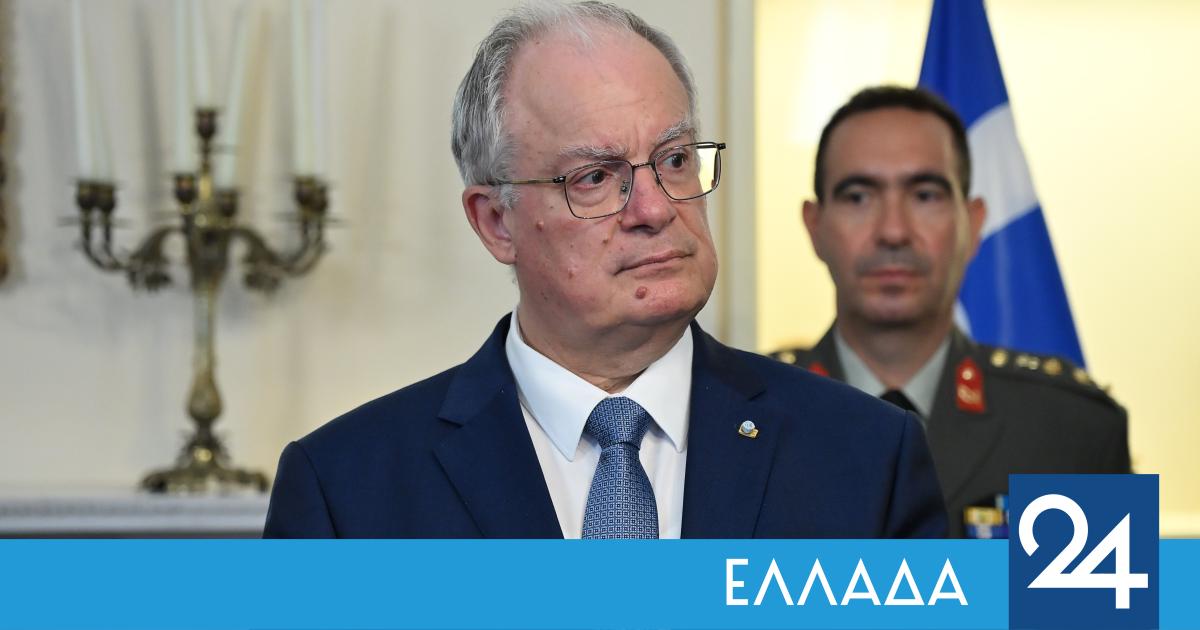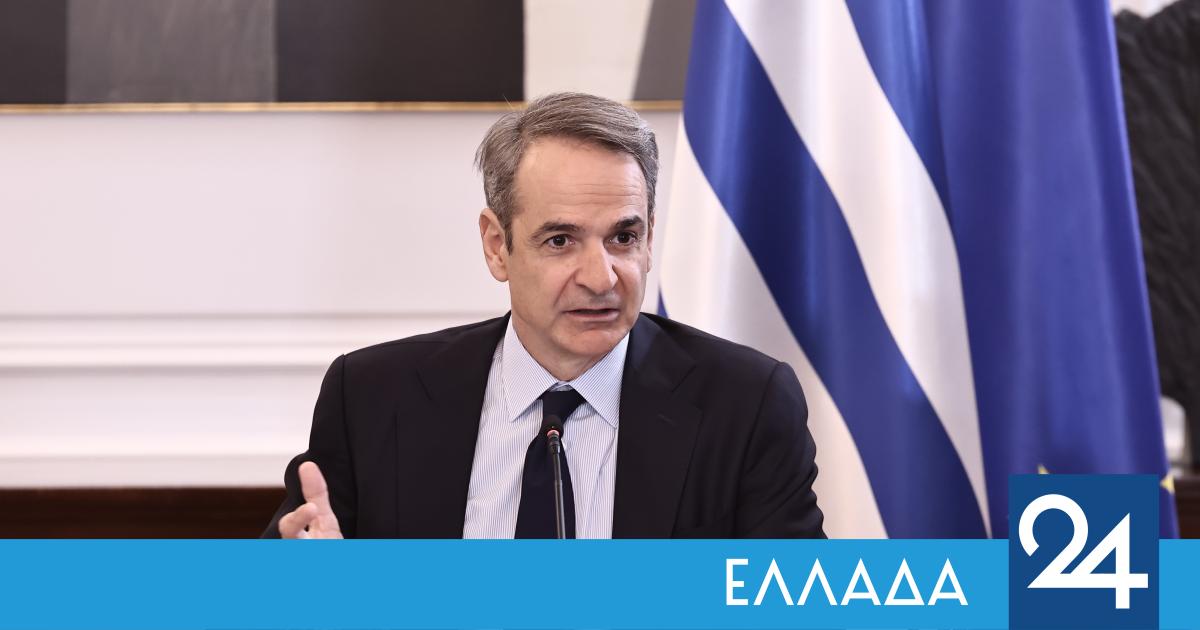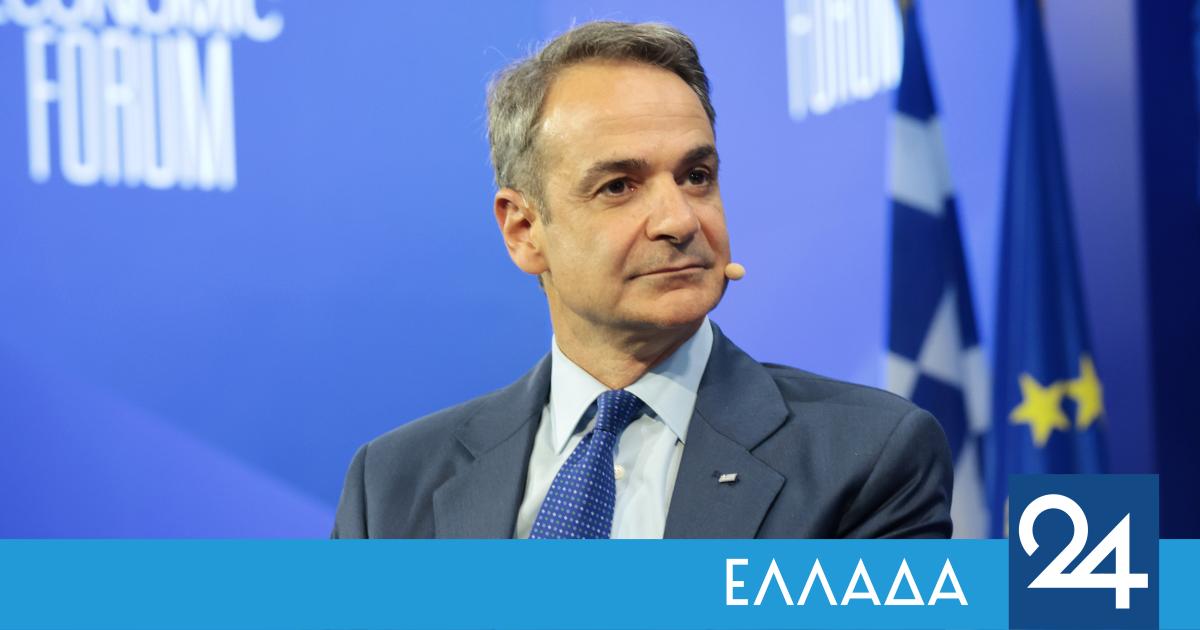
“I would like to thank you and congratulate you for the well-organized dinner which you provided for President Macron and his wife on the occasion of his visit to Greece. I believe that it was a visit with a special symbolism,” Kyriakos Mitsotakis said in his first words in his meeting with Costas Tasoulas.
“We had the opportunity not only to reaffirm the firm alliance ties between our two countries, but also to place the framework of the Greek-French initiatives in a broader debate on the future of Europe. Because I want to remind you that when Greece and France signed the mutual assistance and defence cooperation agreement in 2021, they were actually ahead of the curve,” the Prime Minister continued.
The Prime Minister continued.
And he added: “We were the first to put the issues of European strategic autonomy on the table of the European Council discussions and I am glad because at this moment this discussion has gained an increased momentum. So this visit was not only about multi-faceted Greek-French cooperation in many areas beyond defence and foreign policy, but also about a common vision which we share with France for a more strategically autonomous Europe, a more self-confident Europe, a Europe which will actively defend the European way of life and strive to protect the interests of European citizens in a complex world in which many of the constants of the past are now being called into question. And of course this brings us to issues related to the economy and support for very ambitious European initiatives, at least as they have been expressed at the level of the European Council”.
M Mitsotakis noted: “We are in the midst of a major economic crisis. The Greek government has done the best it can, Mr President, to support Greek households, Greek businesses. We are always moving within the framework of fiscal rules and fiscal discipline, which is not imposed on us by Europe, but by the need we have to reduce this unbearable debt that we have inherited from other generations. And here I want to mention by way of example, and I showed it graphically yesterday in the post I made, and it is perhaps the greatest success of economic policy, and we do not talk about it enough, that Greece has in recent years achieved the largest and fastest recorded reduction in public debt as a percentage of GDP of any economy in the history of modern economies. This is a very great success. We are taking a very big burden from future generations and at the end of this year I hope that we will not have the highest debt in Europe. So this debt reduction policy gives a big breathing space, not only to future generations because they will not have to inherit another burden, but it also allows us to be able to borrow on better terms and to respond to emergencies in a more efficient way.
But that is why I am so insistent on the need to maintain fiscal stability, we cannot deviate from this path. I believe that this path is and should be a non-negotiable national priority for the country. It is not only a priority of the government, it is the first time since the post-independence period that this has been happening for many years with such speed and to such a systematic degree. Because you are a history buff, I cannot help but be reminded of the phrase that Andreas Papandreou said that either we fight the debt or it will swallow us up. We have been swallowed up by debt for many decades. Well, now, for the first time, we are happy to be able to say that we are addressing this perennial problem in different terms. But because the national context is de facto limited for these reasons, I think it is very important that the debate on Europe’s next budget for Europe should be conducted in terms of, I would say, a broader horizon. What I mean by that: If we have great ambitions, and we have great ambitions in defence, in the climate crisis, in social cohesion issues, in artificial intelligence, Europe must have the financial tools to be able to finance these ambitions. It is a difficult debate, I hope that it will culminate in December this year when we have to agree on the budget and Greece and France, to end where I started, are on the line that we have to be more ambitious if European resources are needed. We need to think about how to use them, not to rush now to repay the debt of the Recovery Fund but to postpone it to the future because that will take resources away from the next budget. And I think that in this way, with this common position we will come to this negotiation, so I can assure you that what happened, which I think showed that France is on our side and we are on France’s side, has a broader dimension, a European dimension, which I think in these difficult circumstances is of particular importance.”
“Thank you, Mr. President, for the briefing and for the details of this briefing that will follow,” the President said, taking the floor.
“Indeed, I too consider that the visit of the French President this weekend was a successful visit not only in terms of bilateral relations – which are in any case at a very high level – but also in terms of a model in view of the need for the EU to forge relations between its members and to underline that the concept of strategic autonomy is not a verbal invention but a necessity in the modern, unstable, complex world that is watching developments. And if the European citizen wants not only to watch them but to stand in front of developments, able to feel that he is not being swallowed up or degraded, then only such bilateral relations as an example can provide an answer to the perplexity of the times.
Our strategic partnership, which has been renewed for another five years and expanded with France, in essence proves that the famous assistance clause in the European Union pact, the famous 47(2), is a solution that states anticipate, adopt and implement, as was the case in Cyprus, where Greece led the way, I would say Greece led the way, and other countries, including France, followed suit.
So, Europe is not watching all these developments in an embarrassed way and I am glad to see, as many others around us are seeing, that our country is leading the way in Europe’s initiative to stand up and not be dragged behind the developments which, over the last four years in particular, have created many challenges and many problems in the global economy, in the global security treaty, in the global energy affair. So, Mr President, things have gone well this weekend with the French President, and of course all this strategic autonomy and strong defence armour with mutual assistance has to do with a strong economy.
It is not possible to aspire to have deterrent power – because our country has a deterrent perspective, a deterrent doctrine, a defensive doctrine, not an offensive doctrine – in the face of the threat we face, we neither threaten nor claim anything, we claim that no one dares to implement their threat. So in view of this, a strong economy, the room for manoeuvre that a strong economy gives us, facilitates both the welfare state and the deterrent power of the country. And of course, the policy of fiscal discipline and fiscal compliance can be a policy that does not hand out money in a wasteful and populist manner but safeguards the future from the frivolities of the present. And because the future was undermined in the past and the future was undermined by the frivolities of the present in Greece and the country and especially its people paid dearly for it in the 2010s and afterwards, this insistence of yours, as you have just underlined to me, on fiscal discipline is nothing but a precaution for future generations against the mistakes of previous generations. Therefore, I am also following these developments with interest, I see the efforts being made and I am sure that the so-called political system will preserve this tactic of fiscal balance because, as it has been checked, it does not concern only one government term, it does not concern a party choice, it is a national policy and as such we must see it as such,” he stressed
.