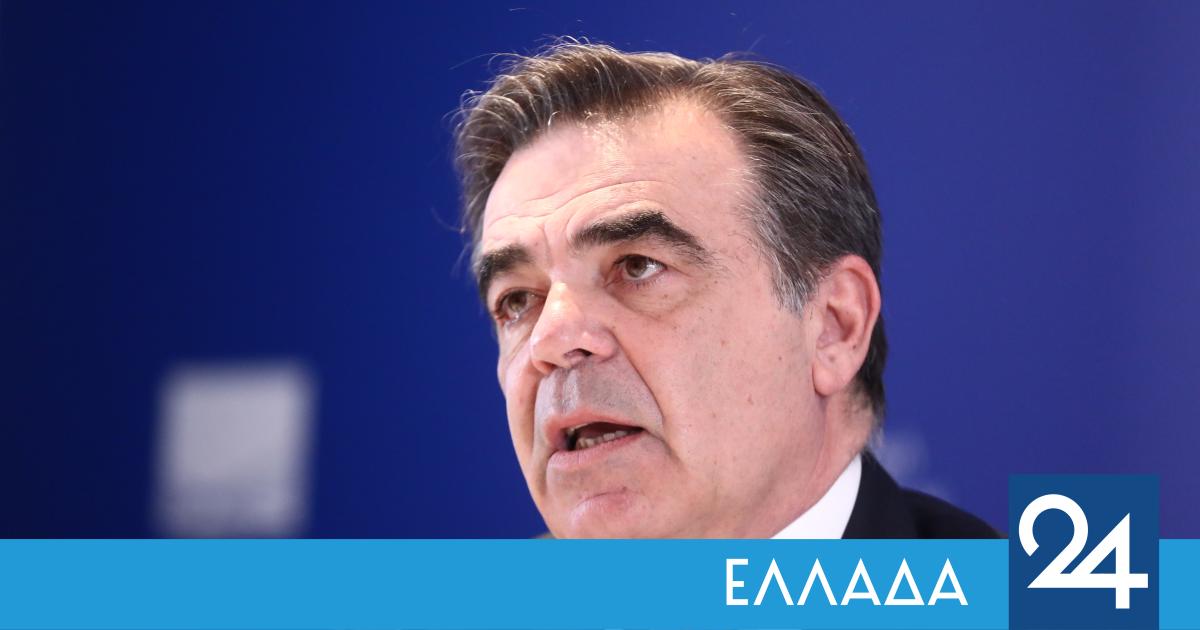
The cancellation of the organic beekeeping and organic livestock programmes, totalling €134 million, was announced by the Minister for Rural Development and Food, Margaritis Schinas. This concerns €19 million for organic beekeeping and €115 million for organic livestock farming.
“We are obliged to cancel the problematic actions,” Schinas said, stressing that “there will be no future funding for organic beekeeping and livestock farming until we find the appropriate framework. We need a fresh start.”
As the minister said, the cancellation does not concern organic farming. He added that the resources of the cancelled programmes would be “directed to other priorities, which we will announce soon”. “We are in full consultation with Brussels and they are fully aware of the situation,” he said.
“We cannot turn a blind eye to problems that have been identified, with overruns of more than 800%, such as in beekeeping. We are aiming to improve the reliability of the organic production system,” said Deputy Minister of Rural Development and Food, Yannis Andrianos. “These resources must, at last, be channelled fairly and transparently to the real producers and, in this case, to organic producers,” he added.
For his part, Secretary General of Rural Development and Food, Spyros Protopsaltis, said that the checks carried out “highlighted problems that we cannot ignore”. As he said, “there were cases where 300 hives were declared and only 3 were found during the inspection, while in other cases we found nothing.”
According to the figures presented, the number of organic producers increased by 250% in the period 2020-2024, reaching 119,000 in 2024, up from about 34,000 producers in 2020.
The figures were presented.
At the same time, demand for organic membership was outstripping available resources. Specifically, in agriculture, against a budget of €172 million, applications amounted to €398 million, i.e. 231% of the available resources. In beekeeping, applications amounted to €166 million against a budget of €19 million, i.e. 874%.
The rates of non-compliance highlighted by the pre-accession controls were also high. In beekeeping, 380 checks were carried out, with findings in 27% of cases and voluntary withdrawals in 16%. In the livestock sector, in 357 checks, findings amounted to 44% and withdrawals to 25%.
Over a total of 737 checks, 35% had findings and 20.5% had voluntary withdrawals, with the sum of findings and withdrawals reaching 55.5%.
As Mr Schinas underlined, the audits carried out on the certification bodies led to suspension measures and fines. In particular, 8 fines were imposed on 6 certification bodies, while a six-month suspension of approval was decided for 3 certification bodies. In addition, in August 2025, the ESMA proceeded to suspend the accreditation of two certification bodies.
The data still records indications of the intensity and quality of audits by some certification bodies. In specific cases, auditors appear to have a particularly high number of audits per day, highlighting the need for stricter supervision, greater reliability and full traceability.
Risk mitigation interventions have already been implemented, including pre-investment controls of producers, controls of certification bodies by ELGO-DIMITRA, imposition of fines, “freezing” payments to producers certified by suspended bodies, “freezing” approval of new certification bodies, and “freezing” integrations in beekeeping and livestock actions.
According to Schinas, the Task Force is working on proposals for a new and more reliable framework for organic, which will include, among others, a new system of controls and sanctions, digital tools, training and promotion of reforms. Finally, the aim, as the political leadership of the Ministry of Agriculture and Rural Development stressed, is to strengthen the credibility of organic production, protect consumers and support honest producers.