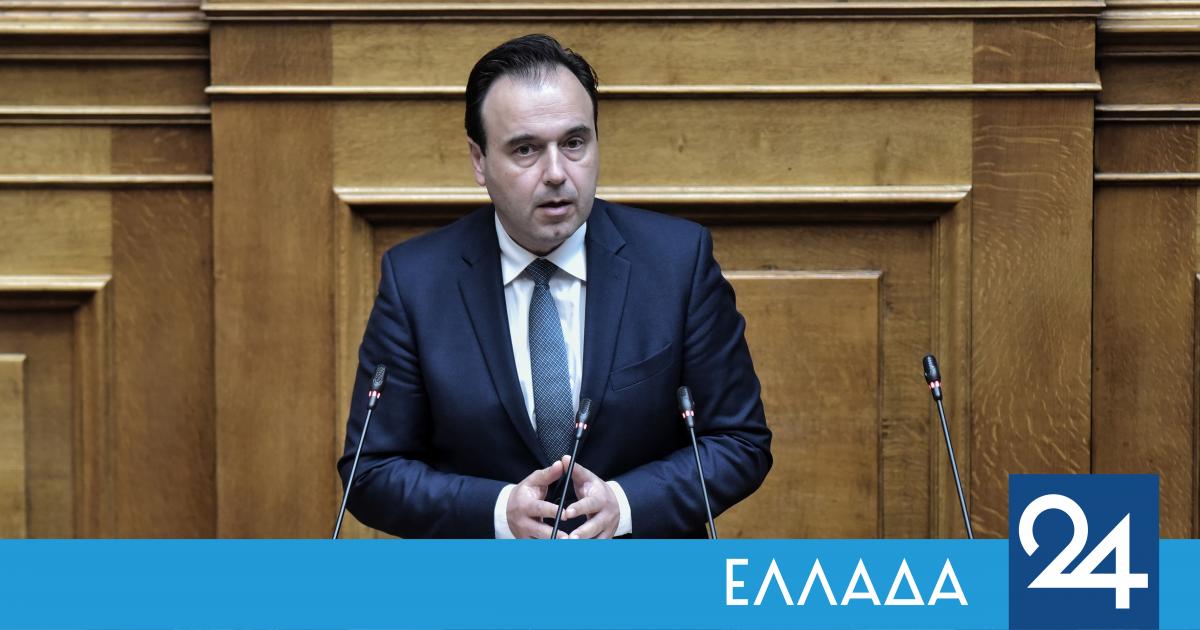
The European Digital Services Act (DSA), which includes measures to protect children and young people online, is among the issues to be addressed – among others – by the National Telecommunications and Postal Services Commission (NTSC). As the Minister of Digital Governance, Dimitrios Papastergiou, said during a hearing of the new EETT leadership by the relevant parliamentary committee, “the National Telecommunications and Postal Commission has been designated as the national body responsible for the issues of the DSA, the Digital Services Act, on which our initiative to limit the use of social media by children under 15 years of age is based.”
In presenting the nominees Dimitris Varoutas, Sotiris Markatos and Antonis Karga for appointment to the positions of President and two Vice-Presidents of EETT, respectively, Mr. Papastergiou referred to the issues currently open in the Commission:
- The public consultation on the 900 and 1,800 MHz bands extended until 7 May, in view of the granting of spectrum usage rights.
- The update of the spectrum usage fees and the new wholesale prices for the broadband market.
- The licensing of mobile, radio and TV coin systems, a bill which is coming from the government in the next few months, in cooperation with the Ministry of Digital Governance.
- The spectrum overhaul for the Security Forces: “The day after TETRA and secure communications, it is a very important project, whose consultation has been completed and has attracted over 70 comments, in order to come out with a project that will take us into the next decade,”
- The issues of postal services and the universal postal service, “something we have discussed in previous meetings and discussions, mainly related to the fate of the Greek Postal Service”
- Transposition and implementation of the Digital Network Act, the DNA, “adopted by the European Commission on 21 January 2026, which consolidates and replaces the previous European Regulation”
- The preparation of the EU Space Act, “a proposal that should be tabled in the near future”
- The preparation for the EU Delivery Act, also a European Commission initiative for ’26.
- “And very importantly, the National Telecommunications and Postal Commission has been designated as the national body responsible for DSA issues, the Digital Services Act, on which our initiative to restrict the use of social media by children under 15 is based.”
- For the position of chairman, Dimitris Varoutas, who is not new to EETT, having served as vice-chairman for about two terms, was not full-time, with very extensive regulatory and institutional experience, having served as both deputy vice-chairman and member of the Plenary of the Communications Privacy Authority from 2007 to 2016, with a very good knowledge and over 120 publications on the broader area of telecommunications and broadband, he is a professor at the Department of Information Technology and Telecommunications of the University of Athens and has very extensive experience in issues such as the ones I mentioned earlier already.
- For the position of Vice President of Telecommunications, we nominate Akis Markatos, who is a physicist with a Master’s degree in Modern Applied Optics from the University of Reading and who has very extensive European and national, and I will mention this in this order, institutional and regulatory experience on telecommunications issues and,
- for the position of Vice Chairman of the Post Office, Antonio Kargas, Associate Professor at the University of West Attica, in the field of Economic Theory and Regulatory Affairs, with studies in Economics, a Master’s and PhD in the Department of Information Technology and Telecommunications, as well as very extensive institutional and regulatory experience in public and private sector entities.”
the minister noted.
.
“We recommend:
In conclusion, Mr. Papastergiou pointed out that the proposed amendments come to help and continue the very important work that EETT has done over the years, at a time when the issue of a natural, national resource, such as spectrum, is very critical, as is, of course, the expansion and regulation of the telecommunications market.