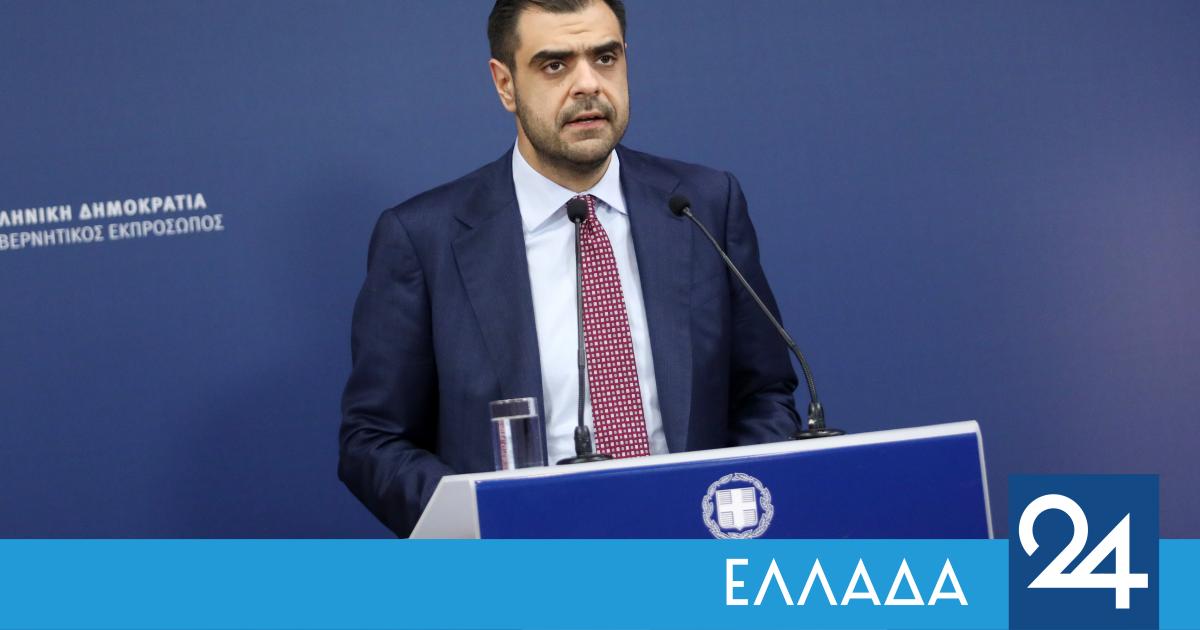
“The staff state is a way of coordinating government policies and managing crises, and even the MPs who spoke about the staff state in an eloquent letter also acknowledged the successes of the staff state. It is nothing more than that. The staff state exists to coordinate policies,” government spokesman Pavlos Marinakis said, speaking on the “Atairistoi” show on SKAI television station.
He stressed that “tomorrow’s Parliamentary Group is also of historical importance, because it will be the beginning of the debate on the constitutional revision, first by the Prime Minister and then by the rapporteur of the New Democracy, Euripides Stylianides, who has a lot of experience in these matters. So, a framework will be put in place which, if it comes to a revision because it needs broader consensus, can change many of the things we are discussing for the better. We have put in place some pillars. In the Parliamentary Group, as we in New Democracy are used to, there is also a dialogue and it will not be the first or the last time. New Democracy only comes out of the dialogue as a winner.”
As for the extra-parliamentary ministers, the course of the New Democracy and Alexis Tsipras, Pavlos Marinakis said that the debate on whether extra-parliamentary ministers should participate in elections is largely inappropriate, as “the answer was given by the citizens… in the last elections”. He also said that democratic legitimacy arises through the judgment of voters, noting that “when you are given an opportunity, you must… be accountable to the citizens.” He cited the 2023 elections as an example, where several extra-parliamentary members of New Democracy were elected to high positions, proving that society accepts this choice. At the same time, he rejected the strict distinction between parliamentary and non-parliamentary, saying that “this distinction is wrong… there are no black and white”, stressing that all contribute to the formulation and implementation of government policy.
As he said, “14 years ago New Democracy got 18%”, while today it is in its second term of government with a strong margin. Despite the difficulties, he argued that the country has improved significantly internationally and economically, stressing that Greece is no longer “the ‘black sheep’ of Europe”. At the same time, he called for unity and attention to internal voices, noting that MPs should be heard, but without undermining the overall course, expressing confidence that “only New Democracy will emerge victorious.”
He also strongly criticized Alexis Tsipras, particularly for the 2015 period and his subsequent political stance. He argued that he was attempting to distance himself from that period, and accused him of “fooling the people” with pre-election promises that did not materialise. At the same time, he dismissed claims about the pension swap with the Prespes Agreement as a distortion, but insisted that the agreement was negative for the country and that the Tsipras administration had put a significant burden on the economy, saying that “a country that was ready to come out into the light […] was burdened with […] 100 to 120 billion unnecessarily”. Overall, he presented Alexis Tsipras as the main person responsible for the choices made during that period, rejecting the narrative that he was misled by his associates.
On the OPEKEPE case, Marinakis rejected accusations of unequal treatment, arguing that “the Constitution provides for two completely different procedures” for ministers and MPs. He stressed that in the case of ministers, the Parliament judges whether there are indications, while for MPs the Justice has already made a first assessment. He insisted that “there is no question of a cover-up, but of respect for the Constitution” and that “in the absence of evidence […] we will not allow the country to turn into a vast court,” accusing the opposition of trying to create artificial tension.
On the proposal for a commission of inquiry, he argued that the opposition is not seeking the truth but political tension, saying that the goal is “to go to the elections […] with a parliament that has turned into an endless process of examinations”. At the same time, he pointed out that there are already previous procedures and decisions of the judiciary that must be respected.
He argued that the measures taken on fuel had a greater benefit than a possible reduction in the Excise Tax, and raised the issue of fiscal costs, noting that the opposition did not explain “who would pay the fiscal costs”. At the same time, he stressed that the government is giving as much as European rules allow, saying. He linked the current policy with past pathologies, criticising the logic of “come on, we will be taken care of by future generations.”
Finally, on purchasing power, he acknowledged that it is not at the desired level (“do we have the purchasing power we want? No”), but argued that there is a clear improvement compared to 2019. He said that the economy and employment have strengthened and that wage increases and tax cuts are gradually paying off, noting that “you can’t go from the third basement to the 25th floor overnight.” He concluded by stating that, without triumphalism, this policy creates conditions for citizens to “get what they were deprived of” as long as growth and fiscal balance continue.