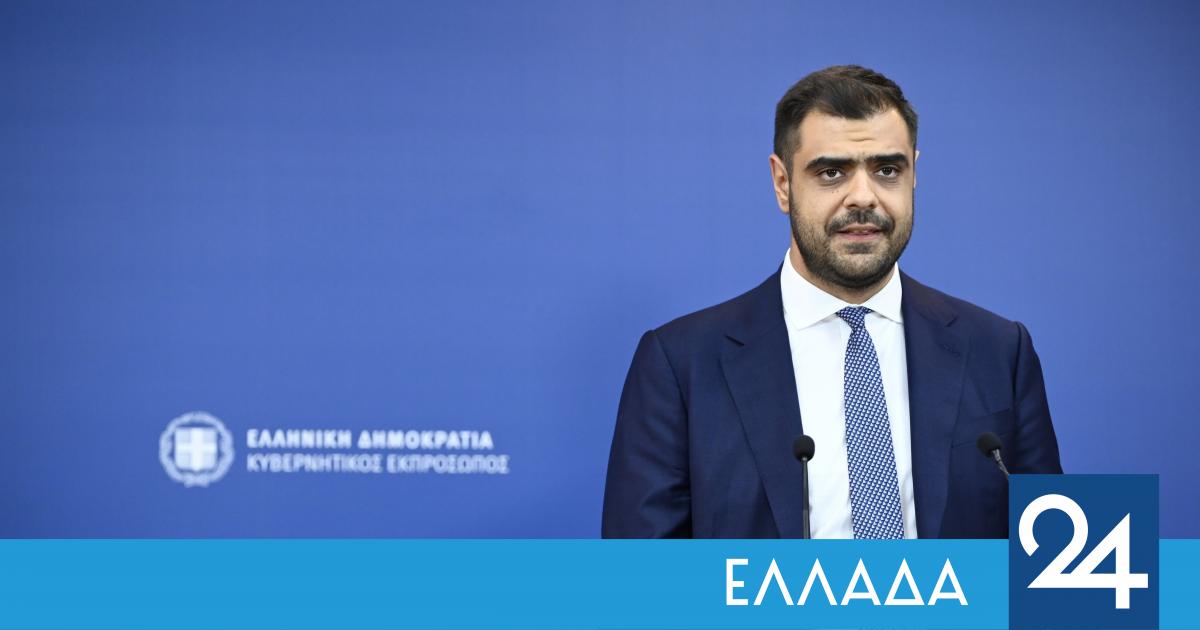
Government spokesman Pavlos Marinakis spoke to Parapolitika 90.1.
about the meeting of the ND’s Central Committee, the possibility of early elections, the findings of the polls, the rumours about Kostas Karamanlis’ absence from the ND congress and whether it will affect the party, as well as Alexis Tsipras’ first political speech, among other things.
“To put it very simply, the Prime Minister’s statement was not of a negative nature, he was not talking about people who do not “sweat”. He said the obvious, which he himself has experienced as a member of parliament for the second half of Athens, a minister and above all a member of the New Democracy party who came to lead his country’s party, that to win battles you have to ‘sweat the jersey’,” Marinakis said.
And he said that in times of difficult current affairs for the government, clearer answers and a greater public presence from government officials are needed, especially on issues that cause social pressure. He stressed that in the period after the Tempi tragedy, he said, there was an effort to misinform public opinion, which the government had to counter with respect to the relatives of the victims and society. He noted that at the time some officials came out more in front of the public debate, however, clarifying that he did not believe that some “hid”.
Marinakis stressed that government officials should not limit themselves to their portfolios, but should defend government policy as a whole when the news is one-sided. He pointed out that political presence is not limited to media appearances, but also requires constant contact with society and local communities, citing as an example the presence of ministers across the country. He also stressed that the government’s agenda must be determined by the problems and needs of society.
Referring to Nikos Dendias, he said there is no problem in his relations with the government and noted that he has been a key contributor to Kyriakos Mitsotakis’ policy on defence and foreign policy issues. He stressed that Greece has achieved significant results in recent years in these areas and called the focus of the public debate on a single person or minister wrong.
At the same time, he stressed that the government must remain focused on the issues that really concern citizens, such as accuracy, geopolitical developments and their impact on everyday life. He said that the country has made progress in reducing the debt, which allows for the financing of measures to support society, and referred to the government’s successes in the economy and foreign policy. He added that debates that move away from the problems of society are not of interest to citizens and do not offer anything meaningful.
On the possibility of early elections, Marinakis reiterated that elections will be held in 2027, as the prime minister has stated, noting that as the end of the government’s term approaches, the relevant scenarios will intensify, but they do not correspond to reality.
The government spokesman described opinion polls as a “useful tool”, noting that the real political picture is mainly derived from the vote estimate and not only from the voting intention, as a significant percentage of citizens remain undecided. He said that New Democracy is polling close to 30%, a figure he said is similar to the one from which the 2023 election period began, explaining, however, that “every electoral process has its own characteristics.”
Marinakis also stressed that the government’s goal for 2027 remains self-reliance and linked the electoral performance of New Democracy to the effectiveness of the government’s work and the presentation of a clear plan for the next four years. As he said, “the great comparative advantage of Kyriakos Mitsotakis personally and of the party as a whole is that what we say has a beginning, a middle and an end”. At the same time, he admitted that there are issues that require improvements, especially in the economy and in dealing with the issue of poverty, noting, however, that the government is not limited to parochialism but also explains how to finance the support measures through growth, job creation and the fight against tax evasion. Contrasting the government’s stance with that of the opposition, he said that “we do not only say what we will give, we also explain how we give it,” while expressing cautious optimism for another election victory as long as the government continues to present a concrete programme and, he said, against it there are mainly “voices, toxicity and ‘no for no’ objections.”
Referring to Alexis Tsipras’ return to the frontline of politics, Marinakis noted that the reappearance of a former prime minister “cannot be underestimated” and described it as a political event, recalling that Tsipras has already been evaluated by citizens both as prime minister and opposition leader. He argued, however, that the former prime minister is operating in a different political field from New Democracy, saying that he is “playing in a different arena”, which he associated with “demagogy, easy but unworkable solutions and intense confrontation”. He stressed that the government will not follow this logic, insisting on programmatic discourse, self-criticism and concrete policy results. At the same time, he estimated that Tsipras’ return might cause shifts in the opposition, but without affecting the government’s strategy.
On the possibility that Tsipras might come in second place in the next election, the government spokesman avoided making predictions, saying it was premature to draw any firm conclusions. He noted, however, that the former prime minister has the advantage of authentically expressing a specific political space, but also the disadvantage of having already been judged by the citizens both as prime minister and as leader of the opposition. As he said, “citizens have seen Mr Tsipras both as prime minister and as leader of the opposition”, adding that the final judgment belongs to society and voters.
On rumours of Kostas Karamanlis’ possible absence from the New Democracy congress, Marinakis said no decision had been taken yet and that the invitation to the former prime minister would be made institutionally by the chairman of the congress’s organising committee, Theo Roussopoulos. He stressed that Karamanlis is a “living part of the history of the party” and noted that everyone wants him to be present at the congress. At the same time, he stressed that the congress “belongs to the party and not to a person”, noting that the course of New Democracy will be judged mainly by its ability to respond to the problems of society and especially to the “hot” issues that concern citizens. As he said, after the period of memoranda and “easy solutions”, citizens now evaluate parties based on their effectiveness, the costing of their proposals and their ability to implement them.