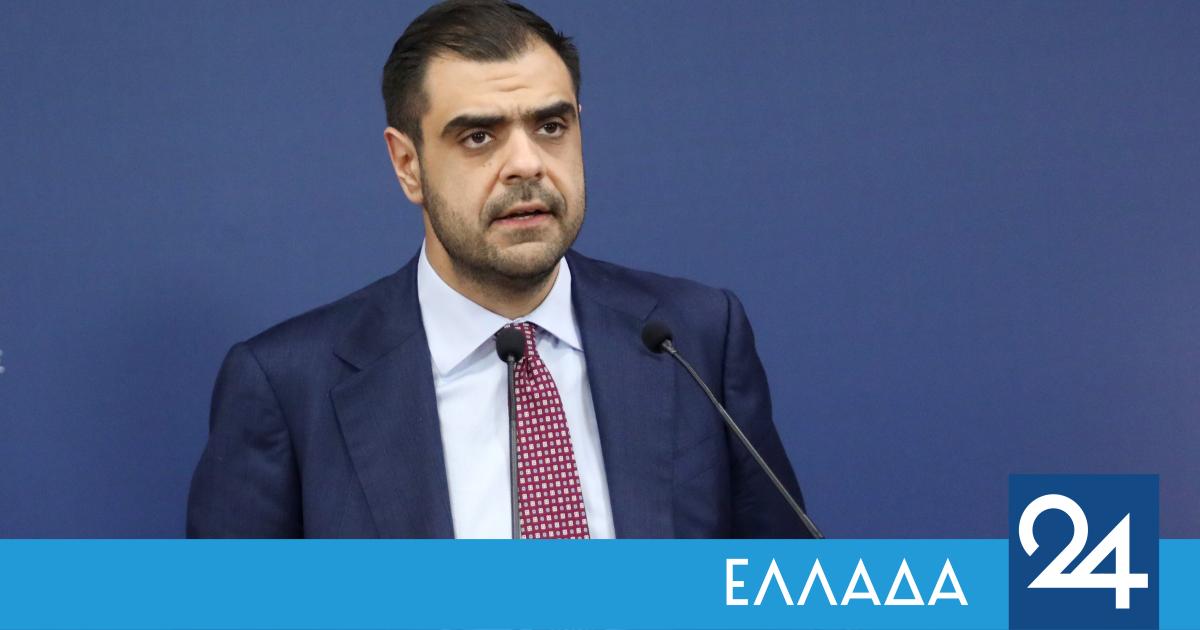
“Important agreements of a strategic nature that deepen the already close Greek-French cooperation in critical areas such as defence and security were signed during the two-day visit of French President Emmanuel Macron to Greece,” noted Government Spokesman Pavlos Marinakis, starting the briefing of political editors. “Greece and France have also reached agreements in other key areas such as the economy, education and innovation. With the signing of these agreements, the Greek-French relationship is being upgraded even further by acquiring a more integrated and multi-level character. Our country’s progress is recognized by its European partners and it is precisely this progress that further opens the way for major partnerships in critical areas for our citizens and our country”, he added.
Marinakis referred to a statement by Prime Minister Kyriakos Mitsotakis, according to which “the two countries are today closer than ever before politically, strategically, economically, educationally, culturally. This model of cooperation is perhaps the most advanced form of strategic relationship that Greece has developed with any other member of the European Union.”
Turning to the next issue, he stressed that the plenary session of the Parliament voted in favour of the multi-bill of the Ministry of Development for the facilitation of business, which, among other things, provides. The General Secretariat for Private Investment to be the sole body for receiving and processing applications for Strategic Investment. b. Greater flexibility in the operation of business parks. c. For a number of economic activities, such as senior centers, pre-school facilities, wellness, tourism and transport activities, the establishment and operation procedures will be done digitally, through Open Business. d. The anachronistic Industrial Movement Bulletin is abolished. The new Register as a Business Activity Bulletin will be fully digital. e. A comprehensive institutional framework for the protection of Geographical Indications for industrial and handicraft products is created. f. The institution of farmers’ markets is modernised. g. Mandatory labelling is imposed on products whose quantity is reduced without a corresponding reduction in price, with severe penalties of up to €2 million.
Also, the government spokesman pointed out that “the disposable income of the household sector and non-profit institutions serving households increased from 38.77 billion euros to 42.56 billion euros in the fourth quarter of 2025, compared to the same quarter of 2024, according to ELSTAT. This is an increase of 9.8%. In addition, in the same period, the final consumption expenditure of households and non-profit institutions serving households increased by 5.3% compared to the corresponding quarter of the previous year, i.e. from 41.7 billion euros to 43.9 billion euros.”
As he underlined, “the ELSTAT data reflect that the government’s economic policy is paying off in practice. The increase in disposable income, by almost 10%, gives a substantial “breathing space” to citizens, while consumption is also being boosted, which confirms that the market is moving and the economy is growing steadily.”
Then Marinakis said that the Ministry of National Economy and Finance will participate in the PPC’s share capital increase to support its development, in order to maintain, directly or indirectly, a 33.4% stake in PPC. “This decision is part of a clear strategy. We are boosting investment, shaping bigger and stronger Greek businesses and accelerating the transition to a more outward-looking Greece, with companies that compete internationally and consistently and durably support the growth of the economy. In an environment of increased uncertainty, energy is a matter of security and strategic autonomy,” he added.
“The Ministry of Rural Development and Food, in cooperation with the Ministry of National Economy and Finance and the Ministry of Labour and Social Security, is promoting the extension of the measures for the suspension of tax and insurance obligations, as well as the exemption from municipal taxes and for the cases of farms affected by foot-and-mouth disease. This is an initiative in the context of broadening interventions to support the primary sector, following the outbreaks on Lesvos. Cheese farmers, who are directly affected by the restriction measures imposed on the island, are also included in the same framework of support. In the meantime, a wide range of interventions are being implemented to address the consequences of the crisis on Lesvos, with the main focus on financial support for both livestock farmers and the processing sector,” he noted.
The next topic of the briefing was the disbursement by the European Commission of €1.18 billion from the Recovery and Resilience Fund, following a positive assessment of the relevant double request submitted by Greece in December. “Based on these developments, our country has received €24.6 billion from the Recovery and Resilience Fund, which represents 68.5% of the total budget,” he said.
Furthermore, the government spokesman stressed that “the fire season has begun and the Greek state is daily strengthening its forces to meet the increased demands formed by the new climate conditions. However, increased attention is needed from everyone, so until June 15 all property owners or tenants are required to clean their land and submit the relevant declaration. Maintenance and keeping them in a clean state is compulsory throughout the fire season, i.e. until 31 October. “In cases of non-compliance, penalties are foreseen. The aim of the initiative is to ensure timely preparation ahead of the fire season and to substantially reduce the risk of fire outbreak and spread,” he added.
Marinakis also referred to the package of measures to support the coastal shipping industry, amounting to around €57 million, aimed at curbing ticket prices announced by the Minister of Shipping and Island Policy, Vassilis Kikilias. “The main objective is to prevent the increase in fuel costs from being passed on to passengers due to the crisis in the Middle East. In this way, ticket prices will be kept at affordable levels for the average Greek citizen and the Greek family, while ensuring uninterrupted access to the islands,” he said. In particular, he stressed that “the intervention covers a wide range of social groups already entitled to mandatory discounts on ferry tickets, such as students with a 50% discount, children with discounts of up to 75% or full exemption depending on their age, large families with a 50% discount, people with disabilities and reduced mobility with a 50% discount, the needy with full exemption and their companions. At the same time, special categories such as permanent residents of small islands are also covered, as part of the island policy.”
He concluded by talking about the meeting of Prime Minister Kyriakos Mitsotakis with the President of the Republic, Konstantinos Tasoulas, at the Presidential Palace, as part of the regular monthly briefings.
The entire political world must respect the decisions of the judiciary, as a sign of self-evident respect
“We have absolute respect for the judiciary, self-evident respect for every decision of the judiciary and as we did not comment on the first order that was issued, in fact by two high court judges, the result of that order was the decision of the Single Judge of the Magistrate’s Court, we did not comment on that either. So now we are not going to comment on another judgment at the highest level.” This was stated by the Deputy Prime Minister and government spokesman Pavlos Marinakis, during the briefing of political editors, when asked to comment on the decision of the Supreme Court prosecutor.
“There is value in a conclusion that follows from these provisions, that another Supreme Court judge – and indeed Mr Tzavelas – who was not, as some have said, a government appointee, Mr Tzavelas was first in the vote of the Supreme Court plenary, that is, of all the judges and prosecutors, so a suggestion of justice to the cabinet, to the government, after the legislative change we made. Two different provisions at the highest level agree on the same conclusions. This is what the judiciary is saying and it is incumbent on the entire political system, as a sign of self-evident respect, to the independence of powers, to respect it. Everything else does not hold water, and I think they are formulations that go directly against the separation of powers, and restraint is needed, because we are talking about decisions by people who have a long track record in the judiciary,” he added.
“It may have become second nature to the public debate that tele-courts, which unfortunately are not only tele-courts, they are also political courts. It is not only the courts on some TV shows, it is also the courts that are held in Parliament, by self-appointed judges, on TV panels, but that is not how justice works. Not in briefing political editors, not on a panel, not in a coffee shop, not on the street. Justice works in the courtrooms and is administered by judicial officers, on the recommendations of the Greek state. And because we want to continue to have and will continue to have a durable democracy, respect for the presumption of innocence should be non-negotiable and, accordingly, for the separation of powers,” the Government Spokesman stressed.
“So when the judiciary speaks, whatever it says, we cannot, we are not allowed to make any comment. All these things that are being asked, all these things have been investigated by the judiciary and decided. And to show that we don’t say and we don’t talk and we don’t talk and we don’t contradict, we had exactly the same attitude after the decision of the Single Judge’s Court, which I remind you is a decision that has been appealed and will go the way of the Court of Appeal, that is, a second degree hearing. No comment, absolute respect for justice, but from everyone,” he noted.
In response to a question about inflation and accuracy, Marinakis, after referring to the 83 tax cuts and the recent tax cuts on income, stressed: “What do the official data from Eurostat and the Greek statistical authority say? They say that the increase in the average wage, if one includes the effect of inflation, in terms of purchasing power in Greece, is 11%, because the average wage without the effect of inflation has increased by about 30-35%, and the effect of prices has made this 35% to 11%, on average always, because we are simply dealing with an unprecedented wave of inflation. Conclusion: We agree that there is an accuracy issue, and especially for some of our fellow citizens with lower incomes, an even bigger one. The question is how we deal with this problem, which is objective and not just Greek.
We are all agreeing with some of our fellow citizens, especially those with lower incomes, that this is a problem that is not only Greek.
“Others believe that we are dealing with this problem with promises, with money trees, with parochialism. This is the logic that led Greece to bankruptcy and mortgaging our own generation,” the government spokesman said.