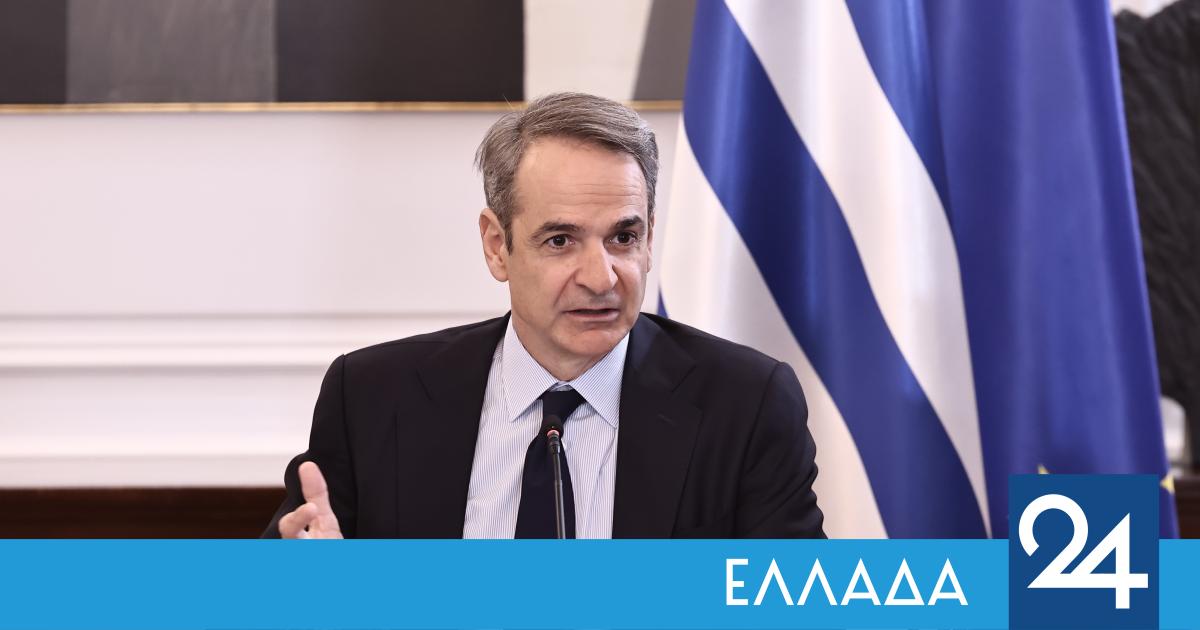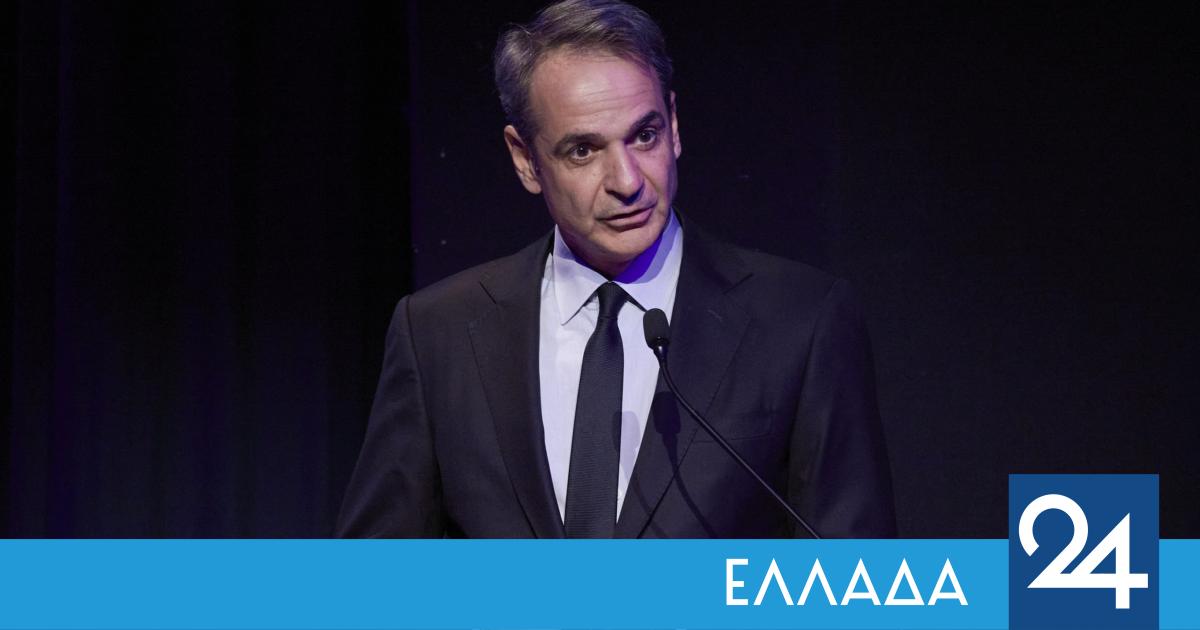
Prime Minister Kyriakos Mitsotakis met with European Commissioner for Defence and Space Andrius Kubilius on Monday at the Mansion House.
During the meeting, issues related to the portfolio of Mr. Kubilios’ portfolio, in particular the roadmap for strengthening EU 2030 defence preparedness and the need to strengthen and accelerate European defence industry and production.
The Prime Minister briefed Koubilios on the Greek programme to strengthen and armour the armed forces and the emphasis on innovation.
Kyriakos Mitsotakis reiterated the need to operationalize Article 42, para. 7 (TEU), noting that this was the direction in which European countries that had recently supported Cyprus on an ad hoc basis and without activating the article had moved in practice.
The Prime Minister also stressed the need for joint European funding for projects of common European interest, such as a European air defence shield, a proposal he had tabled in 2024 together with Polish Prime Minister Donald Tusk.
“I believe that defence is the pre-eminent European public good and should be supported, beyond the actions we take at national level, through some kind of common European borrowing,” the prime minister noted.
After the start of their meeting, the Prime Minister and the Commissioner had the following dialogue:
Kyriakos Mitsotakis: I am very happy to see you again in Athens, Commissioner. I think you come at a very interesting moment, as discussions on Europe’s strategic autonomy and the strengthening of our defence capabilities seem to be the top priority of the European Council. You know that Greece has made an important contribution to this debate.
When it comes to defence spending, we are putting our words into action, but we are also at the forefront of efforts to encourage Europe to work more closely together on defence procurement, with a focus on new defence capabilities. And at a time when some of the traditional constants of the post-war order seem to be being challenged, I think it is extremely important that we have confidence in our own capabilities as Europe.
We firmly believe in the need to have a public debate on Article 42(7) of the European Treaties. We demonstrated our commitment to Cyprus when our neighbouring country was attacked by Hezbollah by sending ships and aircraft. We look forward in particular to making this Article operational to reinforce the defence commitment of EU Member States should the need to support an attacked Member State arise again.
And of course, as far as space is concerned, we have taken the first steps, with the launch a few days ago of four new microsatellites and two nanosatellites. We are beginning to establish our own presence in space and, of course, for areas such as civil protection this is an urgent priority.
So let me stop here and welcome you once again. I believe that this debate is particularly important in view of the new Multiannual Financial Framework. I firmly believe that for certain areas that we consider to be an absolute priority we should consider joint European borrowing to finance projects of common interest.
I believe that defence is the pre-eminent European public good and should be supported, in addition to the actions we take at national level, through some kind of joint European lending.
Andrius Kubilios: Prime Minister, first of all, thank you very much for the opportunity to meet with you. It is a great pleasure and a great honour for me. Secondly, I agree with everything you said from the beginning, and I will try to emphasize certain points that we consider particularly important.
First of all, we are really happy to see Greece leading the way in the development of European defence, with all that you are doing: with the Achilles Shield, with the 12-year programme of €26 billion. It is really great. I always say to other countries: “look at Greece, follow what they are doing”, because certainly the challenges are quite big, both for the development of our capabilities and for the development of our industry.
We always have to remind ourselves that right now, at least from what we see from the public data, Russia is still outpacing us in terms of production with their economy moving at war pace, the numbers are quite different. So that’s why we really need to step up.
.
Secondly, Greece is undoubtedly an inspiring example for us, particularly in terms of developing your space capabilities. I congratulate you on the recent launch and on your participation in the very important European GOVSATCOM (Government Satellite Communications) programme and on the way you are using the Recovery Fund funds. I am trying, and in this case also, to tell everybody to take Greece as an example in terms of how to use the resources of the CDF, to follow this good example.
Of course, the next point on which I fully agree with you – and I have spoken about this – is that Article 42(7) is very important for us as a first step in trying to look structurally at institutional defence readiness. That is, we have material defence readiness, which is about producing and providing weapons and more money for defence. But beyond that, the issue is institutional defence readiness, and Article 42(7) is really critical.
Having done some groundwork, a little bit of groundwork, I can really see that we have some pretty good tools. First of all, on the political side, because when crisis and war are approaching, support from the political side is very important. On the military side, we need to look at how we can coordinate our efforts. But hopefully we will be able to come up with what I would call a manual to help all the institutions understand what needs to be done.
And the last point: the Greek Presidency is approaching. Time, it may seem like…
Kyriakos Mitsotakis: Immediately after the Lithuanian Presidency.
Andrius Kubilius: Exactly. We certainly think that defence and space are really very important issues. We hope that some issues will be closed earlier. However, the simplification of the defence framework, the EU Space Regulation and, most importantly of course, the next Multiannual Financial Framework, with increased spending on defence and space – which we hope that governments will support – will depend very much on the Greek Presidency, if the issues are not closed by then.
.