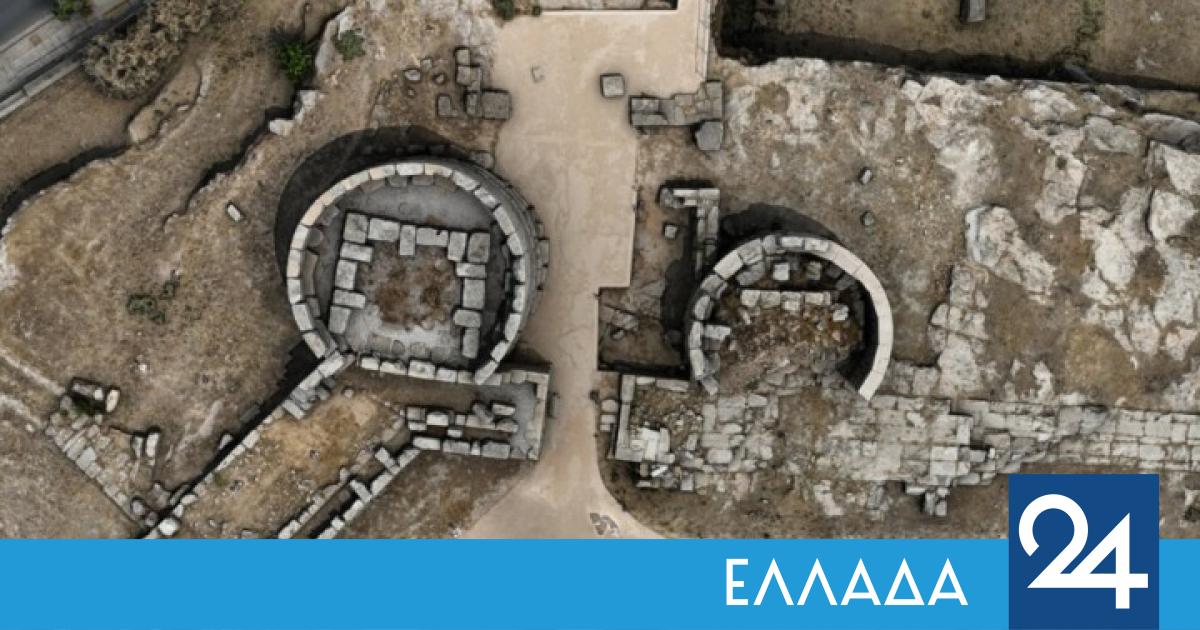
The Ministry of Culture is proceeding with the expansion of the archaeological site of the Hetaeaea Gate of Piraeus, with the utilization of approximately seven acres of land granted by the Piraeus Port Authority (PPA), essentially becoming an organic part of the overall archaeological site. The intervention complements the overall enhancement of the site – shaping of paths and entrance guard, plantings, information signs – and the restoration of the fortification towers, with the aim of improving the visitor experience and universal accessibility. Through the competent Ephorate of Antiquities of Piraeus and Islands, the studies for the maintenance and fixing of the remains of the fortification, the architectural and structural study for the restoration of the eastern circular tower, the architectural, geotechnical and hydraulic study for the enhancement of the entire archaeological site were completed, according to an announcement by the Ministry of Culture.
Culture Minister Lina Mendoni said: “The Themistoclean Walls of the port of Piraeus, of which the Hetaea Gate is a part, are one of the most important works of ancient Greek fortification. They are one of the most important examples of ancient Greek fortification techniques developed in ancient Athens, from the 5th to the 3rd century BC. It is a strong fortification project, at the western end of the Piraeus peninsula and on the northern side of the ancient port of Kantharos -now the port of Piraeus- making it inaccessible from land to would-be invaders, with its naturally fortified position and its bulk. The Hetaea Gate is the largest and most impressive archaeological site on the Piraeus Coast. For the promotion of the archaeological site of Ietiaiaiaia Gate, an area of 20 acres, was signed in 2013, a Programmatic Agreement for Cultural Development between the Ministry of Culture and the Region of Attica. The overall intervention was completed with the illumination of the gate in 2024, highlighting the great historical timelessness of the port of Piraeus. The expansion of the existing landscaped archaeological site, with an additional approximately seven acres, aims to restore the landscape around the archaeological site, improve its aesthetics and serve visitors. The project involves the completion and consolidation of fencing, the construction of retaining walls, the eastern and northern boundary, the care and design of vegetation, and the extension of the highlighting and security lighting. The Hetaea Gate is located directly opposite and in direct connection with the National Museum of Maritime Antiquities, which is under construction and with which it will form a single cultural route, creating a unique experience for visitors to Piraeus.”
The Hetaea Gate is to the west of the ancient port of Kantharos (today’s port of Piraeus), which it protected. It was constructed in 411 BC as one of the two entrances to the fortified city of Piraeus, through which exclusively military forces passed. The dating of the surviving fortifications dates back to different phases, starting in the 5th century BC and continuing until the end of the 3rd century BC. The monument had a simple architecture, with an entrance between two circular towers and was supported by walls, a moat and bastions. Access was via a narrow passage and there was probably a movable bridge. There are also traces of an ancient quarry and buildings in the area, such as the so-called ‘Aphrodisium’. The fortification was constructed and developed in successive phases with significant interventions during the Themistoclean phase (494-478 BC) and the Cononean period (394-391 BC). The first excavation of the site was carried out in 1886-87 by the French School of Archaeology. After 1922, there followed a period of gradual destruction of the monument, particularly during the bombing of Piraeus in 1944, and it was later used as a warehouse for the PPA. From 1990 onwards, excavations and clearances were carried out which revealed important parts of the fortification and restored the site’s appearance. The most significant pathology problem of the monument is the escalating deterioration of the surfaces of the original stones forming the lower layers of the circular front, as rainwater trapping has loaded the ancient materials with moisture and caused severe deterioration of the exposed foundations of the eastern and north-northeastern circular tower.
The archaeological site of the Hetaeaea Gate extends over 20 acres. The area granted by the PPA to the Ministry of Culture has a total area of about 7 hectares and is in the immediate vicinity of the archaeological site, is being used to expand the surrounding area of the monument of the Hetaeaeaeia Gate. Since, however, the allocated area was not included in the Programme Contract for the promotion of the site, it has remained unused to date, aesthetically degrading the image of the archaeological site that can be visited.
The main option of the proposed intervention is the removal of rainwater from the area of the monument behind the restored circular front, in order to stop the ongoing deterioration of the stones of the lower layers, while the worn surfaces of the stones are restored. The landscaping of the extension follows the same principles and materials used in the existing archaeological site, with the aim of restoring the natural relief and enhancing the original form of the ditch. Visitor routes and landscaping are extended, highlighting the fortification, while the scattered architectural elements are organised and displayed in a rational and coordinated manner. The entrance and basic functions remain the same, but new connections and routes are created. Improved access (including for the disabled), highlighting of artefacts and a single restoration of the enclosure are foreseen. The circulation areas are made completely safe, with guardrails where necessary.
.