“Then my bowels churned, and I thought it was time to die; and I found myself in a dark and thunderous place, that shook like a bough of wheat in the mill that grinds it, like grass in the water that bubbles up; then I thought it was Messolonghi, but I could not see the castle, nor the camp, nor the lake, nor the sea, nor the land I was walking on, nor the sky; all things were covered with blackness and tar, glowing brightness, thunder and starlight…”
Dionysios Solomos, The Free Besieged
This year marks the 200th anniversary of the Exodus of Messolonghi at the holiest moment of the Greek Revolution, where history took on an almost metaphysical character.
Messolonghi was a besieged society that functioned with cohesion and discipline under conditions of complete collapse. As Mark Mazower analyses, the besieged were not just a military group, but an organised community that maintained institutions, order and collective responsibility even when hunger and exhaustion had reached the limits of human endurance.
At the same time, the rest of the Revolution was suffering the consequences of the civil conflicts of 1823-1825. According to Douglas Dakin (The Greek Struggle for Independence), the internal strife decisively weakened the Greek side, limiting the ability to effectively strengthen the besieged. Messolonghi was left to hold a single front against an empire.
This contrast captures with stark clarity the dual nature of Greek reality – outside the walls, division and inability to coordinate; inside the walls, unity, discipline and absolute commitment to the common cause. The same society that elsewhere is divided, here it functions as a unified body.
The decision to exit was taken collectively and with full awareness. This act was the culmination of a conscious attitude towards freedom. The conflict that followed was total. Casualties were massive, as William St. Clair (That Greece Might Still Be Free) records, and the destruction of the city was almost total.
However, the significance of the event outweighed its military effects. The Exodus had a powerful impact on European public opinion, strengthening the philhellenic current and influencing the political stance of the Great Powers. As Roderick Beaton notes, Messolonghi served as a turning point in the internationalisation of the Greek cause.
Mesolonghi decided the course of the Revolution. The blood of the Mesolonghians became the “ink” with which God put His signature on the liberation of Greece. From then on, the Greek cause acquired a weight that could no longer be ignored.
This event reveals a timeless conclusion: division weakens even the most righteous efforts, while unity creates strength capable of resisting superior forces.
Eternal memory.
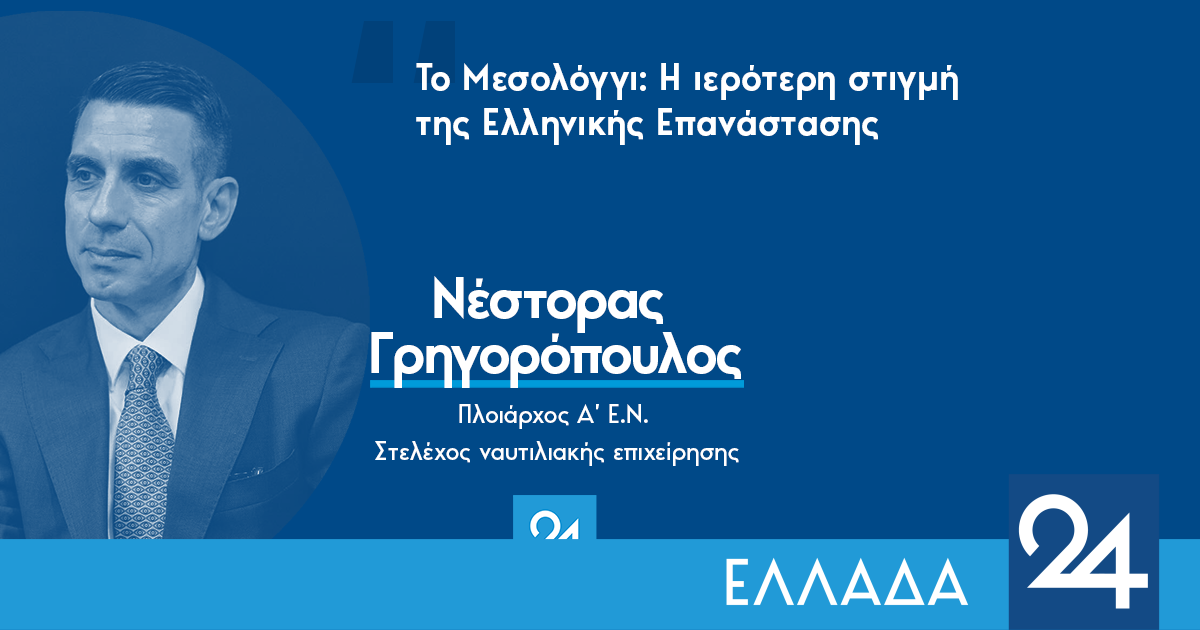
* Article by Nestor Grigoropoulos, Captain A’ E.N., a shipping company executive, for Greece 24