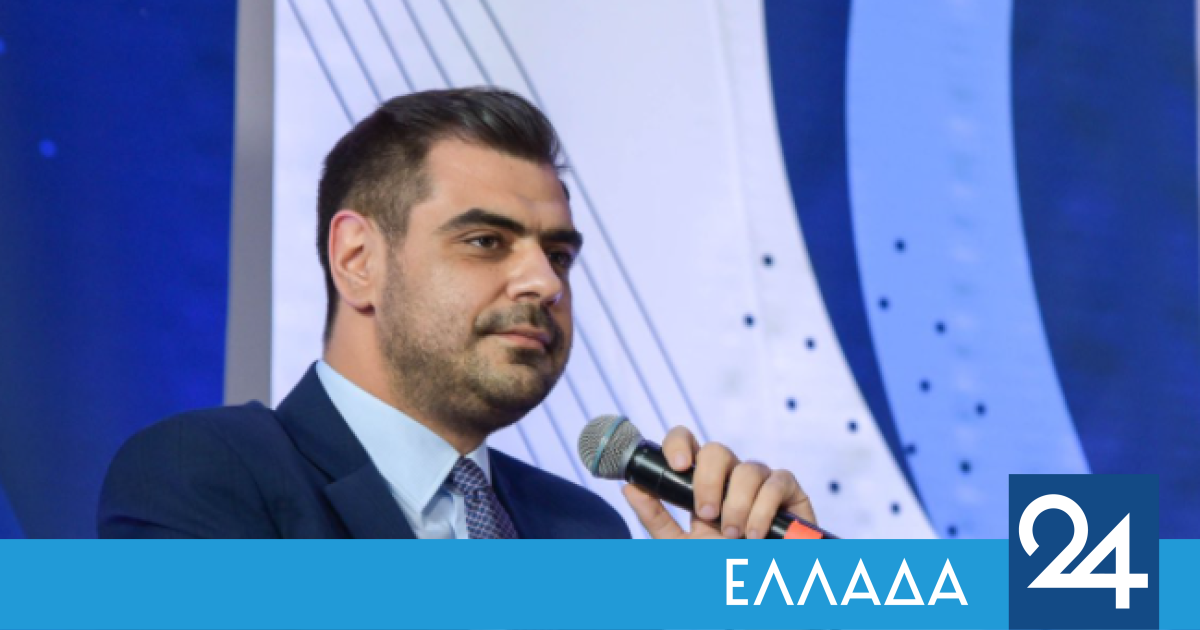
“Unsupportable, unfounded, and deeply dangerous for the rule of law and democracy”, government spokesman Pavlos Marinakis, speaking to the radio station Real FM 97.8, described Nikos Androulakis’ criticism of the rule of law, on the occasion of the Supreme Court’s decision not to withdraw the wiretapping case from the file.
Mr. Marinakis pointing out that “PASOK has over time demonstrated an institutional consistency and seriousness -always, along with New Democracy, PASOK executives were the victims of the targeting of “the upper and lower square” and the people’s courts and at the level of rhetoric, “traitorous Germans”, but also on a substantive level when its executives were pegged in the Novartis case by SYRIZA’s justice ministries,” he said, stressing that “it is terrible that Mr. Androulakis turns a party like PASOK into a party with this rhetoric and identifies with the perpetrators of that era.”
Asked whether there will be an Inquiry, Marinakis said: “We are waiting for the request, we will position ourselves in Parliament and we will answer,” and added that no one underestimates the seriousness of this case, which is why the judiciary at a higher level has positioned itself three times with an order.
He further said regarding the person of Mr. Tzavellas that he could never remember such a large part of the political system and for the first time PASOK sliding down this path. “It is a dangerous path and when we go down this path the consequences are unpredictable. PASOK must stop this institutional downhill slide,” he said.
At this point, Mr. Marinakis stressed that the leader of the opposition this week “did not seriously deal with the fact that our country is one of the five countries that had a surplus – as a result of growth and job creation – he did not deal with it, he did not make a statement about the visit of the French President, which is unprecedented in terms of results, he did not deal with the big and serious things like the fact that the country’s debt is being reduced – because he is also in a party that has a tradition of creating debt – and he behaves like a candidate for the National School of Judges and Prosecutors. Androulakis, since he is the leader of the opposition, is theoretically a potential prime minister and instead of being a potential prime minister he is behaving as a potential candidate for the Judiciary no matter that deadlines have passed for him to be able to do so.”
The government spokesman also said that the Supreme Court prosecutor is answering why the case should not be taken off the file. “I repeat, we are talking about an order of the Supreme Court prosecutor, which I think cannot be weighed in the balance with a subjective political position of an opposition party. In a democracy, the decisions of the judiciary, the judiciary is not attacked and we do not put it to a referendum or political criticism.”
In response to a question about what Tsipras said in this regard, the government spokesman said that during his days he had the expertise to put and take cases off the file, to put and take defendants in a case. “It is the expertise of the justice sub-ministries that Mr Kontonis himself, Mr Tsipras’ justice minister, has admitted existed during their days.” He countered that today our country has improved a lot according to the Commission’s official report on the Rule of Law and Freedom of the Press.
Marinakis stressed that “the European Public Prosecutor’s Office is currently investigating 3,600 cases across Europe – allegations some may be legally and factually sound, some may be unfounded. Of these 3,600, 170 of them refer to our country, some may be serious, others may not. In no other country in Europe does what is happening in Greece, i.e. the entire opposition in the absence of a costed programme and an alternative proposal to make policy on case investigations”. He stressed that this is one thing and a second important element is that what the opposition is trying to do is “on existing problems which the government is dealing with – I think in the best possible way and by correcting mistakes it has made, first and foremost the cost of living – it is trying to create the narrative of a corrupt government.”
He pointed out that “words have lost their meaning. So I say that in the public’s mind what is identified with corruption and corruption for the political system is political money, it’s ministers caught with the goat on their backs, political officials wagging their fingers.”
He reiterated that he is not belittling the wiretapping case but trying to deconstruct what is being said about the most corrupt government of all time.
In conclusion, he stressed that the opposition on the one hand is trying to bag three individual serious issues (Tempi accident, wiretapping, OPEKEPE case) with completely different implications from what people are used to saying about corruption and interference, in order to build a narrative to survive politically.
Responding to messages from listeners, Mr. Marinakis also stressed that according to the Rules of Procedure of the Parliament, if the opposition agrees among itself with 120 votes, we can have an Inquiry again, a right given to the minority by this “supposedly evil and establishment” government.
“We are responding with policies,” he said, citing specific examples of reforms that serve to tackle bribery and make procedures more transparent. “What do I mean? You don’t respond to Rousfeti with pompous accusations when you are a politician. You respond with policies. And yes, we have done a lot for what the people want. We’re late somewhere. Somewhere we have not done well. Like the OPEKEPE. Yes, it was not managed successfully and rightly hurt society. But there too, we provided the solution with delay,” he noted.
Regarding the open letter of five ND MPs to the newspaper “TA NEA” calling for a new model of governance of the country and a re-evaluation of the executive state, Marinakis said that ND “is a party of substantial dialogue. We are even entering a congress phase, our MPs are the foundation of the strength of a second four-year government. Many of them have even been ministers” and know from the inside how the executive state works and what needs to be improved and its great successes. He also drew comparisons with other parties, which he said are holding a convention to say who they will govern with, not how they will govern, i.e., with what programme.
In response to a question, the government spokesman said that the elections will be held in 2027, that any suggestions and opinions are respected but the prime minister has responded. He stressed that stability in an environment of crises and wars is a valuable condition for managing difficult situations, that what happened in 2023 should be a legacy, that is, to have stable electoral cycles and for people to judge a government and evaluate potential other proposals on the basis of a four-year review and planning. The third reason is political and it has to do with the fact that the government has a remarkable body of work to show, so by completing a cycle, answers are given with works.
The government spokesman acknowledged that the number one issue is the inflation that has hit not only Greece but the whole of Europe and made a detailed reference to measures that have been taken starting from the major tax reform but also the growth of the economy, job creation, support for the middle class and for businesses. He also said that there will be more positive news and if the announcements at the previous TIF relieved mainly families with children, the next TIF should be the TIF of small and medium enterprises and businesses as a whole.
Concluding with reference to national issues, Mr. Marinakis said that our country is being strengthened through stable alliances, important agreements it has signed, its defensive armour and a dialogue without making even the slightest concessions to our long-standing claims.