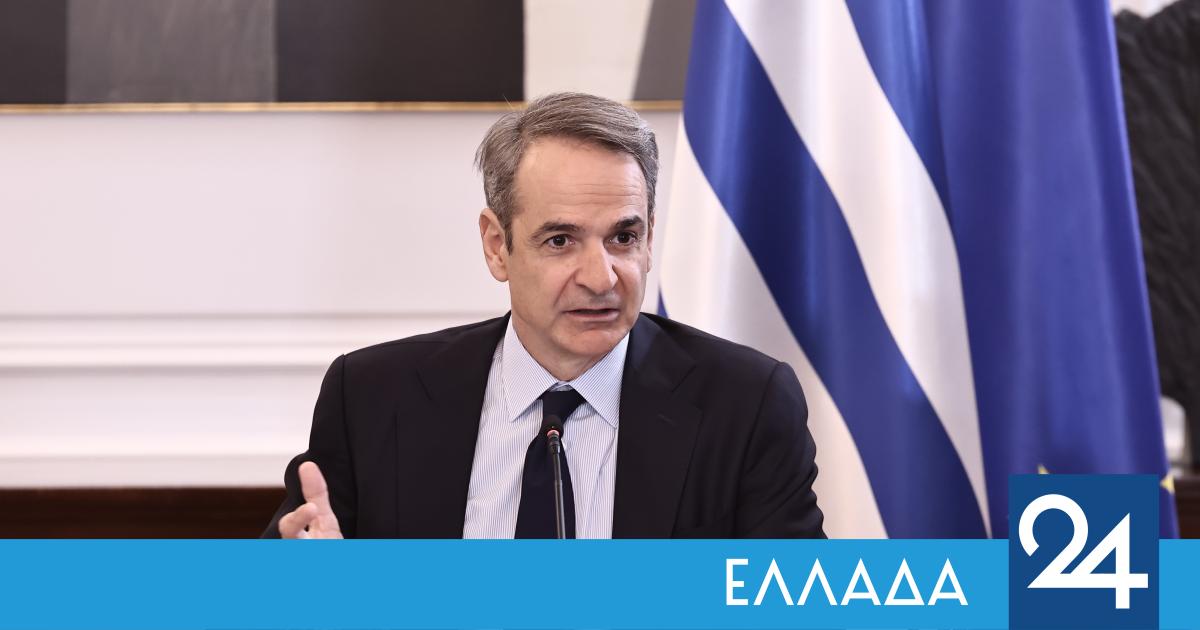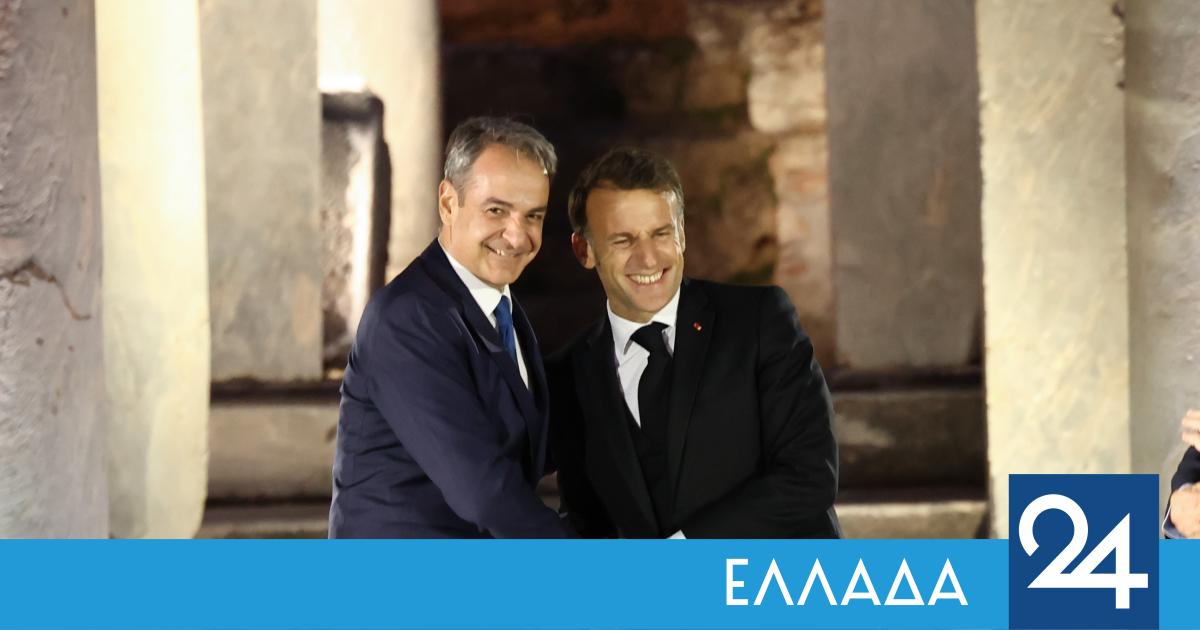
A clear message of support for Greece was sent tonight by French President Emmanuel Macron, during his discussion with Prime Minister Kyriakos Mitsotakis at an event organised by the newspaper Kathimerini on the theme “Challenges for Europe – The road to tomorrow”, at the Roman Agora of Athens.
“If Turkey threatened Greece, we would be here. We would be present. Look at what we did that difficult summer, look at our stance in Cyprus. For me, this is the true definition of friendship. This is exactly what the Franco-Greek alliance expresses. Alliance and friendship are not complex concepts; it is something very simple: when the critical moment comes, you do not wonder what you will do the next day. You already know what you have to do. If sovereignty is threatened, know that we will be here,” President Macron stressed in an unequivocal manner.
The French President spoke at length about the role Europe must play to gain a leading role in global developments, and said that this could be Europe’s moment for many reasons. As he said, there is global disorder, as many admit, and we live in a global order that is being overturned by two great powers. He asked “where is the EU at the moment” and replied that Europe is a place of credibility and predictability because of strong institutions and European law.
He stressed that “we support our partners” and referred to the attitude of European countries in the Middle East crisis where they supported the Gulf countries.
“Europe when we all come together we are a huge defence power, we account for 16% of world trade while the US accounts for 15%. It’s about becoming a global power and helping to find solutions,” he said. He admitted that Europe has imposed excessive rules in some areas of the economy, production and industry, adding that “we need to simplify things, and we are already late.” We need rules – he said – to protect our industry, but China also has rules that favour national players, who sometimes turn against European producers. “There too we may have behaved naively. That is why we talk about European preferential treatment. Today the player we have to deal with is China, and we were late in realising it. Look what is happening with the car industry. A flood of production and so 150 thousand jobs have been lost in Germany. The only response is to protect European producers. The same rules must apply to everyone. That is not protectionism. Look at the excessive subsidies in China and the tariffs in the USA. We cannot remain inactive. Look at what the Chinese are doing with rare earths, they are stifling competition on the merits. If we do not defend our producers we are lost,” the French President said, among other things.
He went on to say that an American President, a Russian President, and a Chinese President are all against Europe and asked us to think about what that means.
“It’s a bellwether, if you will. We need to gain confidence in Europe, look at what happened with Ukraine. When the war started on February 22, many people were sceptical, they doubted our ability to react,” he said.
“And yet, if we look at recent experience, there is a different reading. When war broke out in Ukraine in February 2022, many doubted whether the European Union could respond in a unified and effective manner. Reality proved them wrong. From the very first moment, European countries unanimously agreed on successive packages of sanctions against Russia, reaching an unprecedented range of economic measures,” Macron added.
He also noted that in a world of increasing competition, the big powers – the United States, Russia, China – are primarily driven by their own interests, often without taking into account European priorities. This in itself – he said – serves as a bellwether for Europe: it can no longer rest on its laurels.
He also said that it is very important that Europe has emerged as a key investor and supporter of Ukraine, making a decisive contribution to preventing the country from collapsing. At the same time, he noted, there were also signs that Kiev had been able to regain ground, reinforcing the image of a conflict that was not developing one-dimensionally in favour of Russia.
The most interesting element according to the French president is the gradual emergence of new forms of cooperation in defense and security. According to him, the “coalition of the willing”, involving European countries but also partners such as the United Kingdom, Japan and Indo-Pacific countries, shows that Europe is beginning to test more flexible and autonomous forms of cooperation – even without direct American guidance.
“The basic conclusion is twofold: on the one hand, the international environment is becoming more demanding and less “friendly” for Europe. On the other hand, Europe itself has already shown that, when under pressure, it can move with unity, speed and efficiency,” the French President said.
He added that the challenge is no longer just for Europe to react to crises, but to firmly build up the confidence and tools to act proactively, defend its interests and shape its own role in a changing world. Finally, he said that global competition in the field and in the arms sector has become fiercer, and Europe cannot go forward with structures that hold it back, and assessed that one of the key problems is fragmentation.
He explained that today in Europe we have multiple standards, different technical specifications and parallel systems – in areas such as aircraft, missiles or weapon systems as a whole. This means higher costs, lower efficiency and ultimately reduced competitiveness compared to other powers that operate more uniformly.
According to the French President, the answer to this can only be more unification: common European projects, common programmes, common investments, less bureaucracy and simpler rules. In such an environment, narrow national or corporate interests must take a back seat if the goal is a stronger Europe overall, Macron concluded.
Finally, he pointed out that today the security model has changed for Europe, which after World War II was taken over by the United States. For decades after World War II, Europe essentially did not develop a common defence policy, as security was largely based on the United States, and this created a kind of “taboo”
“Today, that is changing. The concept of strategic autonomy means something very specific: that Europe can produce critical systems itself and support its own industry. “We produce in Europe and we buy European” is not just a slogan – it is a condition of independence,” he said, noting that the French frigates that Greece will buy will increase the share of Greek industry.
The discussion between Prime Minister Kyriakos Mitsotakis and French President Emmanuel Macron was moderated by the director of the newspaper Kathimerini Alexis Papachelas.