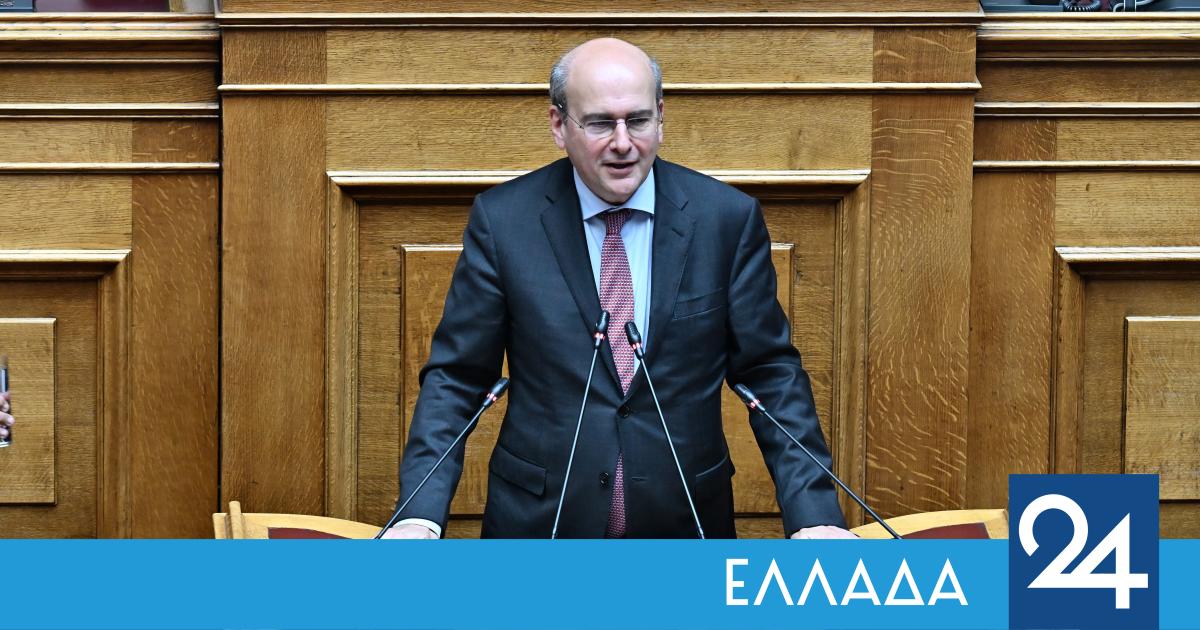
“The Government and the Prime Minister have taken the decision, on the issue of the OPEKEPE, to show the utmost sensitivity and the utmost rigour. For this reason, the Ethics Committee in Parliament will meet on Tuesday to lift immunities. It is, without doubt, an unpleasant affair. But now, because the talks have come to the surface, we can all put the matter in its proper perspective,” Deputy Prime Minister Kostis Hatzidakis said in an interview today on SKAI television.
“Are these,” he asked, “cases of bribery that reasonably disturb public opinion worldwide? Or are they manifestations of what we call the client system in Greece over time and which in some cases have to do with the weaknesses of the state and the OPEKEPE itself?” Referring to 2 cases where the interventions involve a benefit of 190 euros in one and asking a question in the other noted: “The judiciary will decide but I very much doubt from what I have read that such cases will be judged negatively by the judiciary. But we have taken the decision to be as strict as possible, which may have displeased some of the MPs, so that it is not perceived that New Democracy is showing flexibility on a phenomenon that – wrongly – is a common secret in Greece. And there are various cases where we are indeed dealing with some pressures that are beyond the pale.”
For this reason, he added, the government proceeded with the reform by absorbing the OPEKEPE from the AADE. “So that, as is the case with the national examinations, as is the case with the ASEP, as is the case with pensions, which have stopped being a ‘buffet’ because they are issued within two months, in the same way, the issues of agricultural subsidies are not subject to interventions by MPs, but proceed automatically. And I want to tell you that this reform was passed only by New Democracy and not by the otherwise furious opposition, which voted against it.”
Asked as to whether there was political expediency by the European prosecutor’s office, the deputy prime minister said: “I will not tell a European institution in particular and the judiciary in general how to do its job. But because there is a sensitivity here, it would be good if these issues come up as soon as possible, so that Greek citizens, regardless of party affiliations, have a clear picture. There needs to be a clearance and there needs to be speed, because these issues by their very nature have a political connotation.” He recalled that these cases came to the surface after an investigation by national prosecution and law enforcement authorities who opened the phones and recorded conversations and not on the initiative of Brussels.
“New Democracy,” Kostis Hatzidakis stressed, “is not the party of infallibles. We have spoken clearly, we have not hidden behind our finger or said that everything went wrong. But I said in Parliament that people judge us by the overall picture. So we have to decide whether we want a party that accepts its mistakes and makes a fresh start with a new institutional framework. A party that took unemployment to 18% and has taken it to 8%. It has driven the economy to growth more than double the European Union average. It has advanced the digital modernisation of the public sector. It has led to pensions being paid out faster than Germany. He has moved 1555 forward in the Ministry of Labour and the EFKA. He moved 1566 to the Ministry of Health so that there is prioritisation in the admission of patients. It has shielded the country’s defence and enhanced its standing internationally. And on the other hand, this government is facing an opposition which, through Mr Tsipras, says that the banks should be closed and the country should return to the stone age. Or it has a PASOK which is a shadow of its former self and is trying to imitate SYRIZA. The Greek citizens have to make their decisions in this setting. Honestly and clearly speaking, overall the country has risen. Unless the vision of the Greeks is to go back to the Syriza era, back to 2019. Of course, and I say this with respect, the people are the boss and will make their own decisions.”
Asked about the possibility of early elections, the deputy prime minister said: “There are issues before us which we want to run. Among them is the constitutional revision, which is an opportunity to look at issues such as the client system from the beginning, so that the Greek Republic can be restarted. I spoke on this issue the day before yesterday in Parliament, when Mr Androulakis, twice, called for elections. And I told him that he reminded me of the lamb that wishes for Easter to come. It is not our intention to hold elections, my statement was about a message of determination. We should not forget that despite any mistakes made by New Democracy, based on the results of the polls there is a specific setting and specific performance of the parties.”
With regard to the impact of the war on the economy, he noted that the government is monitoring developments on a daily basis and modifying its policy where necessary. “The interventions made so far on diesel and petrol are not negligible. The fuel pass, leads to the charge not being passed on to the average consumer until the price of petrol reaches 2.11 cents. We’re not there yet. We’ve moved on gasoline, diesel, fertilizer, ferry tickets. And we’re here precisely because there’s a government that has been a housekeeper in the economy, hasn’t operated on a give-it-all logic, and we have some money to give out as the situation develops. We were saying that we needed surpluses not just for purchases but to have housekeeping, and here we are, and here we are proving that we were right. While on the other side were the so-called progressives who were telling us to give it all away because they are supposedly compassionate and they love people and we don’t.”
Costi Hatzidakis reiterated that there is no issue of fuel sufficiency. “It is good not to get ahead of ourselves and not to cultivate a climate of panic. Plans are in place from all international organisations dealing with the issue and from all governments.” But there will be lower growth and higher inflation in Greece and around the world, he added. “What the differences will be will depend on how long the war lasts and the intensity of the hostilities,” he said.
Finally, on PASOK’s decision not to cooperate post-election with New Democracy, he said: “PASOK, if given the opportunity of course, is mathematically choosing to form a government of losers. Therefore, it is de facto choosing a government with Mr Tsipras, who says that he should have closed the banks from the beginning and that we should have returned to the stone age of the economy, and with Mrs Konstantopoulou with her usual rhetoric. And that is why I say that New Democracy, despite its mistakes, is the only force that the Greek citizen can lean on.”