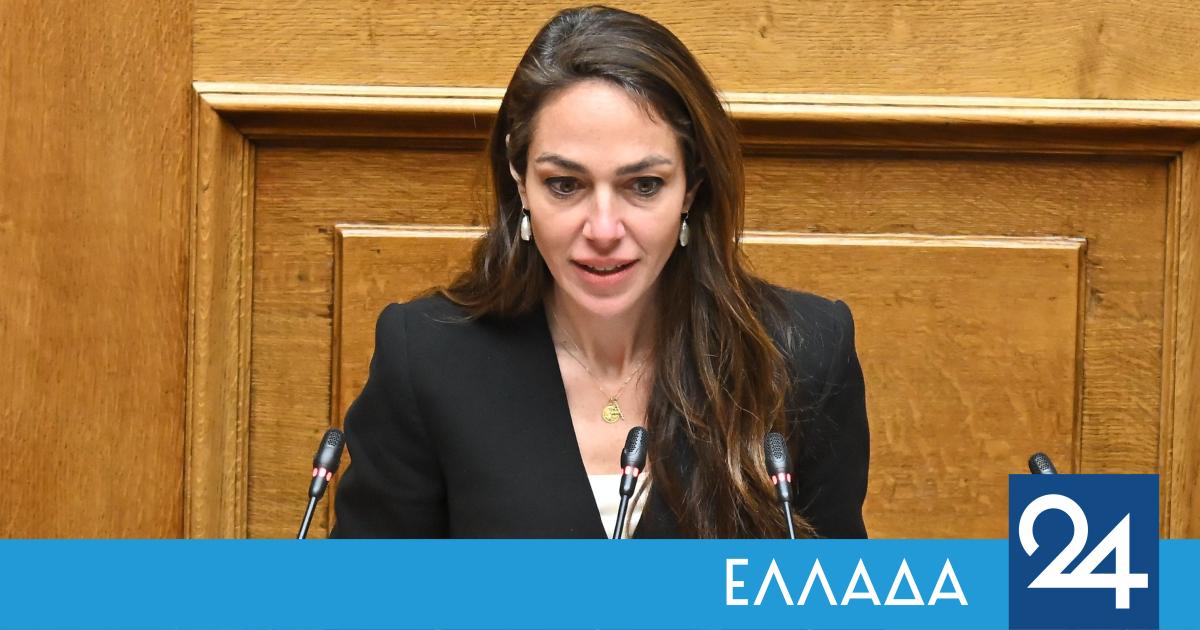
Minister of Social Cohesion and the first social houses, the new “Renovate-Neighbourhood” programme with emphasis on financing the renovation of owner-occupied houses, and the extension of the “Neighbourhood Nannies” programme were discussed by the Minister of Social Cohesion and Family, Domna Michailidou, on ERT.
Referring to social housing, the Minister presented social counterpart as a tool that utilizes idle public properties and converts them into new housing with a social purpose. As she noted, the first two Joint Ministerial Decisions to activate the institution are forthcoming: The first concerns the terms of the social consideration, from the process to the consideration, and the second the first properties on which the social housing will be developed. These first sites include properties in different cities, including Peania, Larissa, Kalamata and Pyrgos. According to the Minister, the aim is threefold: to increase the overall stock of housing, to strengthen social housing and to activate public property that has so far remained inactive.
In terms of the new “Renovate-Renovate” programme, Michailidou said that the programme provides for significantly increased funding. While today the aid is up to 8,000 euros, with the new programme it will be up to 36,000 euros, with an increase of 5,000 euros for each child, reaching up to 46,000 euros for a family of four. In fact, for the first time, the State is financing the renovation of owner-occupied houses, so that the houses in which citizens already live can be made more viable and functional. As he pointed out, this new scale of support substantially widens the range of interventions that can be made, while the aim is to return more foreclosed homes to the market and increase the available supply of housing through the use of existing stock.
She then spoke about Neighbourhood Nannies, a new nodal family support policy that the Ministry is implementing for the first time across the country. The online platform for the registration of caregivers opens after Easter, while the new CPR defines the framework for the implementation of the action, the conditions of participation of beneficiary parents, and the conditions of participation of caregivers for infant and toddler care.
“The program brings an important innovation: We recognize and institutionalize something that is already happening in Greek society. We are enabling not only professionals, but also grandparents to participate as carers, with formal training and insurance. Of particular importance is the fact that for the first time we are also taking social care for female students and student mothers. In other words, we are turning informal care into organized support,” Michailidou stressed.
The Minister described the “Neighbourhood Nannies” as “an essential policy that gives parents with infants and toddlers a reliable solution for the daily care of their children. For the first time, we are supporting participation with income criteria based on the mother’s individual income that are significantly more flexible: Up to €24,000 for one child and up to €27,000 for two children.
The aid amounts to EUR 500 per month for parents who work full-time or are self-employed or self-employed, and EUR 300 per month for parents who work part-time or on a part-time basis, for registered unemployed persons and for female students.
D. Michailidou: 2,300 social housing units are being built in cooperation with the Armed Forces in three former camps in Athens, Thessaloniki and Patras https://t.co/DwSdbg8DRs pic.twitter.com/HjUgSU6T70
– ELLADA 24 (@ellada24) April 6, 2026