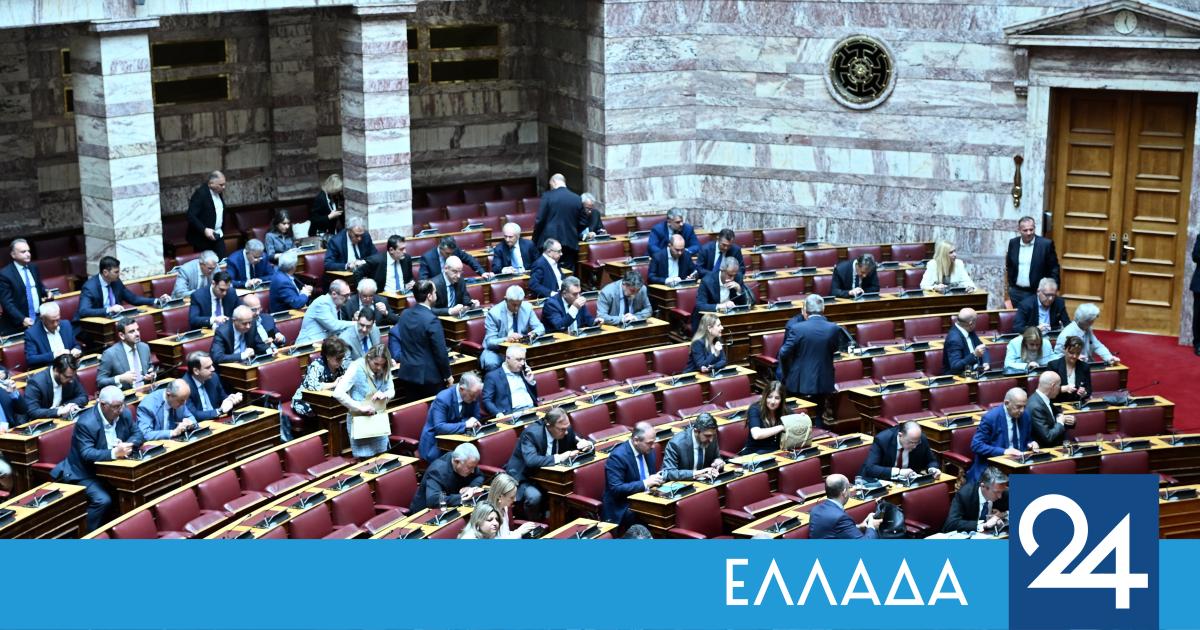
The text of the proposal for the revision of the Constitution bears the signatures of all 155 MPs of the New Democracy, marking the official start of the relevant parliamentary procedure.
The next step is the submission and announcement of the proposed provisions to be revised to the Greek Parliament. The text will then be printed and distributed to MPs in order to start the institutional processing of the proposals.
The parliamentary parties will be invited to nominate their representatives to the Commission, based on their strength in Parliament.
.
The constitutional review process is one of the most important parliamentary functions as it involves potential changes to fundamental provisions of the country’s charter and requires increased majorities and specific stages of approval before its final completion.
The specific provisions to be revised
Article 5 or Article 5A or new Article 58
Artificial intelligence must serve the freedom of the individual and the well-being of society, so that the risks are mitigated and the advantages it offers are exploited.
Articles 14 and 15
It is intended to broaden the protection of freedom of expression in modern media and remove detailed wording that does not fit the Constitution. It also provides for protection of the journalist against his employer.
Article 16
Provision is made for state care for the protection and promotion of the Greek language, as well as protection of the Greek flag as a symbol of the Greek nation. Provision is also made for higher education to be provided by legal entities of university education, public or private, with full self-government, under the supervision of the State and ensuring a high standard of studies.
.
Article 17
Protection is proposed not only of property, but of property. Provision is made for compensation for restriction of use without expropriation, possibility of transfer of building factor and utilization of abandoned buildings for social purposes.
.
Article 21
Provision is made for state provision for affordable housing and for taking account of intergenerational justice and solidarity in the design of public policies.
Article 24
Provision is made for measures to tackle climate change, the efficient management of water resources, the strengthening of renewable energy sources, the safeguarding of the environmental balance in all state intervention and the protection of animals.
Article 29
Parties shall take into account principles of democratic functioning. A law shall lay down the conditions for the establishment and operation of a political party. The Supreme Special Court under Article 100 will verify the fulfilment of the conditions for a political party to participate in elections.
.
Article 30 par. 1 and 5
A six-year term of office of the President of the Republic is provided for.
Article 41 para. 2 and 5
It is proposed to abolish the dissolution of Parliament on a national issue of exceptional importance. Provision is made for dissolution on the proposal of the government and a decision of the Parliament to renew the popular mandate, i.e., self-dissolution of the Parliament.
.
Article 44 para. 2
Rules for the proper conduct of referendums shall be established. The question must be formulated in a way that is understandable and comprehensible to citizens. A sufficient period of time, at least twenty days, must elapse between the announcement and the holding of the referendum.
Article 47 para. 3 and 4
It is proposed to abolish the possibility of granting amnesty for political crimes.
Article 51 para. 4
Provision is made for the possibility of exercising the right to vote by postal vote for voters within the Territory.
Article 54 para. 1 and 3
The electoral system should ensure reasonable proportionality and governability of the country. A law may provide that the Territory shall be divided into minor and major districts.
.
Articles 56 and 57
It is proposed that the detailed list of disqualifications and immunities be transferred to the Act. General principles would be established in the constitution and the law would be empowered to be implemented from the next election or immediately, by a two-thirds majority.
Article 60
The institutional role of the Member of Parliament in the exercise of his legislative and supervisory powers, as well as in communicating with his constituency, is to be safeguarded. Similarly, an obligation is provided for members of the government to respond to parliamentary scrutiny.
.
Article 73 para. 1
The principles of good lawmaking, such as adequate pre-legislative consultation, evaluation of the implementation of the law and measures for codification of legislation, are constitutionally enshrined.
Article 77 par. 3
Provision is made for the possibility of referring issues of unconstitutionality of a law, after its enactment and before its publication, by the President of the Republic, the Prime Minister or the Parliament to the Supreme Special Court.
The President may refer up to one passed bill per parliamentary session. Referral by the House requires a request of an absolute majority of the entire number of MPs.
.
Passed bills under Articles 51 and 54 are compulsorily referred to the Supreme Special Court before their publication. Pending the decision of the Court, the publication of the law is blocked.
Article 78 par. 2 and 6
A tax or any other financial burden may not be imposed by law with retroactive effect. Provision is also made for incentivising a stable tax regime for strategic private investment for the national economy.
.
Article 79
The budget must ensure sustainable fiscal operation. It provides for the obligation to file and publish an annual report by entities that are directly or indirectly financed by the state budget.
.
Article 81 par. 2
Provision is made for the possibility of redefining, by law by an increased majority, the incompatibilities of the office of minister and deputy minister with other functions or qualities. Provision is also made for the possibility of appointing vice-presidents of the Cabinet and non-ministers.
.
Article 82
An annual adoption of a Unified Government Policy Plan for the following year is provided for, which is made public and discussed at a special meeting of the Plenary Session of the Parliament.
Article 86
The prosecution of criminal offences committed by members of the government or deputy ministers in the performance of their duties will be by decision of the House, by an absolute majority of the total number of deputies and by roll-call vote.
Article 89
It is permitted to delegate special administrative tasks to judicial officials by decision of the Parliament, as provided by law. They shall not be allowed to participate, in any capacity, in the government or be appointed to independent authorities for at least three years after their retirement.
.
Article 90 para. 5
Promotions to the posts of the Supreme Court judges shall be made by a special parliamentary committee, without government intervention, from a list of three judges for each post, who shall be proposed by the respective Plenary Sections.
Article 97
It is proposed to abolish the special provision as regards the trial of political crimes by mixed juries.
Article 99
It is proposed to abolish the Court of Malpractice Claims and transfer the relevant powers to the Supreme Special Court.
Article 100
Provision is made for the Supreme Special Court’s jurisdiction to exercise preventive control over the constitutionality of a passed bill, pursuant to Article 77 para. 3.
.
The decision on the constitutionality of a passed bill shall be binding on all courts in the constitutionality review.
The Supreme Special Court will be composed of the Presidents of the Council of State, the Supreme Court and the Court of Audit, two State Counsellors and two lay judges, who will be appointed as members by lot every three years, and two regular professors of law courses of the law schools of the country’s universities, also by lot every three years.
The Court will be presided over by the most senior of the Presidents of the Council of State and the Supreme Court.
Article 101 par. 3 and 5
It is proposed to abolish the presumption of competence in favour of decentralised administrations. The decentralised system can be implemented by having a decentralised state structure and/or by having decentralised departments of ministries and other public sector bodies.
.
Provision is made for state care to support the primary sector and the development of the Greek periphery in order to ensure equal access to public goods throughout the Territory.
Article 101A
The ex officio members of the Council are the Governor of the National Transparency Authority, the President of the Supreme Personnel Selection Board, the Governor of the Bank of Greece, the President of the collective body of the country’s public universities and the head of the collective body representing the first or second tier local authorities.
Article 102
Disciplinary penalties of suspension or dismissal for the elected bodies of local authorities will be imposed by decision of the Supreme Special Court.
Article 103
An obligation to evaluate civil servants on the basis of the principles of impartiality, neutrality, professional competence and efficiency is provided for, with the possibility of the participation of the Supreme Personnel Selection Board.
The evaluation will be two-way, i.e. from subordinates to their supervisors.
A law will define the evaluation process, criteria, rewards beyond the basic salary linked to qualification and performance, and the consequences it may entail, including permanent termination, following a decision of the service council.
Article 118
A transitional provision is provided for the application of the revised paragraphs 1 and 5 of article 30 for the President of the Republic already in office.