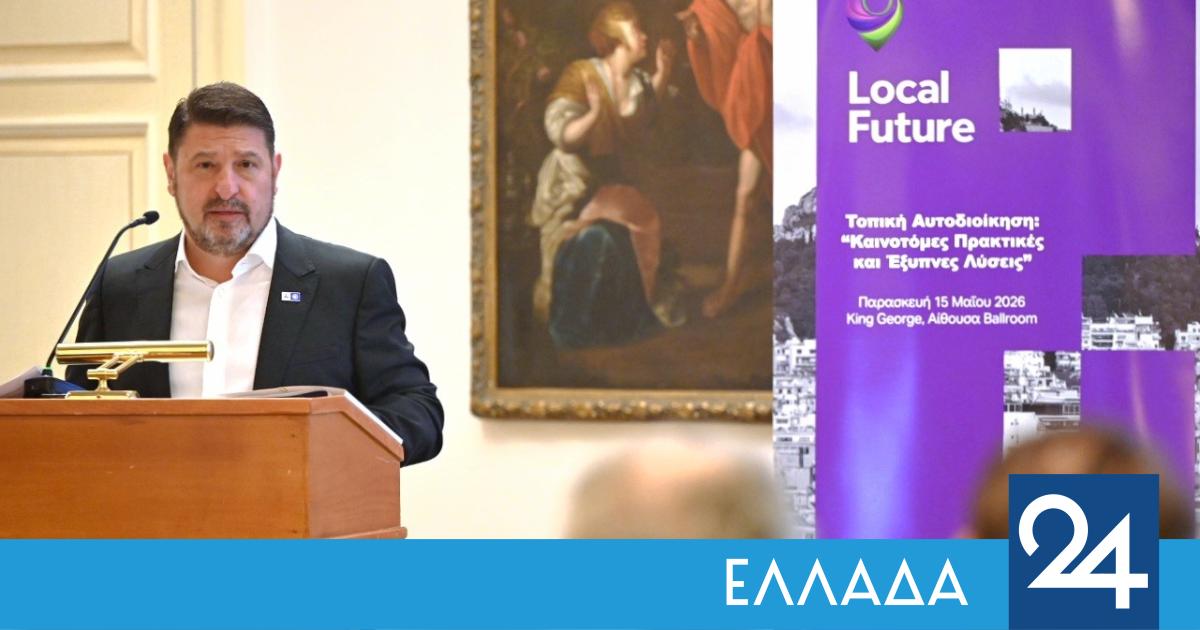
The necessity of metropolitan management of Attica’s most important problems is underlined by the Attica Regional Governor, Nikos Chardalias, in an interview with the newspaper “Today Press” and journalist Martha Lekkakou, while he develops his plan for the implementation of 300+1 projects worth more than 2.5 billion euros and describes the Final Four in Athens as a “unique opportunity”.
In particular, the regional governor describes the balanced development of the basin as “the biggest social stake of his term of office”, as he says “we cannot have a two- and three-speed Attica, we cannot have other regions running ahead and others lagging behind for decades. Balanced development is not just a slogan, it involves a whole plan. For example, in West Attica we have put forward a holistic programme of EUR 545 million, because there are accumulated injustices that have been accumulated over many years. In Piraeus, critical flood protection and urban interventions are progressing. In East Attica, civil protection, streams and infrastructure are top priorities, while in the centre, social policies, housing and public space are needed. This is my line: No municipality left behind, no neighborhood forgotten.”
As for the readiness of the Region of Attica during the fire season, Mr. Hardalias notes: “We are not waiting for the problem to manifest itself to run after it, but we are making sure that it does not happen.” With emphasis on surveillance, direct information, cooperation with municipalities, the use of technological means and the rapid mobilization of machinery and personnel, he stresses that “the independent Civil Protection Directorate is ready to assist with all its forces to protect the basin this year.”
It notes that the Region is called to intervene in a subsidiary manner, where and when needed, always in the context of the national operational planning prepared by the Ministry of Climate Crisis and Civil Protection, clarifying that it does so because there is “a widespread misunderstanding that the Region of Attica is responsible for fire protection. It is not. I admit, of course, that for this misunderstanding I am also to blame, even if unintentionally. Because, in people’s minds, after so many years of involvement with the subject, my fellow citizens have identified me, I would say personally, with Civil Protection.
With regard to metropolitanism, he argues that in crisis management situations, a unified metropolitan coordination between the Region, municipalities and the central state is required, with clear responsibility and accountability. “When a crisis breaks out, especially a natural disaster, everyone cannot work alone. Municipalities, the Region, the Fire Brigade, Civil Protection and the central state must intervene immediately as a single mechanism. The institutional framework needs bold changes. Attica is a metropolitan region; it cannot deal with fires, floods, traffic and waste with fragmented responsibilities. We need unified metropolitan coordination, with clear responsibility and accountability. And that is exactly what we are demanding. Not to get titles, but to solve problems faster,” he stresses.
As for the absorption of European funds, data show that the Region of Attica “is the first region in the country in terms of absorption, having achieved a 90% rate of activation of funds through NSRF. The NSRF 2021-2027 is a huge opportunity for Attica and we are not going to let any of the opportunities that are opening up go to waste. My goal is simple.
With regard to the Euroleague Final Four to be held in Athens next week (22-24 May) with the support of the Region of Attica, Mr.Hardalias notes that it is a unique opportunity “to showcase the modern face of our region. And in such events there is no room for sloppiness. We are constantly in open communication with the Euroleague, with OAKA, the government, the municipality and all stakeholders, so that the event is safe, organized and worthy of the image we want for Athens. The plan is not only about the stadium and the playing facilities as such. It is also about transport, accessibility, fans, visitors, safety, security, tourist promotion and the functioning of the city. We want visitors to come, to be served, to feel safe and to leave with the feeling of a European metropolis that knows how to organise great events. Because such events are not only sport. They are economy, tourism, image, self-confidence.”
Accordingly, the upcoming OTA EXPO 2026 specialised exhibition for local government organisations, which will be held in the capital on the weekend of 8-9 June, “is seen by us as a springboard for the wider economic development of Attica and its connection with investors from abroad”, he stresses, adding: “The exhibition is an appointment where we will see in practice how digital transformation, green growth and new technologies become tools in our hands. The goal is to leave it with new solutions that will be adopted immediately.”
The aim is to leave it with new solutions that will be adopted immediately.
Asked about his greatest political achievement – to date – and what he would like citizens to say about his administration in 2028, the Attica regional governor replied: “We have brought order, gained credibility and dignity, added rhythm and made accountability the norm. We unblocked projects, launched critical interventions and prioritised hundreds of projects. But the biggest challenge lies ahead. From the creation of new school units and the maintenance of existing ones, to streams and flood protection, road construction, playgrounds and social structures, every day a project is being done and judged that has never been done in Attica before, at least since the preparation period for the 2004 Olympics.”
“For our administration, I would like 2028 to say something simple: That we worked. That we didn’t hide behind responsibilities, we didn’t get lost in bureaucracy, we didn’t hand out promises without impact. That where we could solve a problem, we stepped forward. And where we couldn’t do it alone, we pushed, we cooperated, we asserted ourselves,” Mr. Hardalias concluded.