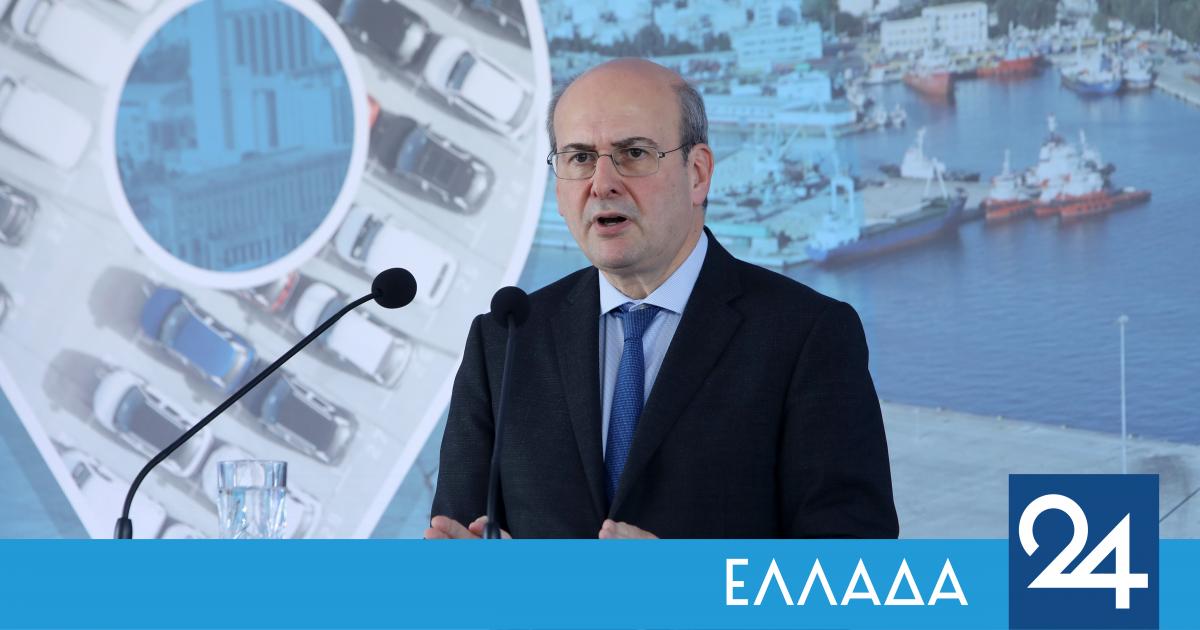
Following the announcements, in the context of the Delphi Economic Forum, about the Greek government’s cooperation with the OECD on the “Pissarides 2” plan, the Vice President of the government, Kostis Hatzidakis, in an interview with “Sunday Afternoon”, points out that “the Greece of 2030 will not be built with “money trees”, but with specific reforms aimed at further growth of the economy and increasing the income of citizens”.
And, given that “so far we have achieved significant progress, focusing basically on fiscal seriousness and pro-investment policies”, from now on, he continues, “we turn our attention basically to increasing productivity and distributing wealth in a socially just way. We have therefore announced, together with the Secretary General of the OECD, Mathias Corman, the government’s cooperation with the OECD, the IOBE and the Bank of Greece, with the aim of designing the country’s economic and social policy for the period 2028-2034.”
And he adds: “And of course Kyriakos Mitsotakis and the New Democracy Party, in their bid for a third term, will put into the political dialogue a very specific plan of reforms and policies to take Greece higher. In the face of populism and the opposition’s unrelenting parochialism, we will oppose a new Truth Agreement with very specific commitments.”
The next question concerns the upcoming Constitutional Review, whether, in particular, he believes that the necessary consensus can be built. In this regard, the Deputy Prime Minister testified his belief that “the Constitutional Review is a great opportunity to restart the political system. And I think that, despite the aggressive rhetoric being deployed by the opposition, consensus can be reached on important issues. For example, on the revision of Article 86 of the Constitution on the responsibility of ministers. Or on how to select the leadership of the judiciary.
The Prime Minister has submitted a package of proposals and this week the Parliamentary Group of the New Democracy will meet to submit its proposals, discuss the issue and formulate its final proposal.
Thus, the institutional modernisation of the country, through the Constitutional Review, will be a key part of our plan for Greece 2030.” While he closes his response with the wish that “the opposition will move away from extremism and fanaticism and that the major institutional changes demanded by the vast majority of citizens will proceed.”
Asked about the letter of the five New Democracy MPs, the party’s vice-president assessed the letter as “useful”, regardless of whether, as he clarified, “one agrees or disagrees with the views they express, as they have the right to do. They, moreover, stress that in important crises the staff state has paid off. No one doubts, I believe, that with the ‘staff state’ there is good government coordination, public planning and internal control of the progress of the reforms being implemented. Coordination with particular utility and added value.”
“Obviously,” he acknowledges, “there have been some failures in government coordination, which, after all, we have openly talked about, but were things better without the executive state?” he asks, and continues: “And of course, in the context of the Constitutional Review, we will certainly have to look at both the issue of the Government’s relationship with the Parliamentary Group and ways in which the role of the MP will be enhanced. In this context, any suggestion is welcome.”
Following this, the Deputy Prime Minister noted that “New Democracy MPs have, over the years, backed important reforms and have contributed in a very substantial way to the resolution of various issues that exist in their constituencies. At the same time, there are ministers who are not MPs, such as Akis Skirtsos, who are carrying out their duties in government with dedication and efficiency. Since its foundation by Constantine Karamanlis, New Democracy has been a broad, popular party that moves forward with compositions. And it is the job of all of us to do everything in our power to make Greece stronger and the everyday life of its citizens better.”
On the issues of the rule of law and corruption, he said that “in recent years, significant steps forward have been made in this area. This is underlined by the Economist, which ranks our country among the 25 countries with full democracy. Progress is also recorded in the reports of Transparency International. While in the recent OECD report, Greece has the second best performance in implementing the recommendations for tackling corruption. In addition, we have taken a number of initiatives to tackle the phenomena of the deep state, such as the digital modernisation of the public sector, the recent law for a more citizen-friendly state, which was passed by the Parliament on my initiative, the swift award of pensions, the promotion of evaluation in the public sector.”
In conclusion, “all these are reforms that show respect for the citizen and significantly reduce any room for corruption. No one denies, of course, that there are still issues to be addressed. But in no case is there the picture of disaster described by the opposition.”
And in response to the position of opposition leader Nikos Androulakis on the wiretapping, the deputy prime minister stressed: “At some point we should learn in this country not to take a position on court decisions depending on whether we like them or not. The judiciary is independent and decides on the basis of the facts of each case, not on the basis of what each of us feels. Personally, I respect all decisions, whether they are made by the Supreme Court or the Single Judge Court of Appeal. However, since Mr Androulakis and PASOK are breaking their mantra that the judiciary is supposedly an instrument of the government, let us come to agree, as we propose, to change the way in which its leadership is selected. At the same time, however, they seem to refuse to cooperate in the Constitutional Review.”
On the question of whether the gestating parties of former Prime Minister Alexis Tsipras and Maria Karustianou are changing the political scene, Hatzidakis is of the opinion that “all these fermentations concern the opposition, which is already fragmented and will not affect New Democracy. New Democracy is addressing citizens with a common sense agenda and as we approach the national elections we will focus more and more on our proposals for Greece 2030.”
And he adds: “The problem, however, is that as competition in the opposition increases, so does populism and a metaphysical approach to problems. We see this in PASOK, which is making a turn to the left, with the anxiety of the Tsipras party.
On the other hand, Mr Tsipras, who, it should be noted, has been repeatedly judged by the people and left the country a loser, talks about the past decade, saying, for example, that he should have closed the banks from the first day he became prime minister or appearing to be nostalgic for the bankrupt PPC he handed over to us. I don’t think there are that many Greeks who would want our country to return to where it was in 2015.
In addition, Ms Karystianou is addressing parties that are purely populist. So let Ms Konstantopoulou and Mr Velopoulos reflect on her party.”
On the occasion, moreover, of a recent statement by former Prime Minister Alexis Tsipras on the PPC, he replied: “Mr. Tsipras does not forget his old habits and makes the white and black with great ease… But reality itself and the numbers prove him wrong! I remember very well my agony in the summer of 2019, when I became Minister of Environment and Energy and the PPC was on the verge of bankruptcy. The auditor himself had raised the issue of viability in April 2019 under the Public Limited Companies Act. Its shares had collapsed from 7 euros in 2014 to 1 euro in 2019. PPC was selling electricity to its competitors at below-cost prices. PPP had even run out of poles. Through a series of our own reforms and successful actions by its management, PPC is now recognised internationally as an example of success and is becoming a national energy champion. The value of the 35% currently held by the State is 16 times the value of the 51% held in 2019. In recent years, the State has received dividends greater than the total value of its stake in PPC in 2019. Mr Tsipras may be nostalgic for the bankrupt PPC he handed over to us, but citizens remember his works and days very well!”
“Should we expect something better at the TIF?” is the concluding question, with Mr Hatzidakis, after recalling that “all these years, within the limits of the economy’s strength, we have been supporting society and reducing taxes”, saying that: “In the same direction will be the measures that Kyriakos Mitsotakis will announce at the TIF in September. Tax cuts and further support for the vulnerable. We will do our best. I cannot be more specific than that. We will have a clear picture of the available fiscal space late in the summer. In any case, however, I would like to underline that the government has moved with great speed, taking a number of initiatives to deal with the consequences of the war, and a few days ago announced measures amounting to 500 million euros for families with children, for tenants, for pensioners, for debtors, which have not yet been implemented.”