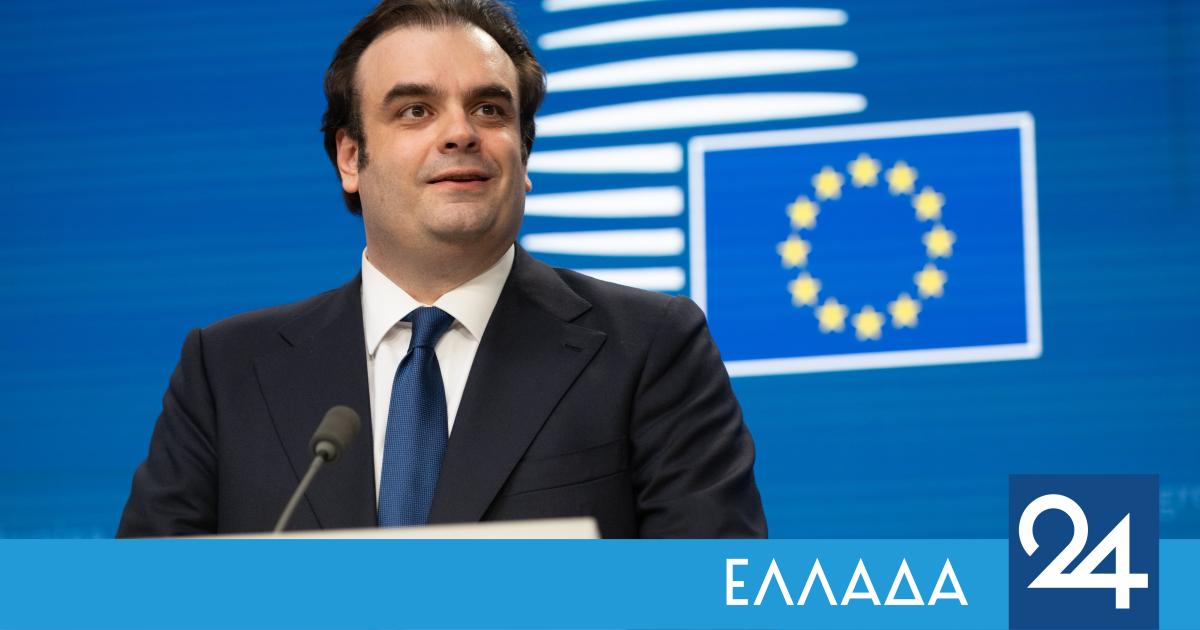
The Minister of Economy and Finance Kyriakos Pierrakakis referred to the five lessons that Europe must learn from Greece, at a dinner at the Athenian Club, organized by the University of Piraeus and Panteion University in the framework of the “3rd Maritime Security Conference”. As the minister said, the topics were the course of the Greek economy (primary surpluses, debt deflation, unemployment reduction), digitalization, energy, RRF and mindset.
In detail, the Minister said:
“Thank you very much, dear colleagues, dear admirals, ladies and gentlemen, it is a great honour for me to be here with you tonight. And let me begin by referring to what to me is obvious: that the topic itself, I suppose, although you are holding this event on an annual basis, when you chose it you did not expect it to have such a timely dimension, given what has happened in recent months.
And let me also say that we did not expect it either, as Professor Arvanitopoulos mentioned earlier my recent election to the Eurogroup presidency.
It seems that we discuss a different crisis every month in these meetings when the European finance ministers meet. But there is a very strong return of geopolitics in these crises and in these challenges that we face. And let me start with that, because, Professor, you also mentioned the element of my generation.
When we were at school or university, my generation, looking at the international relations literature, was closer to people like Richard Rosecrance, who talked about the rise of the “virtual state”, and less to the classics of geopolitics, like Alfred Thayer Mahan and the “influence of sea power on history”. As we have many admirals in the room.
We didn’t think, especially those of us more focused on globalization and technology, that geography would play such an important role in international politics in our time and in our generation. And frankly, we were wrong.
Because today, if you look at the trends that are shaping the international and global economy, I would say it’s a shift of power from the West to the East. It is a shift of power from the state, from the core of the state, to other entities as well, such as the private sector, non-governmental organisations. There is a rapid technological acceleration. Technology has always played an important role in economic growth, but that acceleration now seems to be getting faster and faster, month by month, not even year by year.
The return of geo-economics and geopolitics to the political equation and the “chessboard” is now evident. And all of these together have completely changed the mix of policies we have to manage and implement.
Even if we look at governments like ours, which has been in power since 2019, if someone told us that the last seven years we would have to manage, on the one hand, the resolution of the unfinished business of the past, that is, all those reforms that were not made in the previous decades, and at the same time a series of emerging crises that nobody could have foreseen, from a pandemic to Russia’s invasion of Ukraine, it would look a bit like a novel or a science fiction film.
But by and large, it all happened. So let me start by saying that as policy makers we need to have a duality in mind, a dual mental map when we manage policy change and reform.
Because on the one hand one has to be flexible enough to understand the “dividend of the obvious”, that is, the obvious reforms and the obvious things that have not yet been resolved; and on the other hand one has to have the reflexes to respond to emerging crises, to what, if I recall correctly, Donald Rumsfeld described as “unknown unknowns” as opposed to “known unknowns”.
You should be able to do both. And it’s hard enough for politicians and policymakers around the world to respond equally well to both challenges.
The crisis of the moment, in large part, and let me start with this one, is the “choke point”, the Straits of Hormuz, which gives a different dimension to your conference.
And let me begin by echoing the words of Fatih Birol, Executive Director of the International Energy Agency, who stressed that this crisis has the potential, if the Straits are not opened fast enough, to be the biggest energy crisis in history.
And I think the numbers bear that out. If you look at the loss in millions of barrels of oil per day in the 1973 and 1979 crises, in total we were talking about minus 10 million barrels per day, whereas now we are at minus 13. So it’s bigger.
If you look at gas and compare it to Russia’s invasion of Ukraine, the drop then was from 155 to 80 billion cubic meters per year, so minus 75. Now, if you break down the current losses to an annualized basis, it’s minus 110.
.
When you add it all up, if the Straits remain closed, it has the potential to be the biggest energy crisis in history. And Fatih Birol is absolutely right.
Of course, our job internationally is to prevent this from happening. On the one hand, policymakers around the world and especially in Europe are responding with the best available policy tools. In the European Commission there is a very specific framework of measures to support citizens and businesses: measures that are temporary, targeted and tailored.
Why we also have the 2022 lessons. We know what worked and what didn’t. And we know that fiscal policy should not conflict with monetary policy. However, the impact of closing the Straits is huge. It’s not just oil and gas, but other products: a third of fertilizer, helium, petrochemicals.
The impact on the global economy is huge. Asia is most affected; 80% of the oil and 90% of the gas that passes through the Straits goes there. But the impact is already visible in Europe and the United States, especially on fuel prices.
So we know that this crisis must be resolved. But what does ‘resolution’ mean? For a European finance minister, it is a function of three things: the duration of the crisis, how quickly the Straits will open, the depth of the impact -80 energy infrastructure affected, 30 severely – and the situation after the Straits open.
Why we don’t believe in “tolls”. We believe in freedom of the seas. And that will be built into the pricing of risk.
No government or country in the world is big enough or powerful enough or autonomous enough to regulate AI to the extent that it should. Because the very structure of these models is such that it requires international cooperation and a coordinated response. I think governments around the world are becoming more and more aware of that.
At the European level, of course, the need is to have a broader technology policy, I would even say a “doctrine”, as to our choices and what we should do as Europeans. And this very much touches on basic notions of sovereignty.
Again, inspired by the presence of so many international relations experts in the room, particularly Professor Arvanitopoulos, I remember very vividly the Westphalian concept of sovereignty, the 1648 Treaty of Münster and the Osnabrück Treaties. And the idea that sovereignty usually means external autonomy and full internal hierarchy.
In our world, this is not something one comes across often. Our world is inherently interdependent. Therefore, the question when trying to think about sovereignty is not whether to equate it with autonomy. Autonomy is a dimension of sovereignty. But sovereignty also involves interdependent dynamics. And the goal should be to avoid being asymmetrically interdependent.
This touches heavily on the choices and policy proposals we as Europeans will adopt on technology. We should not seek universal autonomy, because, frankly, that is simply impossible. And I would argue that this is true for every country.
.
The idea is to enhance our capabilities in the areas where we are close to the technological frontier and to make specific technological choices that are consistent with our key strategic priorities, whether it is energy, artificial intelligence or any other policy area.
To give an example, which I have written about publicly. The first Trump administration’s policies on networks and 5G indirectly supported the business ambitions of not one American company, but two European ones, Ericsson and Nokia.
We as Europeans should have taken advantage of this juncture, this “equation” that was in front of us. And I must say that we did not. Why did we not? Because we failed to develop an industrial policy around these “winners”. We were right on the technology frontier, no American company was there with them, and instead of building ecosystems around them and allowing them to compete globally, creating European champions, we chose to go ahead with 27 separate 5G spectrum auctions in Europe, with 27 different strategies and 27 regulators.
At the same time, America had a single telecoms regulator. So if you’re Deutsche Telekom, which owns T-Mobile in the US, you’re interacting with a regulator. But in Europe you interact with 27.
So we had a fragmented environment. At the same time, China didn’t even do an auction, but administrative spectrum allocation to accelerate growth, knowing that the value would come from the application level.
I say this as a “counter-example”, because what we should have done – and I will refer to my experience at the Ministry of Digital Governance – in Greece we applied a more interesting model. We used 25% of the proceeds from the auction to create a fund that financed 5G applications. We called it ‘Phaistos’. At the same time, we gave free access to the spectrum to startups and universities and designed the auction to accelerate growth rather than maximise revenue. That was the “triple” policy.
So imagine the alternative scenario: a single European auction, pan-European funding and exploitation through the European Investment Bank. That would be pure European industrial strategy.
To sum up, we need to focus on “winners” and build European champions in areas of strategic importance, such as national security or where we want to create industrial advantage. Think Galileo, think Airbus. In other areas, we need to work cooperatively as global regulators. That is the smartest and at the same time the most “sovereign” way to go.
I think there are many lessons that Europe as a whole can learn from what has happened, particularly here, particularly in Greece.
Last week we announced a primary surplus at 4.9% of GDP. And if someone had gone to sleep ten years ago and woke up today to see Greece with the fastest declining debt in the world, primary surpluses and economic growth twice the European average, they would find that absolutely unexpected.
And today I had the opportunity to participate in the EFC meeting taking place in Athens, the Economic and Financial Committee of Europe. The Deputy Finance Ministers at European level are meeting in Athens. And they all agreed that what happened in Greece is something that no one would have expected. But I think there are a lot of lessons that can be learned overall from our experience.
I mentioned at the Delphi Forum last week that, in this comparison, I believe in the “Frank Sinatra doctrine” of politics: if you can do it there, you can do it anywhere. So if you can make it in Greece, you can certainly make it at the pan-European level.
And in this context, both in terms of our overall economic management, so how do you create this positive feedback loop of growth, lowering unemployment, de-escalating debt, etc.> and in terms of our digital transformation: the most bureaucratic, the most “kafkaesque” country in Europe now offers over 2,200 digital services.
And we have additionally listed the rest and we know what to do about them. So the whole state will be digitized over the next few years, particularly as the RRF projects, the European-funded projects, are activated. From the electronic patient record to the Land Registry, which was not completed in Greece, it was a pending project since the time of King Otto, and now it is going to be completed by this government. King Otto was the King of Greece in the early 19th century after the Revolution.
And on energy, how do you use your position on energy policy? It is an area where many can learn lessons from us. We had the PPC, a company that was almost bankrupt when we took over. And now there has been a capital increase of about EUR 4 billion and at the same time the company is becoming a European champion. At the same time, we are gradually becoming independent of lignite. We have become a net exporter of electricity. And if you look at it as a whole, this is the European challenge. Because 57% of the energy in Europe is imported. 47% of electricity is produced from renewable sources. So we are leveraging our position both in terms of renewables and geopolitically.
.
There are a lot of Americans in the room. For us, the LNG vertical corridor is a very important strategic project that can play a much bigger role in both our country’s energy security and that of Europe as a whole.
The fourth point from which lessons can be learned: the RRF and how you can optimally link European funding to reforms; another area where we had a strategy and managed to link it to specific funding priorities.
And one last point: mindset. Fiscal discipline in Greece was not a given in previous decades.
But today it is the status quo. The election of a Greek finance minister to the Eurogroup presidency is a symbol of this shift, this change in the mentality of Greek society as a whole. And I would say that it reflects a decision by one generation not to pass the bill on to the next, as previous generations have very strongly done.
.
And in the hope that I have not spoken too much, since I am the only one separating you from dinner, I will close by returning to the point from which I began.
The key element and the key skill, as we talk about AI and changing the skills required, is this duality in thinking. That is to know that there are many loose ends, which, if you look at it another way, offer the “dividend of the obvious.”
If Europe goes ahead with the Savings and Investment Union, the digital euro – the so-called Banking Union and the Capital Markets Union – all these projects that we have been talking about for years, the IMF estimates that they can add 5 to 7 points of growth per year for each member state.
There is now a generation of European officials saying: let’s do the obvious things we haven’t done for years. That’s exactly what we did.
Constantine Arvanitopoulos was Minister of Education, as was I. And the main discussion when I was a student was whether to allow private universities in Greece. We were the last country in the world, along with Cuba, not to allow it.
It was a debate that had been going on since our parents’ time. And I had the honour of completing this reform, which was deemed constitutional by the Council of State and today private universities are operating in Greece. That sounds obvious internationally.
But these “obvious” things, when implemented, produce results. And at the same time, you have to be able to respond to the unpredictable. And that requires having a plan, as Clausewitz describes it: the general must have a plan going into battle, but knowing that it will change as soon as it begins.