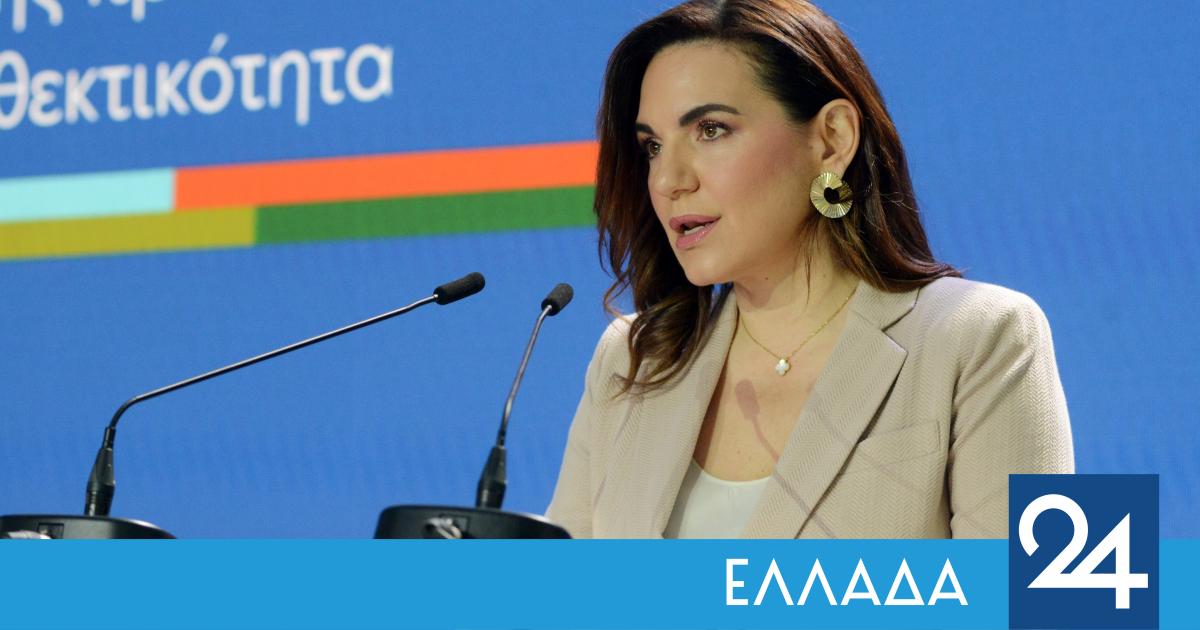
Global tourism is once again facing external challenges, according to the Minister of Tourism Olga Kefalogianni, speaking today at the 11th Delphi 2026 Economic Forum. However, as she noted, in such circumstances, the importance of the maturity, experience and credibility of each destination is highlighted. According to Kefalogianni, Greek tourism has gone through many crises (economic, pandemic, war in Ukraine, Middle East crisis) and has proven that it is now mature and resilient. “We are a destination that can speak with great confidence about safety. That automatically positions us as a destination that also has that competitive advantage.”
The Ministry of Tourism, together with the Hellenic Chamber of Hotels, monitors on a weekly basis the progress of bookings and cancellations. As Kefalogianni said, “there is no reason for concern for Greek tourism. At the beginning of the war in the Middle East we saw there was a ‘numbness’ but this has been fully restored. We have no reason to worry. However, the potential impact on air connectivity, transport costs and the wider economic environment cannot be ignored.” Responding to a question on fuel sufficiency, due to the crisis in the Middle East, Kefalogianni said that this issue has already been answered by the European Commissioner for Sustainable Transport and Tourism, Apostolos Tzitzikostas, that “Europe has fuel sufficiency”. In this context, the Minister highlighted the need to formulate a European crisis management mechanism for tourism, with the aim of strengthening the resilience and sustainable development of the sector across Europe.
Focusing on 2026, the first available data suggest that the year has started on a very positive note. January saw a spectacular increase in receipts, of 58%, compared to the same month in 2025, and 33% in arrivals. In February, as in March, a new increase in traffic from abroad was recorded at the airports of Athens, Thessaloniki and other destinations. He also noted that 2025 recorded an increase, around 10%, in revenues, which was significantly enhanced compared to the growth rate of arrivals (5.5%), which is indicative of a remarkable improvement in the qualitative indicators of tourism. Large increases were also recorded, particularly in revenues, but also in travel, in the off-peak months.
As for the Ministry’s strategy, Ms. Kefalogianni said that the strategic objective is to promote Greece as a destination with a multidimensional tourism offer, capable of providing authentic and high value experiences all year round. “We want to showcase a Greece beyond its narrow, traditional footprint, exploiting the wealth of destinations, culture, nature, gastronomy and special forms of tourism. The digital transformation of tourism promotion is also part of this direction, with the redesign of visitgreece.gr and the creation of specialised digital tools for individual tourism products. Our goal is a more modern, more targeted and more effective promotion of the country.”
In addition, emphasis is placed on activities and experiences with high added value for destinations, such as yachting, diving and winter tourism, health and wellness tourism, gastronomic tourism and wine tourism. At the same time, for the first time, Greece is promoting mountain tourism in a targeted way through an integrated promotion programme, with the central message “Mountain Greece. It takes you high. All year round”. As Kefalogianni said, the aim is to give mountainous Greece a new, more prominent role, so that it can emerge as a year-round travel option in its own right, making the most of its natural environment, local production, traditions and the overall experience it can offer.
As for the Special Spatial Framework for Tourism, he noted that it is in the final stage of preparation and the relevant Joint Ministerial Decision will be presented soon. This is an extremely important tool for planning tourism development and for investment guidelines. According to Kefalogiannis, the basic principles it serves are sustainability, adaptation to climate change, green transition, resilience of destinations, support for the country’s growth potential and promotion of the necessary infrastructure and modern tourism products. The guidelines, rules and priorities for investment are defined and specified on the basis of the dynamics of the regions (developed, developing, etc.), their specific geographical characteristics (islands, coastal or mountainous areas, urban centres) and their specific features (protected areas, archaeological sites, traditional settlements). Overall, the guidelines of the Special Spatial Framework for Tourism offer a set of clear rules necessary for the formulation of investment proposals, while also facilitating the process of their evaluation and approval.