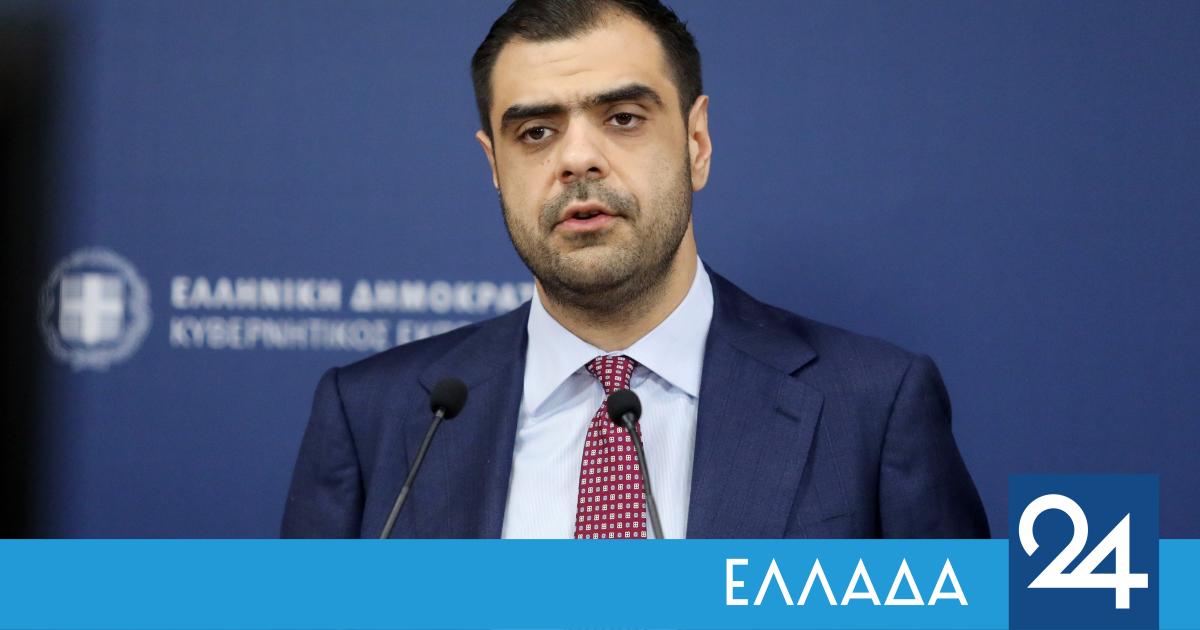
The latest poll results and the elections, the lifting of the immunity of MPs and the investigations of the European Public Prosecutor’s Office, the measures and benefits announced by the Prime Minister and the latest internal attacks on the ruling party were among the topics mentioned by government spokesman Pavlos Marinakis in a discussion with journalist Antonis Sroiter on the sidelines of the 11th Delphi 2026 Economic Forum.
Speaking about the polls that give ND 29.5%, Mr. Marinakis stressed that “if the polls are the photo of the moment, the elections are the verdict for a four-year term” and said he was “cautiously optimistic.”
Marinakis said the following conclusions were nevertheless drawn: “a government in its second four-year term has a very large gap from the second party and that this 29.5% in the vote estimate is far from the desired percentage for our re-election with self-reliance. So, some things are recognised, that’s why we have that big gap, but we have to work much harder to achieve our goal.”
On the OPEKEPE case which has “several scandal implications” as Mr. Marinakis, he described it as a “great plague for the country” and that “on the issue of illegal agricultural subsidies Greece has paid 3 billion euros over 30 years”. He added that the 13 MPs themselves requested the lifting of their immunity, which honours them, and “until the lifting of the immunity of the 13 MPs, 97 MPs from 2019 to date have been or are under the status of lifting immunity. Whether they are innocent or guilty will be decided by the judiciary.” However, there are currently two felony cases under investigation and these two people have declared that they will not be candidates, Marinakis clarified. For the others who are on misdemeanor charges, as for the previous ones, “the cornerstone of democracy and the functioning of institutions is the presumption of innocence and the functioning of justice,” he said. “We have been insisting for the past 2-3 weeks all government officials, with the Prime Minister being the first, to speed up the clearance of the case, so that we can ideally go to elections and society, the voters, can have a clear picture of these people,” he said and stressed that “we will continue to substantially support the operation of justice, both domestic and European.” The European Public Prosecutor’s Office is currently investigating 3,600 cases across Europe, Ms. Covesi said, all for possible misappropriation of public money. In Greece, 170 cases are being investigated. “So there is no country where fraud is more or less intense,”
she commented.
Speaking about curbing similar phenomena, he said that in the last seven years the government “did a lot”, such as increasing the number of ICUs by 80%, creating a digital state with 2.500 digital services, reducing the contact between civil servant and citizen, paying pensions in 2 months instead of 3 years, electronic service of calls, and more. In the OPEKEPE the transition came “late”, he argued, although before the European Public Prosecutor’s Office 5,000 VATs were sent to the Justice for verification. “The transition of OPEKEPE to the AADE is the end of these phenomena that rightly hurt people,” he added.
“Greece has a solid democracy,” Marinakis explained, adding that “this is reflected in the Commission’s annual report on the rule of law, we are in better shape than 15 European member states and very much improved, especially on the issues of the portfolios I have the honour to represent, of freedom of the press and media, remarkable progress.”
Regarding Adonis Georgiades’ statements, he said, “Mr Georgiades is a man who has been the victim of a frame-up by another government. He continued: “Mr Georgiades, and none of us, will never question the catalytic role as a pillar of stability of the constitution that the judiciary has,” but he appreciated that “it raises legitimate questions.”
On the criticism of subsidy policy, he described that surpluses come from increased tax revenues as a result of three factors, creating 600.000 jobs, tackling tax evasion and developing the economy, while, as Marinakis argued, under the SYRIZA government, the surpluses came from tax increases.
In response to a question on the energy crisis and accuracy, Mr. Marinakis that “right now we have another 200 million for 2026 and secured, always to see how things go, but it seems that things are manageable because we have a solid and resilient economy, about a billion to give for 2027.” He added that “if the 2026 TIF was the TIF for individuals, where we had the biggest tax rate reduction for families, children and overall all earners, the 2027 TIF we aspire to be for everyone again, but with a focus on businesses, especially SMEs and the middle class.”
On the discussion about non-parliamentary ministers and MPs, Marinakis argued that “as much as the person who will go to ask for a cross is important, it is equally important which electoral list this person is on. The policy of the Mitsotakis government that has produced results has been achieved by parliamentarians and non-parliamentarians together. According to Marinakis, the debate was opened “for no reason” with the controversial post by Skertzos, which “did not target any MP.”
Finally, speaking about Alexis Tsipras, he said that “we are waiting for him to announce his party and his programme”. In 2015, if it had not been for the then New Democracy and PASOK MPs, “Greece would not have been in Europe, we would not have had the Recovery Fund, we would not have had vaccines, at Delphi in the next few years we would not have discussed the European perspective in Greece, probably 500,000 people would not have found jobs,”
On the possibility of cooperation with Tsipras’ party, he clarified, “we and Mr. Tsipras and any party, either of the far right or that came from Mr. Tsipras, we will never sit at the same table.”