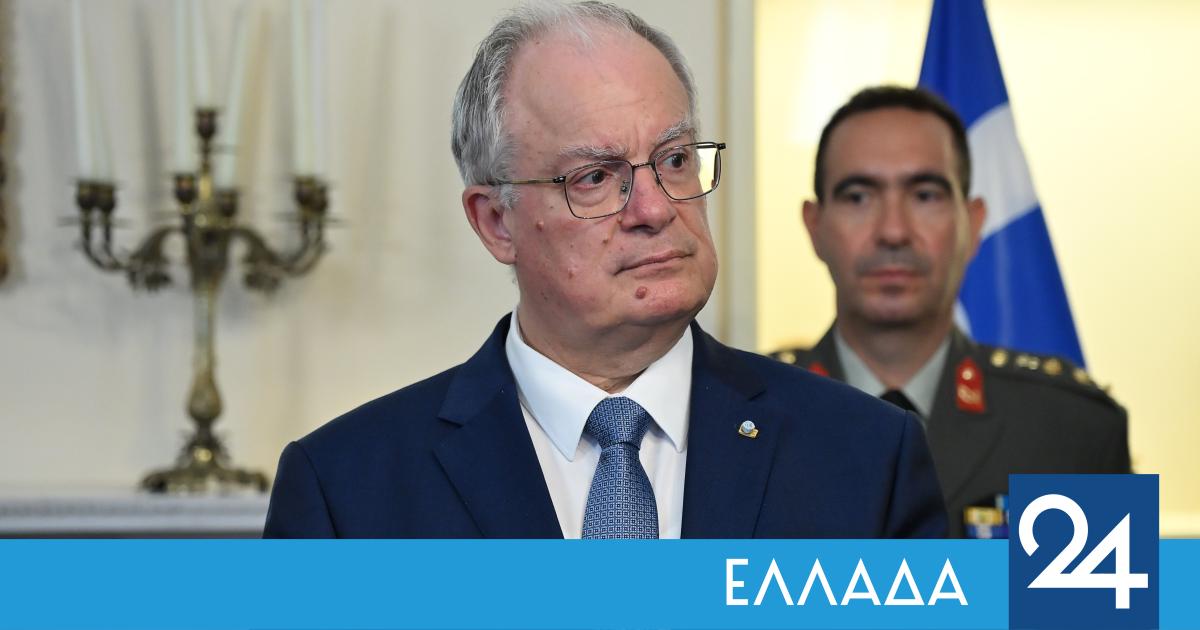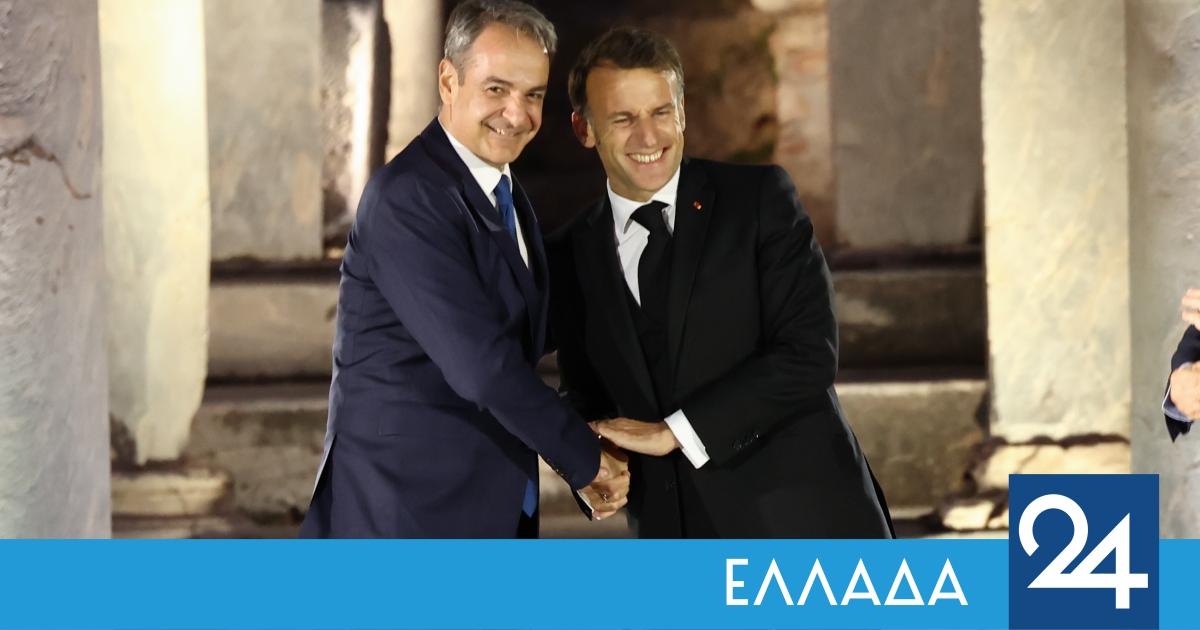
“The Greek-French alliance is a model of cooperation for all of Europe, in a new geopolitical environment, where decades-old constants are being challenged and international legitimacy is being challenged everywhere,” said the President of the Republic, Constantine Tasoulas, during his address at the official dinner hosted in honour of French President Emmanuel Macron at the Presidential Palace.
Mr. Tassoulas, after welcoming the French President and his wife to Greece, underlined that his visit reflects the close friendly ties between our two countries and marks the renewal of our strong allied relationship, as well as the expansion of bilateral cooperation in a number of areas.
At the same time, he pointed out that “Greek and French culture have been in fruitful dialogue for centuries, contributing significantly to the shaping of modern European identity” and added that Europe must now assume its historical responsibilities, making it a strong geopolitical power, as the times of carelessness are past.
He also recalled that “February marked four years of war on our continent” and noted that “Greece has shown from the very first moment and without any hesitation practical solidarity with Ukraine, maintaining a principled stance”.
As he said, “In the face of outdated revisionism and the brute force of power, Greece always and everywhere upholds the commitment to the fundamental principles of international law, such as the prohibition of the use or threat of use of force, respect for the sovereignty and territorial integrity of states and the peaceful resolution of international disputes.”
In fact, he observed, “He could not have done otherwise, as this year marks 52 years since Turkey’s invasion of Cyprus, which opened a gaping wound in the body of Europe. We never forget that the Cyprus problem is a matter of illegal invasion and occupation, from which no legal results will be produced. I would like to express my sincere thanks for France’s long-standing support for the Republic of Cyprus and its efforts to find a viable and workable solution on the basis of United Nations Security Council resolutions and the European acquis.”
Speaking about the situation in the Middle East, he argued that “While the war is still raging in Europe, another multiple front has opened, from 2023, in the wider Middle East, endangering not only regional stability, but also Europe’s energy and economic security. In today’s chaotic circumstances, I would like to send a message of restraint, prudence and support to the thousands of innocent victims of war, including the Christians of the Middle East. It is clear that the solution to the region’s chronic problems can only come through dialogue and diplomacy.”
Referring to the growing challenges facing the European Union, he argued that “In this environment of repeated crises, Europe is experiencing unprecedented challenges that test its cohesion as a union of states, but also the resilience of our societies themselves: Migration, rapid technological progress, energy insecurity, economic instability, the rise of extremes, hybrid threats and the climate crisis are conditions that are likely to intensify in the coming years.”
In this context, he assessed that “No European state can face the threats alone, nor can it seize the opportunities that present themselves. Europe must therefore move swiftly and in a coordinated manner towards both strategic autonomy and enlargement in order to play its historic role as a beacon of democracy, peace and prosperity.
He concluded by noting that “Over the past years, decades, centuries, our paths have crossed again and again. Today, we are forging a coordinated alliance on the basis of shared values, interests and vision”, he said, adding that “Greece and France share common views on their bilateral relationship, on European integration and on the path that the international community must follow in the future. And this fills us with optimism and determination for the peaceful battles we are called upon to fight together.”
Macron: The slogan “Greece, France, alliance”.
With the slogan “Greece, France, alliance”, which Greeks were shouting when Constantine Karamanlis, after a decade of exile in Paris, returned in the French presidential aircraft, French President Emmanuel Macron began his address, underlining that “Today, it is more relevant than ever”.
Addressing the President of the Hellenic Republic, he noted that “I am honoured by your invitation tonight. It is part of a long history of visits that have marked the friendship between the two countries, such as that of General de Gaulle in 1963, or that of Valery Giscard d’Estaing in 1975, who was the first Head of State to be received by Prime Minister Karamanlis after the return of democracy to Greece. Because France, from the very beginning, has been the main defender of Greece’s European course.”
As he said, “All French Presidents, and I believe all French citizens, embrace the idea that ‘Europe, without Greece, would not be Europe’. Initially, this was shown by the desire to re-establish democracy in the country that was its cradle. Then it was expressed by an unshakeable sense of solidarity, an outgrowth of history, which was not shaken at all when times, especially fifteen years ago, became more turbulent for you and for all Europeans.”
Referring to the depth of the ties that unite the two peoples, he noted that “it takes us back to Antiquity, and to the always intense interest of the French in Greece. The philosophers of the Enlightenment, Montesquieu or even Voltaire, admired the culture and politics born here, studying Pericles and the Church of the Demos at the Pnyx. This strong bond proved particularly fruitful: you invented the Olympics, and a Frenchman managed to revive them.”
He also argued that “This is how the French wave of support for the Greek Revolution was born, fuelled by a thirst for justice and admiration for your history. A support through the struggle of the French volunteers, at Navarino and on the Moria, and through the Philhellenism of intellectuals and artists, who drew inspiration from the words of Lord Byron, Chateaubriand and Hugo, but also from the brush of Delacroix.
In the same context, he recalled that “Later, when Greece went through the trials of the civil war and the dictatorship, France stood by its side, welcoming the Mataroa refugees in 1945, and then the exiles of the junta. France embraced these Greek children, and they repaid her by contributing to French culture with their creative genius, from Costas Gavras to Cornelius Castoriadis. Many Greeks chose to settle in France, and some of them do us the honour of being with us tonight.”
He also noted that “France does not forget the thousands of Greeks who chose to defend it, in the trenches of the Great War and in the troops of the Liberation. Always with the same willingness to stand by each other, whenever the values of freedom and democracy were threatened.”
He went on to note that “This common history is deeply European, as we celebrate this year the anniversary of Greece’s accession to the European Economic Community: Forty-five years of dedication and solidarity, united around the ideal of universal freedom” and added “Forty-five years of mutual admiration, absolutely Mediterranean and so European. Because there is, in Greece, a je ne sais quoi, a particularity that probably derives from ‘kephi’, a concept that is difficult to translate into French, as it embodies your way of life, a collective, shared impulse that combines the joy of life and the excitement of the moment.”
And now, in Greece, there is a je ne sais quoi, a particularity that probably derives from ‘kephi’, a concept that is difficult to translate into French, as it embodies your way of life, a collective, shared impulse that combines the joy of life and the excitement of the moment.”
Speaking about the Greek people and what they have achieved since 2017, which was his last visit to Greece, until today, he said that “On these historic foundations, we are building tomorrow. I could not but express our admiration for the successes of the Greek people in the period since my last official visit in 2017, and after such difficult years. Since then, your country’s recovery has been impressive. This is not a temporary conjuncture, but a structural transformation, a real Greek success, for the benefit of a stronger Europe. Culminating, a few weeks ago, in the presidency of the Eurogroup, with the support of France.”
In the same context, he asked “But how could I talk about the future without talking about sovereignty, about our path and our peoples? And even here, in Athens?” and added “We must work together to build a truly sovereign Europe so that we remain free. In this spirit, in 2021, in a tense regional environment, we entered together into a strategic partnership for defence and security cooperation. Five years on, its results are – we have to say – outstanding, both in terms of strategic and operational cooperation, and in terms of capabilities and industry. We will renew it tomorrow and from now on it will be renewed implicitly. Our friendship fully justifies this decision.”
He also stressed that “We will expand and adapt this strategic relationship to our current challenges and our common ambitions. This new framework will allow us to do more for the security of our fellow citizens, regional stability, the competitiveness of our economies and the defence of our values. I would like to underline the fight against misinformation and for the protection of young people online, an issue to which I know you attach particular importance, as I do.”
Speaking, off the record, he stressed that “Our fate has been linked for centuries” and recalled that “France and the French love you”. “Never doubt it. Whenever there is a danger for you, know that we will be with you.” He concluded by pointing out that “Indeed, the friendship that has united us for centuries, faithful to freedom and independence, continues in practice in the future” and raised his glass saying:
“Greece. France. Alliance. Long live Greece. Long live France. Long live friendship between the two countries!”