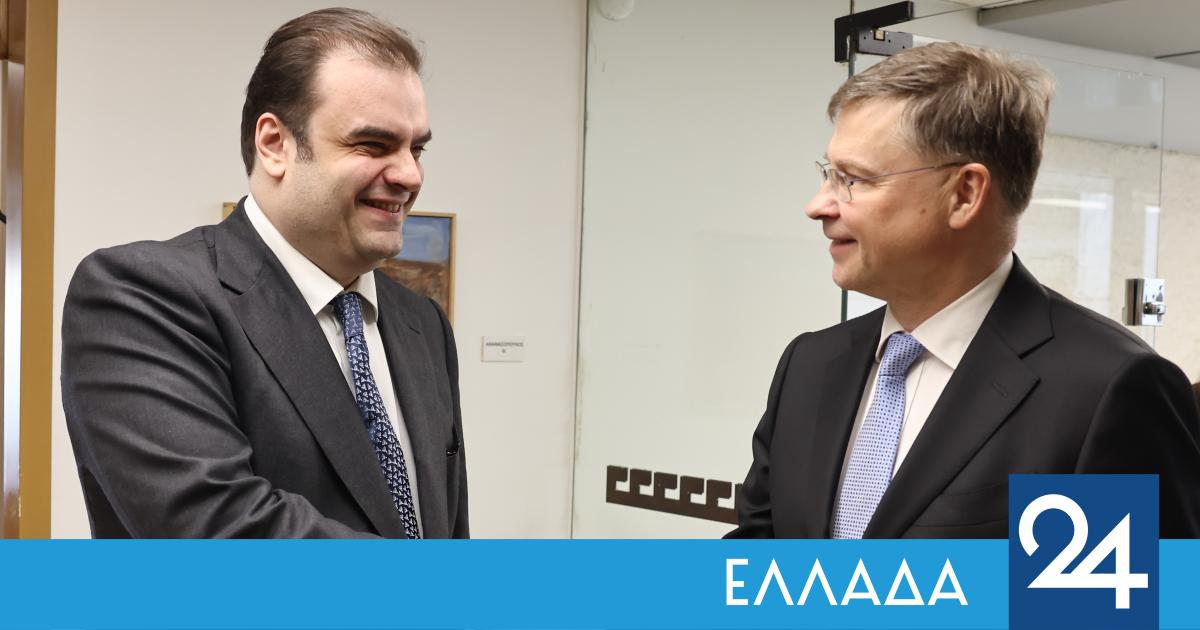
Minister of Economy and Finance Kyriakos Pierrakakis and the political leadership of the ministry met today with EU Commissioner Valdis Dombrovskis, responsible for Productivity, Implementation and Simplification Economy.
The meeting, which discussed the positive performance of the Greek economy and the initiatives to be taken by Europe in the face of the energy crisis, was attended by Deputy Minister of Economy and Finance Nikos Papathanasis and Deputy Ministers Thanos Petralias and George Kotsiras.
Kyriakos Pierrakakis, welcoming the European Commissioner, noted that they work closely together in the framework of the Eurogroup, noting that the presence of Dombrovskis in Athens “coincides with a particularly positive development: Greece today received the 7th disbursement from the Recovery and Resilience Fund, amounting to 1.18 billion euro. 1.18 billion euros. This is another strong signal of confidence in our country” and continued.
We are consistently using European resources for reforms and investments with tangible benefits for citizens. Together with boosting foreign direct investment, they support growth and accelerate the green and digital transition.
In a highly volatile international environment, the Greek economy remains resilient . The final fiscal figures for 2025 are particularly encouraging. They confirm that the Greek economy has outperformed, with better-than-expected results.
This performance is the result of reforms, fiscal balance, structural changes, a systematic fight against tax evasion and strong growth momentum.
In recent years, Greece has been growing at around twice the European average, achieving steady surpluses , recording the largest decline in public debt in Europe, while unemployment is approaching historic lows. This performance creates additional fiscal space, always within European rules.
We have already supported society with €300 million of interventions as a “shield” against the crisis. Yesterday we announced a further €500 million package targeted at those most in need: families, tenants, pensioners, farmers and vulnerable debtors. These are responsible and fully costed interventions. They support income while maintaining fiscal balance.
With the same approach, we discussed with Commissioner Dombrovskis the European response to the energy crisis. The challenge is common. Substantial support for the most vulnerable, while maintaining fiscal prudence.
In this context, I welcome the European Commission’s proposals, which move towards a more coordinated European line. Valdis and I agree that Europe must move beyond crisis management.
We need to substantially strengthen its resilience and competitiveness. This means accelerating carbonisation and reducing energy dependence. But it also means deepening the single market and removing barriers that limit investment and growth.
A central element is building a truly integrated European capital market so that European savings can be channelled more effectively into the real economy. In my role as President of the Eurogroup, I am working to build consensus among Member States to take forward the initiatives on the Savings and Investment Union.
We also discussed the simplification of procedures. We ought to look critically at the regulation of the financial sector.
But modernisation does not mean deregulation. Financial stability remains a top priority, which is why I look forward with particular interest to the Commission’s report on the competitiveness of the banking sector.”
For his part, N. Papathanasis said:
“The meeting that preceded it was extremely productive and demonstrates in practice the excellent cooperation between Greece and the European Commission. Strengthening economic, social and territorial cohesion is a prerequisite for a harmoniously developed, united, competitive and resilient European Union.
The Greek economy has proved and is proving that, in a stable political environment, it has turned a new page. With growth rates above the eurozone average through the strengthening of the business environment, Greece is no longer the country with the highest unemployment in the EU, it is the country with an unemployment rate approaching the country’s historic lows. At the same time, the dividend of growth is returning to society and the economy.
On the occasion of your visit, I would like to reiterate Greece’s will to continue to make the best use of European resources, while we continue our efforts to successfully complete all the milestones and projects of the Recovery Fund within the given deadline of 31 August.
I would also like to reiterate that we do not wish – and for us who have gone through 3 memoranda it is not allowed – to lose a single euro of European resources, which must be directed to the benefit of all our fellow citizens.
We continue to remain among the first in the European Union in the absorption of the resources of the NSRF 2021- 2027 programming period and we managed not to lose a single euro from the NSRF 2014- 2020 programming period.
In the debate that is opening for the 2028- 2034 programming period, I take this opportunity to underline that Greece is not afraid of integrating reforms. On the contrary.
Reforms, at home and in Europe, are in the DNA of the ideology and strategy of Kyriakos Mitsotakis’ governments. We consider them to be a necessary and sufficient condition for shaping the next day of a more powerful, competitive and productive Greece. We consider them an institutional and essential prerequisite for the next day that all European citizens, in our common home, deserve”
.
Valdis Dobrovskis: “Greece is among the strongest performing economies in the EU
In his remarks, the Commission vice-president referred to the progress of the Greek economy and the 7th disbursement of 1.18 billion He highlighted the progress of Greece’s progress in the EU and the 7th instalment of the €1.18 billion Recovery Fund, underlining that Greece is now among the strongest performing economies in the EU, thanks to the implementation of important reforms and investments. In particular, he noted:
“Earlier today, during my meeting with Prime Minister Kyriakos Mitsotakis, I had the pleasure to confirm the disbursement of another tranche of €1.18 billion from the EDF. This reflects the positive progress in the implementation of the Greek Recovery and Resilience Plan. At almost €36 billion, Greece’s plan is the largest in the EU as a percentage of GDP.
It includes measures to help Greece become more sustainable, more resilient and better prepared for the challenges and opportunities ahead. It includes, among other things, wide-ranging reforms in areas such as improving the business environment, public administration and the judicial system, as well as investments in energy efficiency, upgrading electricity interconnections and strengthening digital skills.
As we approach the completion of the TDCA, Greece must remain fully committed to accelerating the implementation of the Programme, with only four months remaining. In our meeting today we discussed how Greece can ensure the timely implementation of all outstanding measures of the Plan. This is crucial to fully exploit the potential of the Fund. The European Commission stands ready to support these efforts at every step.
We also discussed the broader economic outlook. The conflict in the Middle East is casting a heavy shadow over the economy, pushing up energy prices across Europe and globally. This is another test of our resilience and poses a real risk of a stagflationary shock to the European economy.
Our response, beyond short-term measures, must be to keep working hard to create a more competitive and resilient European economy. In this context, we can all learn lessons from Greece’s determined reform efforts over the last decade. These laid the foundations for a sustainable recovery, so that today Greece is among the strongest economies in the EU. As a result, the Greek economy is growing, while public debt and unemployment have declined.
Of course, there is still much to be done. Today we discussed reforms that can help maintain this positive momentum, as well as the EU’s overall competitiveness agenda.
On the fiscal side, I welcomed the fact that Greece continues to maintain a strong fiscal position and that the 2025 results were even better than previously estimated. The fiscal surplus is based on strong revenue growth, supported by measures to fight tax evasion and undeclared work.
In the near future, it will remain important to remain committed to sticking to the agreed expenditure path and to further improving the public finance picture. This will be crucial for maintaining Greece’s strong fiscal performance.
Finally, I would like to highlight our excellent cooperation with Minister Kyriakos Pierrakakis in his capacity as President of the Eurogroup. We are promoting many important initiatives, such as the international role of the euro, the digital euro and the Savings and Investment Union.
I am pleased to see that on these issues – and many others – our priorities are closely aligned. We are moving in the same direction. So thank you for your leadership in the Eurogroup and for your close cooperation beyond that. I look forward to continuing to work closely with you in the years ahead.”