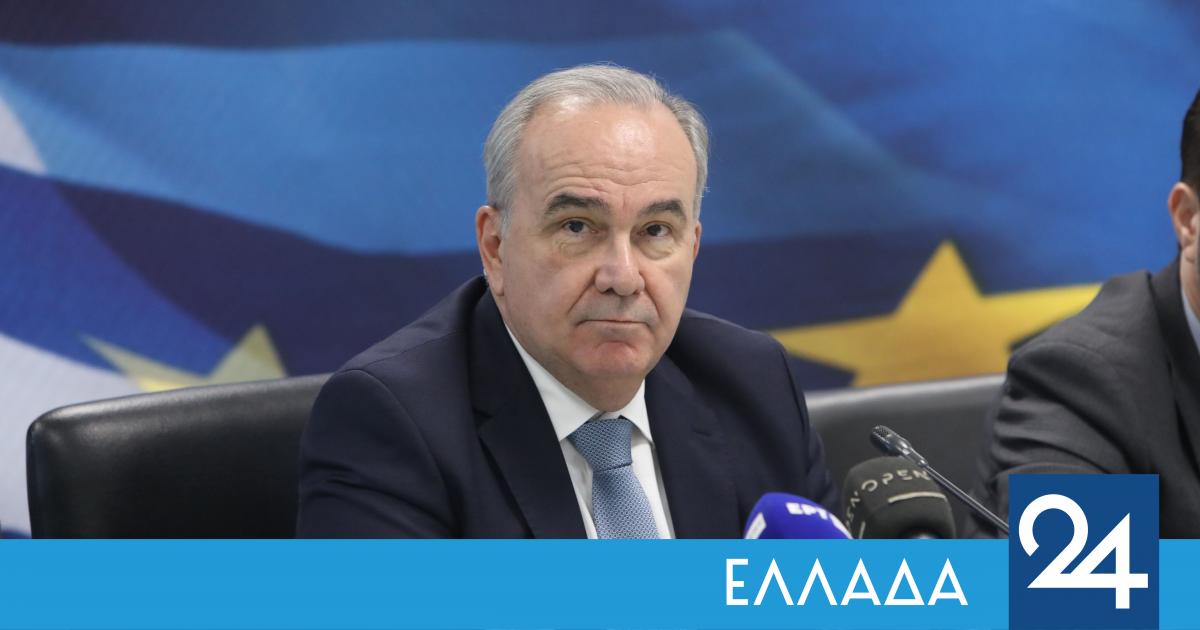
Deputy Minister of National Economy and Finance, Nikos Papathanasis, speaking at an event at Zappeion, entitled “Progress that can be measured – Future that is being built”, highlighted the measurable benefits of the NSRF 2021-2027, underlining the positive impact of the projects on society and the economy, as well as the progress in the implementation of the new programming period.
In his intervention, he pointed out that Greece is no longer a mere observer of developments in the European Union, but an active protagonist that is shaping the future. Greece is ranked fourth in Europe in terms of absorption of funds, and has successfully completed the NSRF 2014-2020 without any loss of resources. At the same time, he noted that the mid-term review of the NSRF 2021-2027 programmes was successfully completed, with €2.13 billion redirected to critical sectors, ensuring an extension of the eligibility of expenditure until 2030 and additional advances of €650 million.
He made special reference to the adoption of an action for affordable and sustainable housing, with a budget of around €500 million, including subsidies for the renovation of closed housing.
As for the individual programmes, the “Competitiveness” programme, with a budget of €3.8 billion (€4.6 billion with over-commitment), aims to boost entrepreneurship and the adoption of cutting-edge technologies, through actions such as “Research – Innovate”, “Produce in Greece”, “TEPIX III” and “Start a Business”.
At the same time, through the “Human Resources and Social Cohesion” programme (€4.2 billion, or €4.5 billion with overcommitment), interventions such as the Multichannel 1555, actions to strengthen entrepreneurship for unemployed people aged 30-59, inclusive education and apprenticeships, as well as regional coordination in Thessaly for the effects of the bad weather Daniel.
In the field of climate policy, the “Environment and Climate Change” programme (€3.6 billion, or €5.7 billion with over-commitment) funds projects such as the “ExoEconomy”, the settlement of the Rafina stream, the regeneration of the Faliriko Bay, the development of recycling plants, as well as actions for sustainable mobility and water management.
At the same time, the “Civil Protection” programme (€713 million) includes, among others, the National Crisis Management System, the supply of a DHC-515 fire-fighting aircraft and digital training platforms.
In the infrastructure sector, the “Transport” programme (€2.2 billion, or €4.1 billion with over-commitment) includes major projects such as Line 4 of the Athens Metro (Veikou Park – Goudi), the development of a zero-emission bus fleet, rail projects and major roads.
Special emphasis is also placed on the areas of just transition, with total resources of more than €2.1 billion directed to investments and projects such as the Hydrogen Hub of EKETA in Ptolemaida, bio-economy actions in Megalopolis and pilot programmes of “smart” cities.
“The NSRF 2021-2027 is not just a project budget, but our contract for a strong, modern and fair Greece. Our obligation is to ensure that not a single euro is lost,” Papathanasis said.
For his part, ERDF, ESF and CF Secretary General, Vassilis Siadimas, stressed that the programmes are in full swing, with most of the resources already committed and a significant proportion channelled to the real economy. He said that the total public funding for the sectoral programmes amounts to €14.5 billion, of which €9.5 billion has already been committed as legal commitments, while expenditure amounts to €3.3 billion.
The Director of the EIDAM, Pelopidas Kalliris, noted that more than 2.2 billion euros have already been secured for investments and infrastructure projects in the fair transition areas, which create new development prospects.
The event was attended, among others, by Minister of Health Adonis Georgiades, Minister of Labour and Social Security Niki Kerameos, Minister of Social Cohesion and Family Domna Michaelidou and Deputy Minister of Energy Nikos Chafos, as well as representatives of the European Commission, ministries and local government bodies, according to APE-MPA.