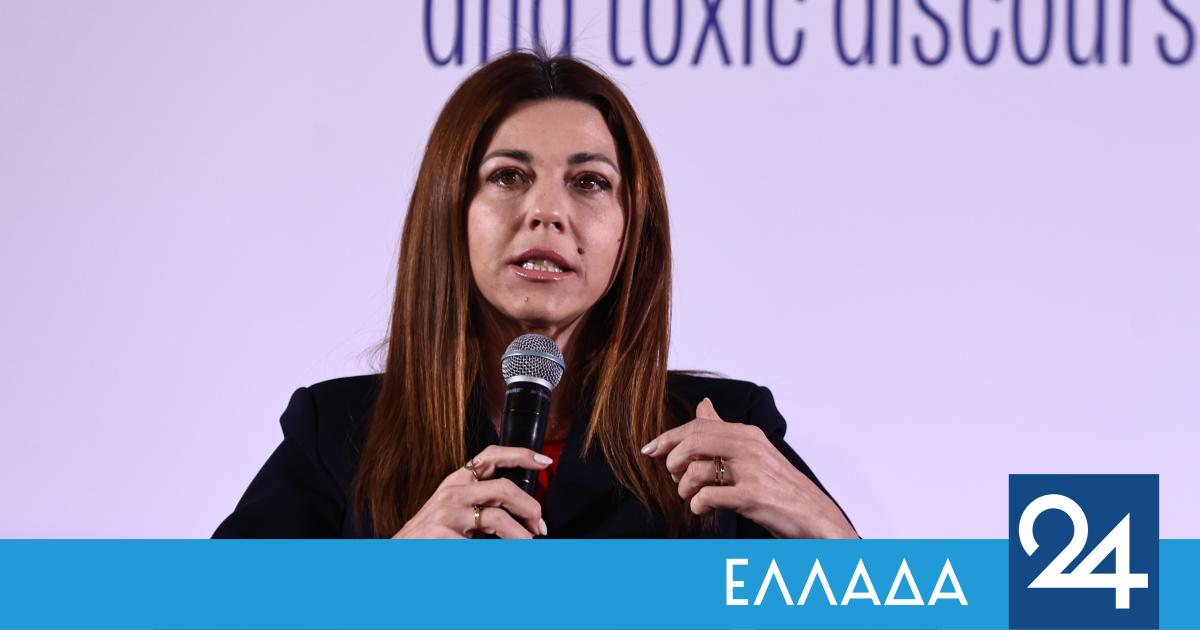
The Minister of Education spoke to the Athenian-Macedonian News Agency about the characteristics that policy interventions in education should have in order to meet modern needs, as well as about the interventions themselves, which the Ministry of Education is undertaking, Religious Affairs and Sports, Sophia Zacharaki, in an interview she gave on the occasion of her presence at the 11th Delphi Economic Forum, which will be held from 22 to 25 April 2026, bringing together personalities from Greece and abroad, where the critical developments of the period will be discussed.
“Education should not follow the times, but shape them. Policies that stand the test of time invest not only in tools, but in principles and values,” she said. Zacharaki and stressed that reform is not in itself the presence of a modern tool, but a school “that teaches the child to think, evaluate and create.”
The Education Minister explained that policy interventions are based on the trifecta of flexibility – schools that cultivate life skills – investing in teachers.
As for the developments brought about by AI, Ms. Zacharaki said they are turning into opportunities “for a school that is more open, modern and fair”. “We are systematically investing in digital transformation, with the goal of equal access for all and lower costs for families,” she said.
Most notably, the Digital Tutoring Center, which, the minister said, is “being transformed into a more comprehensive and interactive learning and support environment for children” and is being developed as an “ongoing support mechanism, not just a preparation tool for Grade 3.”
In the same context, Ms. Zacharaki included the operation of interactive whiteboards, the distribution of robotics kits to schools and specialized tools to support students with disabilities, the creation of 13 Innovation Centres (where collaboration between students, teachers, researchers and the local community will be promoted), the piloting of personalized training for children and teachers on AI, as well as the piloting of a news and information literacy program.
The Education Minister, in response to a question on whether full staffing of schools is the most necessary of interventions, made it clear that “filling the gaps is a structural problem, which cannot be solved with incantations, inexpensive and unattainable promises of thousands upon thousands of recruitments”.
He said nearly one in three permanent teachers currently teaching in schools have been appointed after 2019, while for better and more informed planning, forecasting and immediate response, the ministry is developing the “EduPlan” platform.
“Supporting and better functioning public schools is not just a matter of resources and recruitment, but of organizing on the right data,” Ms. Zacharaki and underlined: “Everything we plan and implement is also part of the logic of tidying up and tidying up things that we see are not working as they should or can be done better.”
The full interview with the Minister of Education, Religious Affairs and Sport follows, Sophia Zacharaki, to RES-MPE and Athena Kastrinaki
ER: You are taking over the leadership of the Department of Education at a time marked by the rapid expansion of productive AI across all sectors. Institutions that are policy makers and implementers, such as ministries, need flexibility to adapt and implement policies in the now. How is the ministry trying to keep up with the speed of developments?
AP: At the Department for Education we do not stand by and watch AI developments. We are turning them into opportunities for a more open, modern and equitable school. We are investing systematically in digital transformation, with the aim of equal access for all and lower costs for families. Digital Tutoring is being transformed into a more integrated and interactive learning and support environment for children with the help of AI. A distinct reform that came and “took root” in education, it already counts around 310,000 users and over 6,400 hours of teaching. At the top of this effort is the “EduAI” project, which enhances personalised learning. Through EduAI, students will receive, in real time, during live lessons, exercises tailored to their level and performance. The system “understands” the course content, identifies potential knowledge gaps in time and supports targeted practice by providing immediate feedback. At the same time, the difficulty of the exercises is dynamically adjusted, allowing students to progress at a pace that meets their actual needs and enhancing self-assessment and meaningful consolidation of knowledge.
A few days ago, we also signed a memorandum of cooperation with Microsoft, for the integration of AI into the Digital Tutorial, with the creation of a free digital assistant for the national examinations in foreign languages (English, French, Italian, Spanish, German).
From the new school year onwards, the “live” lessons are extended to students in the first and second grade, significantly enhancing the role of the Digital Tutorial as an ongoing support mechanism and not only as a preparation tool for the third grade. With this extension, the programme becomes more “alive” and more meaningful for students, covering critical stages of their educational pathway. Last November, Digital Tutoring enhanced the synchronous (live) courses with four (4) additional Vocational Education courses, with more hours of instruction per month, and also, as of November 2025, three (3) new Special Education courses were added to the asynchronous format, providing even more meaningful support for students with special education needs. In addition, 39,000 interactive whiteboards are already in operation in our schools, with another 8,000 to be added in 2026. 117,121 robotics kits have been distributed to more than 11,000 schools, and nearly 17,000 specialized tools support students with disabilities.
With resources from the Recovery Fund, we are gradually creating 13 Innovation Centres, one in each region of the country. There, students, teachers, researchers and the local community will be able to work together to turn knowledge into innovation and tangible results. It is the choice of the Government and the Ministry of Education to give every child equal access to new technologies, innovation and experiences that cultivate essential life skills. In collaboration with and sponsored by the Onassis Foundation, we have piloted a personalized training for children and teachers on the use and potential of OpenAI in 20 high schools across the country.
At the same time, we want children to acquire, within the school environment, the skills to “survive” in the world of over-information, misinformation and deepfakes. We are implementing – in cooperation with my colleague Minister Pavlos Marinakis and the Aristotle University of Thessaloniki – for the first time a pilot, systematic and scientifically documented model of news and information literacy. AI is a tool and like all tools the important thing is to use it to reduce the risks and derive the benefits. We certainly want it in the school of tomorrow that we are building.
ER: I’d like to dwell on this a little bit. Interactive whiteboards, for example, may have been a demand in the pre-AI era, and new curricula and textbooks when they arrive in schools may have already been a need for modernization. What, in your opinion, should be the characteristics of the interventions to make them timeless?
AP: Education should not follow the times, but shape them. Policies that stand the test of time invest not only in tools, but in principles and values. An interactive whiteboard is not reform in itself; reform is a school that teaches a child to think, evaluate and create.
Our interventions are based on three pillars: First, flexibility, with curricula that can be adapted to the needs of the times, and substantial support for remedial teaching in our schools so that no child is left behind. Secondly, a school that cultivates life skills and is not limited to the transmission of knowledge, but teaches children how to think, cooperate and use technology properly. And third, investing in our teachers. With up-to-date training tools and continuous skills cultivation, because no technology can replace an inspired and meaningfully supported teacher.
Our goal is not just to equip schools with the facilities of “today”, but to prepare them for the demands of “tomorrow”. And that requires policies with duration and continuity, not an expiration date.
ER: One could argue that more necessary than all of the above is the proper and full staffing of schools. How would you respond to that?
AP: I will answer you with complete honesty. In education there are no issues less necessary than others. Every choice, every policy intervention counts the same, because schools are a set of things in terms of operation, safety, infrastructure, human resources, innovation.
Let’s be clear: filling the gaps is a structural problem that cannot be solved with incantations, inexpensive and unattainable promises of thousands upon thousands of hires.
This year’s nominees were 10.000 teachers were appointed this year, last year also 10,000. Nearly one in three permanent teachers currently teaching in our schools were appointed after 2019. We are talking about more than 48,000. The numbers alone show how much insecurity we have left behind in recent years. For the teachers themselves, their children and their families. Thousands, of course, are the substitutes who support the needs and operation of our schools in every corner every year.
The need for better and more informed planning, forecasting and immediate response will be met with “EduPlan”: a digital and innovative platform that leverages AI to capture and predict gaps and fill them. I insist, and we have worked a lot on this, that supporting and better running public schools is not just a matter of resources and recruitment, but of organising on the right data. At the same time, this year, we are completing early service and school changes, enrollment and overall the necessary preparation for the start of the next school year.
Let me say more broadly that everything we plan and implement is also part of the logic of tidying up and tidying up things that we see are not working as they should or could be done better. I believe that good public education is predominantly where the fight against inequality begins.
ER: Which of the Ministry of Education’s interventions do you consider most important for improving the quality and modernization of public education?
AP: In public education there are no first- and second-tier interventions. Each action contributes to the overall development of the school. Today, we have significantly reduced inequalities in practice, creating equal opportunities for every child, whether they live in a mountainous school in Evritania or in the densely populated neighbourhoods of Athens. We invest in people: modern infrastructure, teacher training and evaluation, digital tools. With new programmes we intervene early to address learning gaps, while the Public Onassis Schools and the network of Model and Experimental Schools disseminate good practices. The central political and personal goal is a public education “catalyst for opportunity” and we are integrating the national dialogue on the new high school and the National Baccalaureate into this goal.