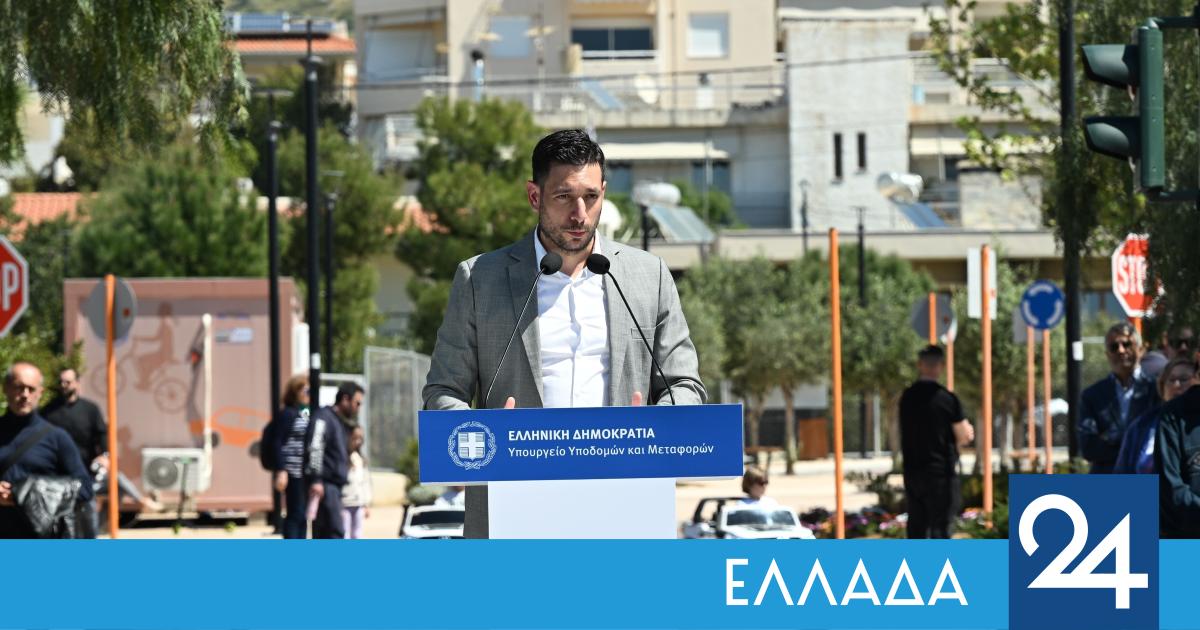
The event “Greece creates a road safety culture” was held at the Traffic Education Park of the Municipality of Glyfada with strong symbolism and clear political weight, in the presence of Prime Minister Kyriakos Mitsotakis and the leadership of the relevant ministries, confirming that the issue has become a top public policy priority.
The event was opened by the Mayor of Glyfada, Giorgos Papanikolaou, while the Minister of Civil Protection Michael Chrysochoidis, the Minister of Digital Governance and Artificial Intelligence Dimitris Papastergiou and the Minister of Education, Religious Affairs and Sports Sofia Zacharaki addressed the event.
Subsequently, Deputy Transport Minister Konstantinos Kyranakis presented the detailed data, before a discussion with the Prime Minister and front-line people – from ambulance rescuers and traffic police officers to paralympian Yannis Kostakis, who shared his experience.
The picture that emerged was clear: road safety has moved from the realm of declarations and proclamations to that of systematic policy with tangible results.
The data showing the turn
The data presented captures a variation with duration characteristics. In 2025, traffic fatalities totaled 517, compared with 665 in 2024, recording a decline of about 22% – the largest annual drop on record in the country and the lowest level since the 1960s.
The importance of the result is even more pronounced in the European context: Greece is among the most improved countries, far outperforming the European Union average. At the same time, around 4 out of 100 traffic fatalities remain, which underlines that progress is substantial but the challenge remains complex.
The qualitative characteristics of accidents are particularly important: two-wheelers continue to be disproportionately involved in fatalities, while night-time and non-urban journeys are more dangerous.
From the interpolations to the result
The presentation focused on the strategy that led to this development. As highlighted by Deputy Minister of Transport Konstantinos Kyranakis, the change was not the product of a single intervention, but the result of a coherent plan implemented with continuity and perseverance.
The passing of the new Road Traffic Code was a key pillar, as it introduced a stricter framework and for the first time the concept of repeat offences for critical offences. At the same time, the strengthening of policing and the systematisation of testing – with around 1.8 million breathalyser tests in 2025 – have created an environment where the rules are not just theoretical but are applied in practice.
The contribution of technology has also been crucial. The activation of cameras on the roads and the digital management of offences have reduced the sense of impunity that has characterised the road system for years. Targeted information campaigns, as well as measures such as the 24-hour operation of public transport on Saturdays, which intervene precisely at times of heightened risk, are part of the same framework.
Infrastructure strengthening has been complementary. Over 2,000 kilometres of new or upgraded roads, extensive maintenance interventions and ongoing projects across the country make for a safer road environment.
Over all, the picture that emerges is one of a policy that for the first time works as a system – not as a sum of fragmented actions. In this transition, the systematic approach taken by the ministry responsible is proving to be a decisive factor.
ODYSEAS: Technology in the service of prevention
A key element in this new approach is the “ODYSSEAS” (Road Service of Surveillance and Safety Systems) system, a fully digital traffic control system that aims to radically change the way rules are enforced.
The system leverages artificial intelligence technologies and interfaces with the digital state, allowing for automated recording and dispatching of violations. At the same time, it creates a dynamic data analysis tool that enables targeted interventions at high-risk locations.
This transition from fragmented recording to active information management is seen as critical for the next phase of road safety, where prevention will increasingly be based on data.
The change that passes in society
Perhaps the most essential element is that the change is beginning to be reflected in everyday behavior. According to the data, about 45% of people say they have changed the way they entertain themselves.
Less drinking before driving, greater use of public transport or taxis, choosing a “sober driver” and avoiding travelling at high risk times all add up to a picture of a gradual change in attitude.
This change did not occur by accident. As it has emerged, it is the result of a policy that combines control, prevention and alternatives. In this environment, compliance is gradually becoming a habit.
The bet on continuity
Despite significant progress, challenges remain. The summer months, with increased travel, higher speeds and greater alcohol consumption, continue to see a disproportionate increase in risk.
The progress to date, however, suggests that the direction is clear. Greece seems to be leaving behind a long period of stagnation and entering a phase of systematic improvement.
The question now is not whether the measures are working, but whether they will be maintained at the same intensity. Because real change on the streets is no longer judged not by proclamations, but by duration on the ground – where, every day, lives are saved.
Deputy Transport Minister Konstantinos Kyranakis noted that “such a large reduction of 22% has never been achieved before in the history of the country and this year it was the second best in Europe”, but he stressed that “we are satisfied but we cannot celebrate, we must continue even more resolutely in the same direction, in order to reduce as much as possible the blood on the asphalt” and noted:
“This is a collective effort by the State that is paying off. We emphasized prevention. The implementation of 24-hour public transport in Athens on Saturdays has provided a safe and reliable alternative to travel, especially for young people. A big “thank you” is due to the public transport workers who made this measure a reality and contributed in practice to the reduction of traffic accidents. The reduction in road fatalities is not a statistical achievement. It is human lives saved. And that’s the only indicator that we’re interested in continuing to improve.”