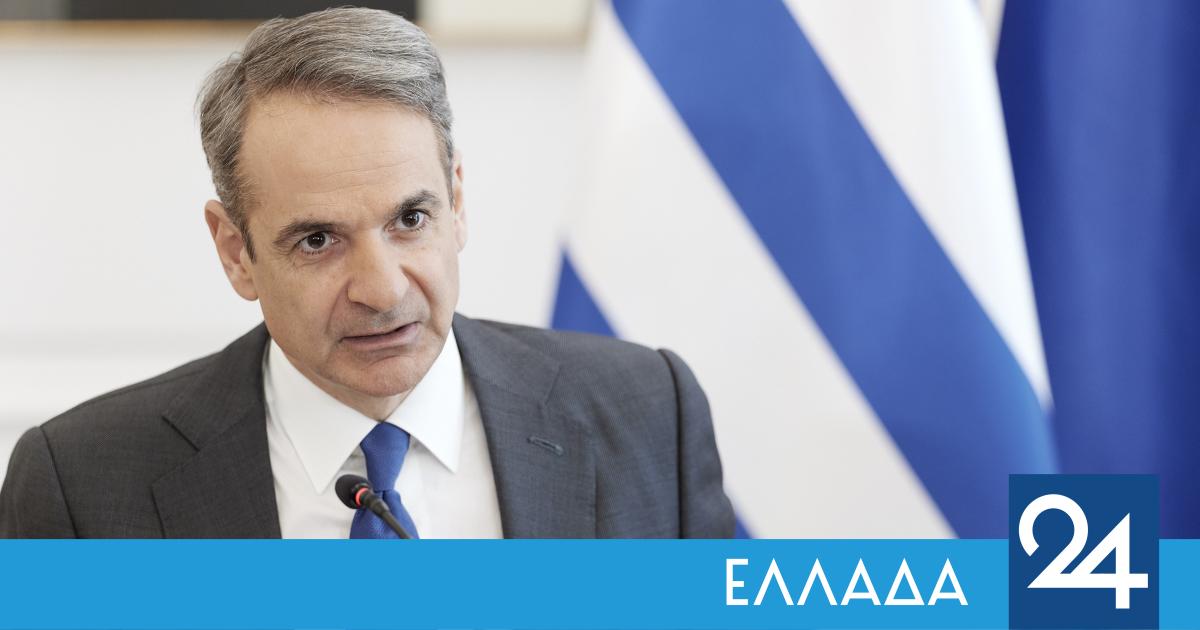
In his usual Sunday review, Prime Minister Kyriakos Mitsotakis refers to the latest developments in the OPEKEPE case, noting that in this case, unfortunately, the country’s long-standing and inter-party pathologies met with “our own failures”.
As he points out, these are a thing of the past with the absorption of “this sick organization by the ADSE” and notes that the lessons from this negative experience remain and are a starting point for a more dynamic confrontation between the State and the “deep state”.
The Prime Minister’s entire post:
“After seven years of governance, it would be easiest to talk only about conquests. But true responsibility is judged in the moments when we confront the country’s long-standing and bipartisan pathologies, as well as our own failures. Two elements that have unfortunately come together in the case of OPECPEPE. I am speaking, in fact, in the past tense, as everything that is currently in the news has already been overcome following the absorption of this sick organisation by the AADE. Today, for example, compensation is determined digitally without human intervention. While the relevant measurements are no longer made by agents susceptible to pressure. But by satellites that monitor crops and by modern instruments that measure livestock.
The lessons, however, from this negative experience remain. Not only for more effective and fairer support for our farmers. But also as a new starting point for a more dynamic confrontation between the State and the Deep State. But I will take a much more detailed position on this tomorrow.
I’m putting a full stop on this issue and moving on to the rest of the week. I’m well aware that the great anxiety of every home, especially now before Easter, is punctuality, with the impact of the international crisis in the Middle East putting even more pressure on. Already from Wednesday diesel is being subsidised by 20 cents a litre, and from tomorrow the fuel pass on petrol opens. We want the support to get to you quickly, so the money will be credited just 48 hours after application. At the same time, checks on obscenity in fuel and supermarkets are being stepped up, with the new Independent Authority already checking over 100 major food companies for their profit margins to keep prices reasonable, and we are also supporting production with a retrospective subsidy on farmers’ fertiliser.
Now, as we are one week away from Easter, as far as the Holy Light is concerned: the war in the region makes transporting it a much more complex affair this year. But the State will make sure it comes safely from Jerusalem, knowing how important this is for the faithful.
Two things happened on April Fool’s Day that were not a lie: first, the new minimum wage came into force at 920 euros, increased by 4.55% with 1.5 million workers benefiting. Secondly, the digital job card was extended to 8 other sectors, from private healthcare and telecommunications to hairdressing and cleaning services, employing 200,000 workers. The implementation is being piloted for three months to allow small businesses to adapt smoothly, and will become mandatory from the autumn. Data shows that the card is working: 2.7 million more overtime hours were declared and paid in 2025 than in 2024. Our aim is that by 2026 the digital card will cover the entire private and public sector, putting a definitive end to undeclared work.
Yesterday in Parliament, 14 important interventions were passed that help address the problems of public administration in terms of citizen service. For example, long-standing property disputes are now coming to an end, as the State is withdrawing from claims against citizens. Most importantly, the State is no longer exercising legal remedies in cases of great social importance, such as Mandra, Mati and Tempi. It is a self-evident gesture of respect for society. Another intervention provides for simplification in real estate transfers and the lifting of seizures by the AADE, while we are giving everyone a new digital tool: you will be able to track online exactly where your case is in the public sector and who the official handling it is, while all circulars will be compulsorily posted online, otherwise they will not be valid.
Another thing that was passed in Parliament last week is the establishment of the Higher School of Performing Arts. I am even glad that this reform was supported by the opposition, by PASOK and Plevisi Eleftherias. With the first public university for theatre, dance and music, a decades-old pending issue is closed. Now, arts studies are gaining a clear graduation and professional perspective, with the aim of the first students entering the school in the 2027-2028 academic year.
A useful reminder for the younger people reading me here: the vouchers.gov.gr platform has opened. Young people who have turned 18 or 19 by the end of 2025 can apply for the Youth Pass of €150. This is a sum reserved exclusively for purchases in culture, tourism and transport and we are pleased to see that every year more and more young people are taking advantage of it.
I come to public health and first to Personal Paediatrician, a free service that covers all children up to the age of 16, insured and uninsured. Although the institution is in force from the summer of 2025, the truth is that not as many families as could use it yet, despite the fact that the available paediatricians in the NHS and those contracted to the NHS can cover over 880,000 children. This is why the Department of Health has sent informative text messages to those parents who have intangible prescriptions, reminding them that they have this option. And the response was immediate, with 24,000 new enrollments in one month. I should say that registration is very easy, either at prosopikos.gov.gr or through the pediatrician himself, and ensures free visits and vaccinations. I urge families to take advantage of this opportunity.
Another of our public hospitals, Konstantopoulion “Agia Olga”, now has fully renovated Emergency Departments with modern infrastructure and medical equipment. This is a complete renovation of infrastructure and equipment through the Recovery Fund, in a hospital that serves over 500 patients on a 24-hour on-call basis. We are aware of the pressure on the NHS and that is why the proper use of European funds must result in such tangible projects. It is another step in the drive for a health system that is more functional and more reliable in practice.
I am continuing with urban transport and the Clean Line project for the Electric. With ridership steadily increasing, reaching 70 million boardings last year, the need to upgrade trains on Line 1 is a priority. Cleaning and installation of anti-graffiti membranes has already begun, with -5 of the 30 HSP cars already ready, but the essence lies in the reconstruction of 14 trains that will begin to enter service in stages in 2026. Our aim is to bring the journey time to 5.2 minutes, and the reintroduction, after necessary maintenance, of decommissioned wagons is also underway.
Something else concerning travel safety. A large number of violations -1,213 to be precise – were recorded within a few days by the 8 AI cameras operating on a pilot basis at high-risk points in Attica, while another 19 violations were recorded within a two-day period by the cameras installed on 10 OSI buses for the control of bus lanes. The 130 administrative fines imposed were sent electronically to the Citizen’s Box at https://www.gov.gr/ and Gov.grWallet. As I have said before, fines are not an end in themselves. Our goal is to comply with the rules and, above all, to prevent traffic accidents and ensure the safety of every human life.
This week also saw the launch of five more Greek microsatellites from the National Microsatellite Program, which will “test” new space technologies developed in Greece with the aim of strengthening the domestic industry. They are part of an array of 11 experimental cubesatellites and the data they will collect are very important for critical areas such as communications, mapping, navigation, precision agriculture, spatial planning and disaster response.
I conclude with important news for Greek sport. The commitment of €5.25 million has been signed for the institutionalised reward for athletes and their coaches who placed in the top three places in 2024 at the Olympic and Paralympic Games, as well as for Olympic champions who placed 4th, 5th and 6th from 2012 to date. Compared to the past, the time from success to rewarding our athletes has been reduced to a minimum. This, after all, is what they deserve.
The next review will be after the Easter days have passed, always with government actions that improve the daily lives of citizens. I wish you a happy Sunday and a Happy Easter, but I will see you later in the week!”