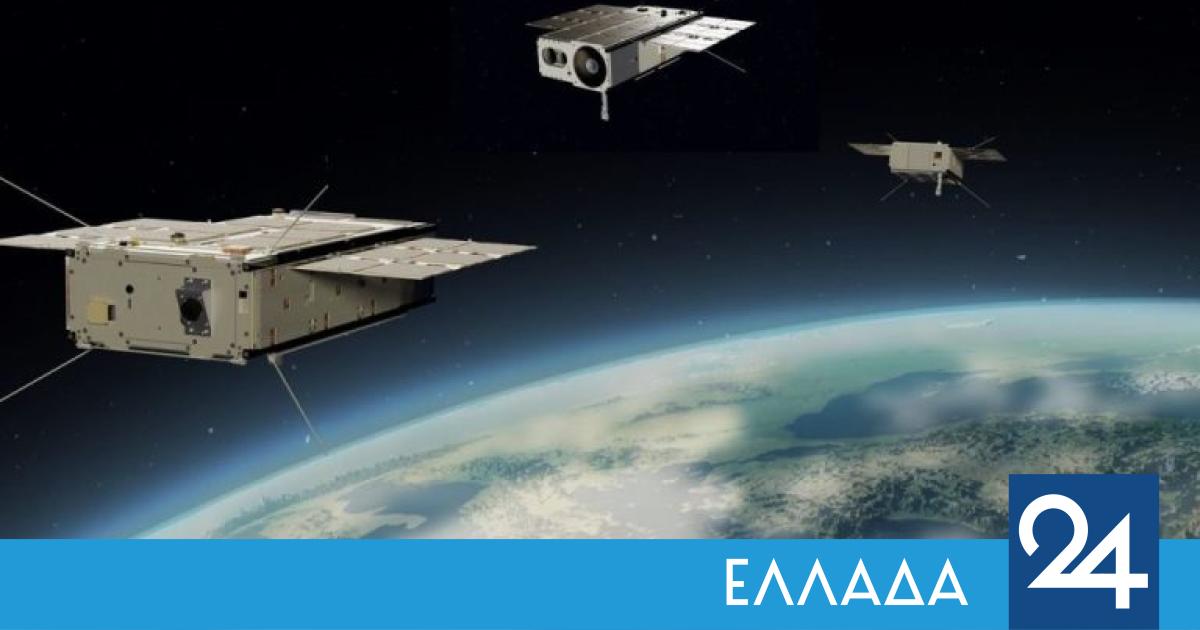
The 3 ERMIS “Made in Greece” nanosatellites, built at the Department of Aerospace of the University of Athens, are ready for launch into space, in a 500 km orbit. The 3 ERMIS 1, 2 and 3 nanosatellites will be launched on 30 March,13:20 by SpaceX with the Falcon-9 rocket.
The launch will be streamed live at here
The ERMIS – [ERMIS Hellenic Cubesat Demonstration Mission] project aims to certify new, innovative space technologies and applications, such as 5G communications for the Internet of Things (IoT), laser satellite telecommunications and hyperspectral camera Earth observation.
The ERMES project is the first part of the National Microsatellite Programme with a budget of €200 million and is funded by the European Recovery Fund (RRF – EU Next Generation EU). The project with a budget of approximately 4.9 million is coordinated by the newly established Department of Aerospace Science & Technology of the National and Kapodistrian University of Athens (www.aerospace.uoa.gr) and the project involves OQ Hellas, the University of Patras, the University of the Aegean and the National Observatory of Athens. The ERMIS space mission is overseen by the European Space Agency with the support of the Ministry of Digital Governance.
Summary of the ERMIS space mission: In the framework of the ERMIS project, three technologically advanced nanosatellites (CubeSats) were built in Greece, with a focus on 5G/IoT telecommunications, inter-satellite link and hyperspectral remote sensing, and new technologies developed in Greece will be certified for the first time, such as: IoT/5G communications, inter-satellite links, in-orbit image data processing using hardware accelerators for hyperspectral image compression algorithms and optical channel coding according to CCSDS space standards, automatic control algorithms for observation and control of the exact position of the satellite, optical laser communications and linking the satellite to the optical ground station on Helmos, as well as hyperspectral remote sensing with a precision of 5 m for space applications of national interest, such as smart agriculture.