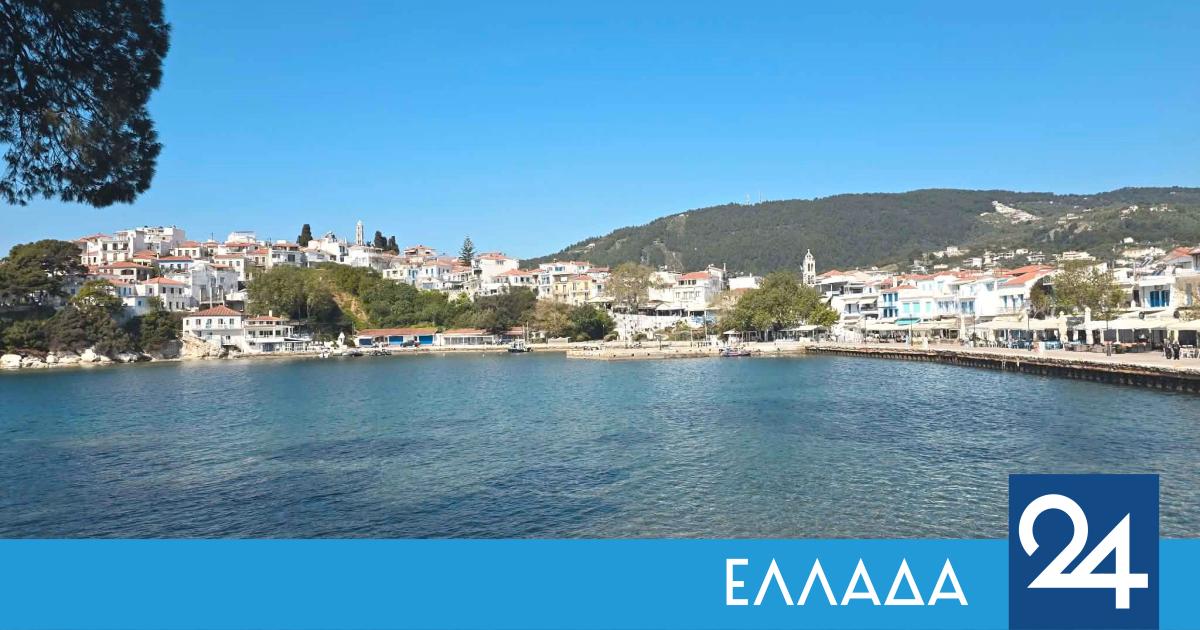
With a view to a more resilient and modern tourism orientation, Skiathos is investing in a development model that prioritizes society and sustainability. The main pillars of this strategy are accessibility, extending the tourist season, participating in European programmes and strengthening the resilience of the destination through targeted policies and tools.
In this context, the choice of Skiathos to host Sustainable Travel AGORA, an initiative of the UK and Ireland EOT in collaboration with the Municipality, was not a coincidence. From 18 to 21 April 2026, the island was at the centre of an international dialogue on the future of tourism, with the participation of around 20 experts from the UK, representatives of organisations such as the World Travel & Tourism Council, The Travel Foundation and ABTA – The Travel Association, as well as major tour operators such as EasyJet Holidays, Intrepid Travel and Exodus Travels.
An island that invests substantially
As the mayor of Skiathos, Thodoris Tzoumas, explained to the Athens-Macedonian News Agency, the strategy of Skiathos is reflected in specific actions. These include the enhancement of accessibility, both for people with visible and “invisible” disabilities, the extension of the tourist season through the promotion of gastronomy, walking routes and culture, and major cultural restoration projects, such as the restoration of the Castle and the monasteries, with a budget of 4 million euros. In the same framework is also the participation in European projects such as the “Loop Zone” for the reduction of plastic, where Skiathos acts as a pilot destination and the drafting of a civil protection guide for visitors, in cooperation with the University of Athens.
“Sustainability is not a label, it is a continuous commitment,” said the mayor of Skiathos, stressing that the aim is for development to be done with respect to society, creating jobs and highlighting local culture, without overexploiting resources.
What AGORA is and why it matters
The EOT’s “AGORA” initiative, launched in 2023 with its first event in Crete, operates as a “community” for the exchange of knowledge and experiences. It is not a formal conference, but an open dialogue between different stakeholders: tourism organisations, tour operators, media and communication companies.
As noted by the head of the UK and Ireland EOT Eleni Skarveli, “this is an action that brings together meaningful representatives, with the aim of creating a community. Through this dialogue, we see how we can take sustainability issues forward, not as theory but as experience.”
She noted that interest is now turning to regenerative tourism: “We are not just talking about sustainability. We are talking about experiences that bring visitors closer to the place and return value to the local community, socially and economically.”
Skiathos was chosen, he noted, because “it is a destination that wants to grow, but wants to do it right. The initiatives of the municipality, the partnerships with international organisations and the active participation of the local community create a model that can serve as an example for other destinations.”
The importance of local community
One of AGORA’s key conclusions is that no strategy can succeed without resident participation.
“For this model to work, you have to have the local community with you,” said Ms.Skarveli adding that new partnerships are also created through the organization.
At the same time, the exchange of expertise from countries such as Chile, Colombia and Costa Rica, as well as European destinations such as Switzerland, has shown that despite differences in models, problems are often common, from mass tourism to seasonality.
“First People”
For her part, Carol Rose, Head of Sustainability ABTA-The Travel Association explained, speaking to APE-MPA, that “sustainability is about people first. It is about connecting with nature, because we are part of it. It is not a linear thing. It’s about society, the planet, the whole ecosystem.”
She said that tourism is a critical sector, as “80% of its goods and services depend on nature”, noting that the challenge is not perfection but continuous progress. “You never reach a point where you can say ‘I have become sustainable’. It’s a constant process of evolution,” he said.
“We are an organization that acts as a guiding force in sustainability. Among other things, we help our members – travel agencies and tour operators etc. – to meet their obligations and objectives. We monitor developments, legislation and new frameworks, bring them to light so that they can make use of them and, in addition, issue guidelines for sustainability initiatives.
Referring to Skiathos, he noted: “What I liked even more is the intergenerational activities. We came across three or four cases where the parents have the business and the children carry on. This is very common in Greece, but not in the UK. And that in itself is sustainable, because history is never lost. I loved that when I saw it,” and said that the thing that keeps it going on the island is that “it puts people first and then everything else falls into place.”
A model for the future
The organization of AGORA in Skiathos is not limited to discussions. Its work is expected to result in a practical guide with guidelines and best practices, which can be used by both Greek destinations and tourism professionals.
At a time when the UK market is becoming increasingly sensitive to environmental and social impact issues, Skiathos is attempting to position itself as a destination that not only follows trends, but actively participates in shaping them.
And, as was evident from the dialogue that developed, the stakes went a step further: how development works multiplicatively and in all directions, returning value to the place and its people.