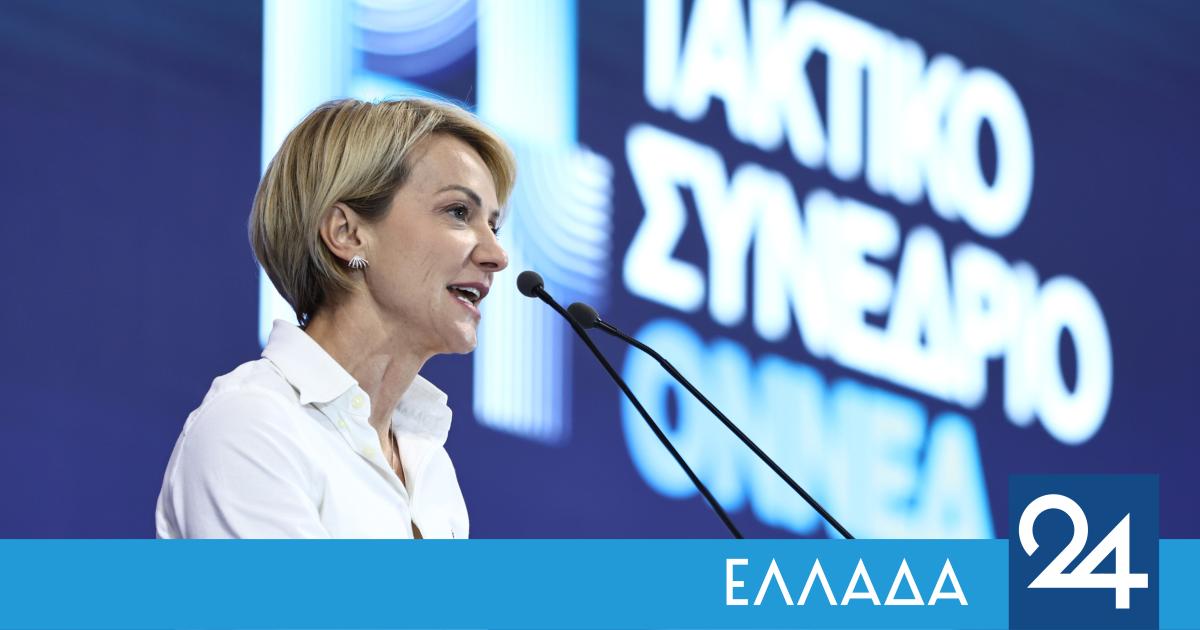
“We need a European reaction and a European response,” said ND spokeswoman Alexandra Sdoukou.
Sdoucou stressed that the crisis cannot be tackled only at the national level, noting that “a European reaction and a European response is now needed to all that is happening, because Europe’s competitiveness is being affected and geopolitical instability, combined with the price increases that we will see immediately, must be an absolute priority at the European level.”
As he noted, Greece will move on the basis of its potential as “we will exhaust every margin that exists in the country based on the fiscal data, but we have to be honest. Our country, because it has also gone through a decade of crisis, knows very well that the fiscal balance must not be disturbed as well.”
Sduku: There are fiscal rules and we cannot ignore them
He stressed that “there are fiscal rules and we cannot ignore them and put them on ice on our own,” noting that “there is always a need for a European understanding” and that “the flexibility that the European Union must give us is crucial and is already being put forward at the level of leaders by the Prime Minister.”
Referring to the measures, the spokeswoman clarified that the government has already made interventions, but the process remains open.
As she said, “we have taken some initial measures to curb the phenomena that are occurring, but it is certain that by seeing how the situation evolves we will assess what needs to be done. Everything is on the table.”
Sduku: The measures taken are not static, they are dynamic, and we are adapting them
She stressed that “the measures taken are not static, they are dynamic, and we are adapting them to the circumstances,” adding that “in any case, what is certain is that we will not leave citizens unprotected. This is the government’s priority.”
Sdoucou accused the opposition of “inexpensive criticism as it does not have the responsibility of governance and is comfortable asking for measures that it has not costed, so it does not know their fiscal impact or their effectiveness,” she said. He stressed that “what is proposed each time must be very specific and well thought out.”
As he noted, “the country has a high debt and this means that we have to be very, very careful, because every tax cut we make has to be accompanied by countermeasures.”
He stressed that past practices “led us to a fiscal path that we do not want to relive,” noting the need for accountability.
Sdoucou stressed that “the government of New Democracy has reduced 83 taxes and has proven that it knows how to reduce taxes and increase citizens’ incomes.” He said that “it is a liberal party that aims to reduce taxes and increase incomes”, clarifying that this is as a result of a well-planned and consistent policy and not as a product of circumstance.
He then referred at length to the issue of the market, noting that “preventing obscenity has been and remains our priority and the Ministry of Development is preventing it with constant controls, fines and institutional tools.”
He recalled that this was exactly the role played by the cap, as “we moved immediately and prevented the increases due to the war from being added to the increases by some who would like to speculate. Be well aware of those who may be thinking about this, that they will find the control mechanism against them,” while noting that “controls are being carried out throughout the chain and intensively.”
At the same time, he acknowledged that “there are structural issues in the market that cannot be solved immediately, but require a comprehensive approach.”
Referring to the recent past, she noted that “in the previous energy crisis we were among the first countries to react before the European Union as a whole even moved and we took measures by subsidising electricity bills with more than 10 billion euros”.
As he said, “the measures we could take then we took them and we will take them now,” noting that there is “know-how and a toolbox. But more importantly, there is experience and the continuous analyses that are done allow us to intervene at the right time but also to maintain the ability to reinforce in the longer term, in the desperate case that the war continues for a long period of time.”
The ND spokeswoman stressed the importance of energy policy, highlighting the country’s strategic choice to strengthen Renewable Energy Sources.
As she noted, “when you have more than double the share of renewable energy sources in the country’s energy mix compared to a few years ago, you make the country much more resilient to changes in international prices. This is exactly why the price of energy remains low, the fifth lowest in Europe.”
Sdoucou stressed that “the only way is to use the sun and wind that our country has and from the 55% of energy through renewables that we are today to reach the target of 80% by 2030.”
He concluded by reiterating that “the government’s priority is to support consumers and society”, noting that managing the crisis requires “European cooperation, fiscal responsibility and continuous adjustment of measures”.