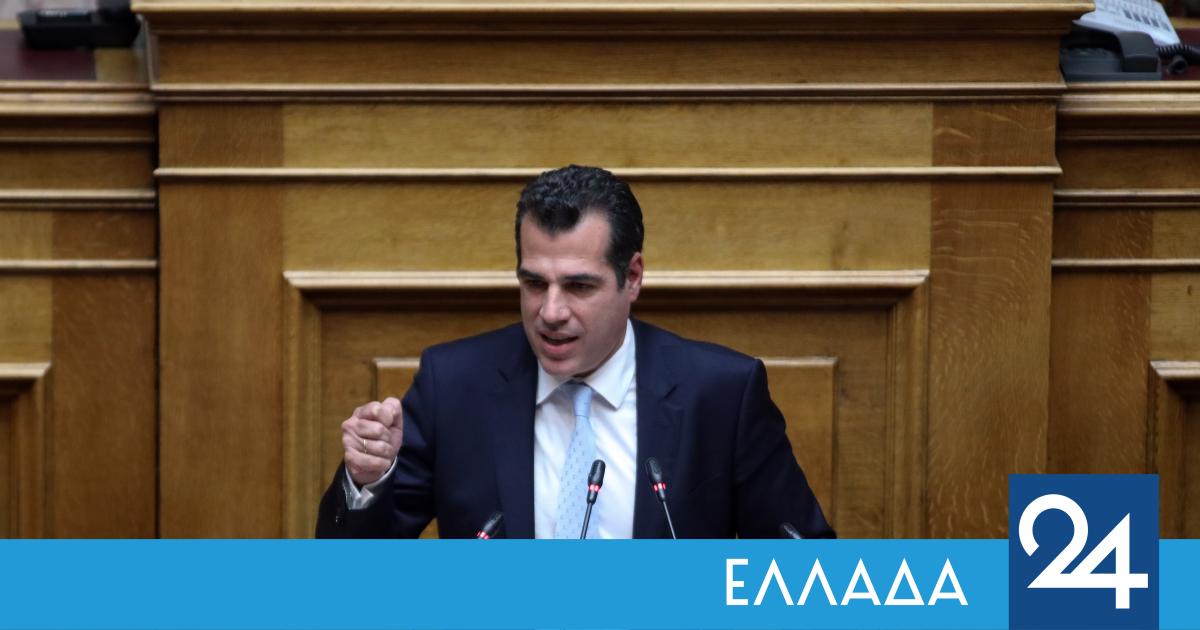
So far there seems to be no difference in migration flows to Greece due to the war in the Middle East, but if the crisis is prolonged and force majeure conditions arise, then the government will take tougher measures than those of last summer, said the Minister of Immigration and Asylum, Thanos Plevris, during his speech at the 1st Blue Heritage Summit Thessaloniki, organized by the organization BeyondCSR, under the auspices and with the support of the Ministry of Interior (Macedonia and Thrace Sector).
“It is obvious that if we find ourselves in such situations of instrumentalisation there is always the factor of force majeure, which we experienced last summer when we suspended asylum – obviously suspension of asylum under international law is not the norm – but it is also not the norm for a Minister, a Prime Minister to see that in three days there are three.000 – 3,500 people and thousands waiting on the shores and saying that I will monitor the phenomenon,” Plevris said.
“So, if we find ourselves in these situations, it is certain that the measures we will take will be tougher than those of last summer. We hope that we do not find ourselves in this situation and we always have our attention on the war as it is taking shape, because it is absolutely clear that if it is prolonged we will also experience new flows like the flows we experienced several years ago, because you will also have a situation that is consolidated.”
He stressed that there has been a large decrease in flows from Turkey. “On the part that has to do with the country’s border with Turkey at the moment we are probably at the lowest flows,” he said, explaining that “to talk about flows from Turkey being at 20,000 a year is really very low flows,” because as he said in 2024 flows from Turkey to the Greek islands were 48,000 and in 2025 it closed at 21,000 flows.
“So, we believe that the islands at the moment are shielded both in terms of deterrence, within the framework of international law, which is always done by the Coast Guard, in terms of border security, but also in terms of management with the structures that exist over there and are fully organized with plenty of positions,” Mr. Plevris.
.
He stated that the main problem is the flow from Libya and said the following: “Our main problem at the moment is a new flow that has been created in the last two years and it’s actually Libya, where it’s basically people from Sudan who are displaced in Egypt (1,500,000 people), Chad (1,000,0000) and Libya (500,000) and the total number is 3,000,000.”
.
He called the migrant pool in Libya “alarming” because, he said, this pool is also combined with flows that do not justify asylum, such as Bangladesh and Egypt.
He said the government’s policy in recent years had been successful and migrant flows had fallen from 62,000 in 2024 to 48,000 in 2025.
“It is a very big mistake to talk about solving the demographic with migrants”
He responded to criticisms of the government’s immigration policy, noting: “There is criticism that this policy is not humanitarian. You know and humanitarianism always has a realism to it. The logic that we open the borders, we wait for you, we greet you and you pass through, basically means the end of Europe. Personally, I think it is a very big mistake to talk about the fact that when we have low demographic indicators this will be solved by immigrants. No, the demographic problem is not a numerical problem. It cannot be a political choice of a country that it will replace population in order to solve the demographic problem. And this has been shown by countries that have tried to do so. The model has failed in Europe. The model that Europe should follow is what the European People’s Party has been saying from the beginning. Asylum to those who are entitled, closed borders to those who are not entitled to asylum and returns, either voluntary or forced deportations, and at the same time, rational, documented entry routes through the legal route so that a balance can work.”
Γ. Koumoutsakos: I am extremely satisfied with what I have heard about the government’s immigration policy
Immediately after the conclusion of Mr. Plevris’ speech, the former Deputy Minister of Immigration and Asylum, George Koumoutsakos, who was present, asked to speak, off program, and observed: “I have heard the government’s policy on immigration in full and I am extremely satisfied, I a moderate, who said strict but fair policy.”
He stressed that the issues raised by the Greek government in Europe during his time (2019-2021), testifying to the anxiety, concern, fears and threats, have matured five years later.
“This force majeure clause, when we tabled it after Evros, when we suspended the right to apply for asylum, which was beyond the legal provisions, but we did it to show the Europeans that when Greece, which is in line with international law, is forced to overcome it, it goes to say that we are facing a vital problem. Then we told the Europeans that a force majeure clause should be put in the Pact. In other words, when a state is faced with a situation beyond the norm, they cannot take us to the European Court of Justice precisely because we are facing an emergency situation. When this was heard I remember the Commissioner for Immigration who almost went under the table and now she is in,”
And addressing Mr Plevris, he noted: “I am glad because the ground you are walking on is more solid than the ground we had, but it is what we as a government and all of us who have handled it have built.”