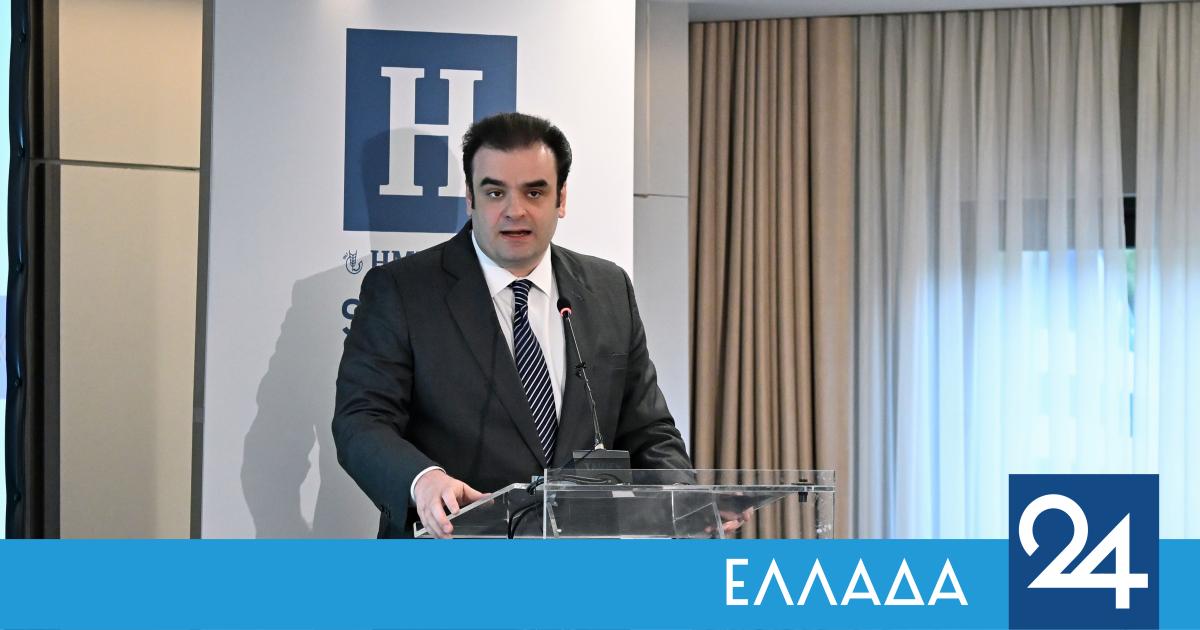
Housing is an issue of social cohesion for Europe, said Economy and Finance Minister and Eurogroup President Kyriakos Pierrakakis, addressing an informal meeting of the Eurogroup in Nicosia. Besides, following a Greek initiative, the housing problem will be a key topic of discussion at the Eurogroup.
As the minister said, “housing is a social cohesion issue and also an economic issue, and we must at least coordinate our policies with each other. We have to at least learn from each other what worked and what didn’t work.”
At the same time, Pierrakakis said that “the security and stability of Cyprus is a matter for the whole of Europe.”
The Minister’s statement and answers to journalists’ questions are as follows:
“Let me say that it is a great pleasure for me to be in Cyprus, a country that is a benchmark for stability and security in the Eastern Mediterranean, a country that has proven that it can turn crises into opportunities and constantly upgrade its economic and geopolitical role. The security and stability of Cyprus is a matter for the whole of Europe.”
Cyprus’ security and stability is a matter for the whole of Europe.
In response to questions from journalists afterwards, the Minister said:
*”First of all, let me say that Europe has already started to face the crisis. In fact, today, at the Eurogroup meeting, we will discuss the updated economic forecasts of the European Commission. There are no major surprises in them. The growth forecasts have been revised downwards and the inflation forecasts have been revised upwards, but we are still within a perimeter of positive growth. There is stagflationary pressure, but Europe is resilient. And what the Commission has already put forward is the perimeter of measures, based on the experience of 2022, which should be temporary, targeted and tailored.
We have seen what is happening in the bond markets and the volatility that exists, and we are trying to balance the fact that on the one hand we have to support our citizens, our societies, the most vulnerable, and on the other hand we should not allow this energy crisis to turn into a fiscal crisis. We must be surgical in our handling. And we have a deep understanding that if the Straits of Hormuz, as you mentioned, do not open in June, June will be worse than May and July will be worse than June. That is precisely why we will continue to have these discussions and continue to coordinate with each other as finance ministers. We are monitoring the situation closely.”
*”The measures are already being implemented at the national level, given the fiscal capacity of each Member State. As you know very well, the fiscal situation is worse than in 2022, we are, so to speak, in a more difficult fiscal equation than before, but we have a better experience than in 2022. What the IMF recently presented is that the measures we have implemented in our energy policies since 2020 have allowed us to have a 12% reduced impact given what has happened in the Middle East as a whole and in our economies.
‘So what we need to do, in addition to implementing measures that the Commission proposes, on the perimeter of the three characteristics – temporary, targeted and tailored – are also measures that fit with our long-term energy policies.”
*”Let me also add that today we are going to discuss two more issues. The first is housing. Housing is not a core competence of the European Commission, the competence is usually national, regional and local. However, I feel that Europe’s finance ministers cannot avoid discussing the issues that are at the core of European citizens’ concerns, and housing is a matter of social cohesion. Housing is also an economic issue, and we must at least coordinate our policies with each other. We must at least learn from each other what has worked and what has not worked. And that’s what we plan to start doing at our meeting today.
The final issue that we will discuss in today’s fairly intensive session here in Nicosia is the Digital Euro. We have invited Aurore Lalucq, head of the European Parliament’s Economic Committee, to discuss the parliamentary timetable for the adoption of the Digital Euro, based on the 2029 time horizon proposed by the ECB.
For us, “Digital Europe” is a matter of financial sovereignty and is a matter, I would say, of constitutional importance for strengthening the international role of the euro. And that is why all these issues are on today’s agenda at the same time.”
*”I would say that there is a stagflationary trend, but we are not in stagflation at the moment. As the European Commission’s updated economic forecast published yesterday also suggests, we are in positive growth. The key word for Europe is resilience. Let us build on that. Thank you very much.”