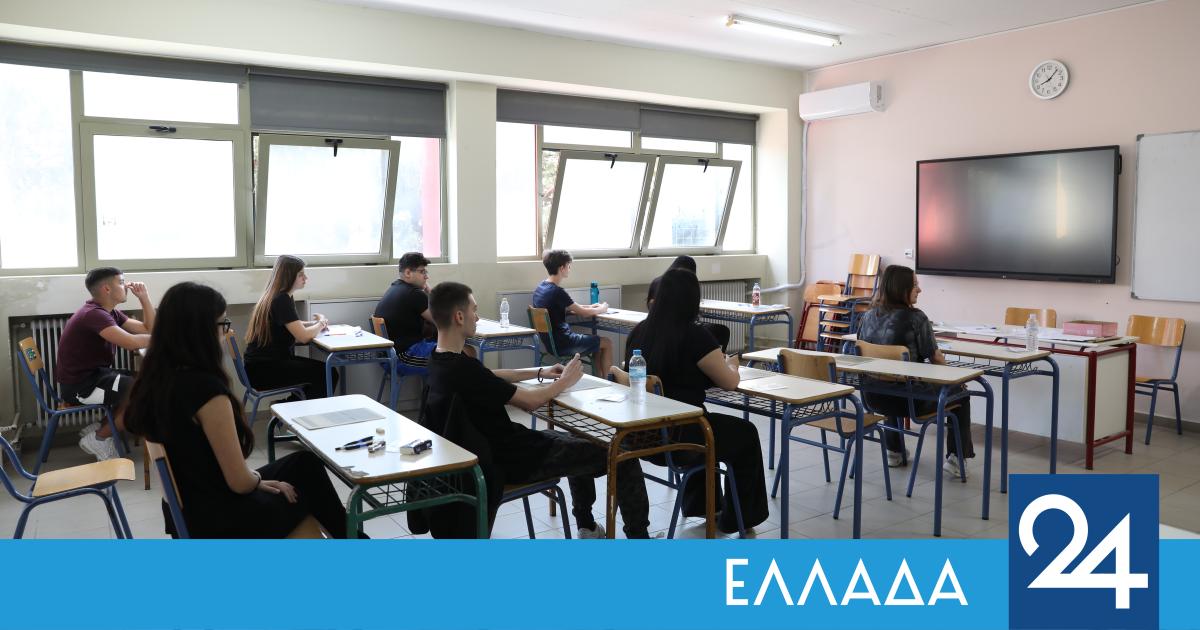
The high school year for high schools ended yesterday Friday and children are entering exam season. On Monday, May 18, the promotional exams for the first and second grade will begin, followed by the Panhellenic exams on Friday, May 29. High school exams will begin on June 2, and classes will be completed on Wednesday, May 27.
Secondary school exams will begin on June 2.
Expectations and pressure to perform are intensifying, which is often accompanied by anxiety in children. How does test anxiety manifest itself? What is it associated with? How can parents help children? APE-MPE contacted Eleni Koutsopoulou, psychologist – psychotherapist of Line 115 25 and the Counselling Centre of Together for Children.
The percentage of parents calling the line regarding how to manage their children’s anxiety, whether they are school-age children (6 – 12 years old) or teenage children (12 – 18 years old), increases every year, Koutsopoulou says. “Anxiety is, after all, a normal reaction of the body to real or imagined risks. For example, for a child, exams may seem like a danger or threat, even though they are not,” she describes.
At what age does anxiety manifest
Performance anxiety does not suddenly appear in high school nor is it exclusive to the Panhellenic exam process. Research data show that it starts to form as early as the early school years, “when the child begins to compare himself with others and realizes that his value is linked to performance in the school context and beyond. In primary school, anxiety is mainly related to grades and performance in extracurricular activities,” Koutsopoulou stresses. “We usually have the image of a child who needs to do ‘everything right’ which is usually reinforced by the environment both in the family (e.g. high expectations of parents) and in school (e.g. entrance exams to standards). Thus, we sometimes see children who display early on a concern about displeasing their significant others and therefore find it difficult to enjoy the learning process.”
One aggravating factor appears to be increased screen use, which “is associated, according to research, with more socio-emotional problems, including anxiety, low self-esteem and emotional distress. At the same time, however, children who are already experiencing anxiety or difficulties often turn more to screens as a way of coping,” Koutsopoulou describes. The WHO (World Health Organization), along with the American Pediatric Society, recommend specific times of screen use, depending on the age group, but for many different reasons these limits are not respected or at least not communicated in an appropriate way, she adds.
The goal is obviously not to have children who never get anxious, Koutsopoulou clarifies – that is another unrealistic expectation. “The goal is for children to grow up having learned to regulate and manage their anxiety, to understand that their personal value does not depend solely on the outcome and to recognise their strengths,” she describes.
It is important to maintain sociability
Parents should remind their child (but also believe it themselves) that exams are an important process but will not determine their entire life, Koutsopoulou stresses. Therefore, it is important to see them as a challenge of how far he can go and not as a problem. “If he gains this perspective then automatically the stress stops being so unbearable and therefore becomes more manageable,” she explains.
The brain needs balance to function well and perform, which means no constant pressure and isolation, Koutsopoulou continues. Rest, movement, sleep, communication and being with loved ones enhance both concentration and mental resilience.
Some practical tips for students include:
*organize your time with a realistic schedule and small achievable goals
* take a break and don’t feel bad about it
*see friends and talk about something else, there’s your life outside of class
* do the activities you love
* don’t identify with the grade you see on the paper
* talk about what’s on your mind to those you love and trust
* soon what you are living now will be a memory, remember how many other things that seemed like a “mountain” you have accomplished
Parents should remind children that acceptance and love are not dependent on performance
At the same time, parents can be instrumental in helping the child to manage anxiety “by first creating a calm and stable environment, listening attentively without direct criticism or advice, recognizing anxiety as normal, focusing on effort and not only on the outcome, encouraging balance (reading – rest) and reminding that acceptance and love are not dependent on performance,” explains Ms. Koutsopoulou.
Excessive pressure, comparisons with other children, constant focus on grades are best avoided. At the same time, parents should not underestimate children’s emotions or give them too much input when they are stressed, Koutsopoulou says.
Parents can sense that help needs to be sought when anxiety is severe and persistent, affects a child’s sleep, mood or functioning, or leads to avoidance or severe withdrawal.
Anxiety is manifested by “tightness in the stomach or chest, headache, tachycardia, rapid breathing, sleep or appetite disturbances, intense worry, negative thoughts (“I won’t make it”), difficulty concentrating, catastrophic scenarios, irritability, withdrawal, procrastination or, conversely, excessive studying without rest,” she says. Koutsopoulou.
Adolescents with parental consent and parents can contact the Together for Children hotline 11525, which provides free counseling. The line is open Monday to Friday 09:00-19:00.
.