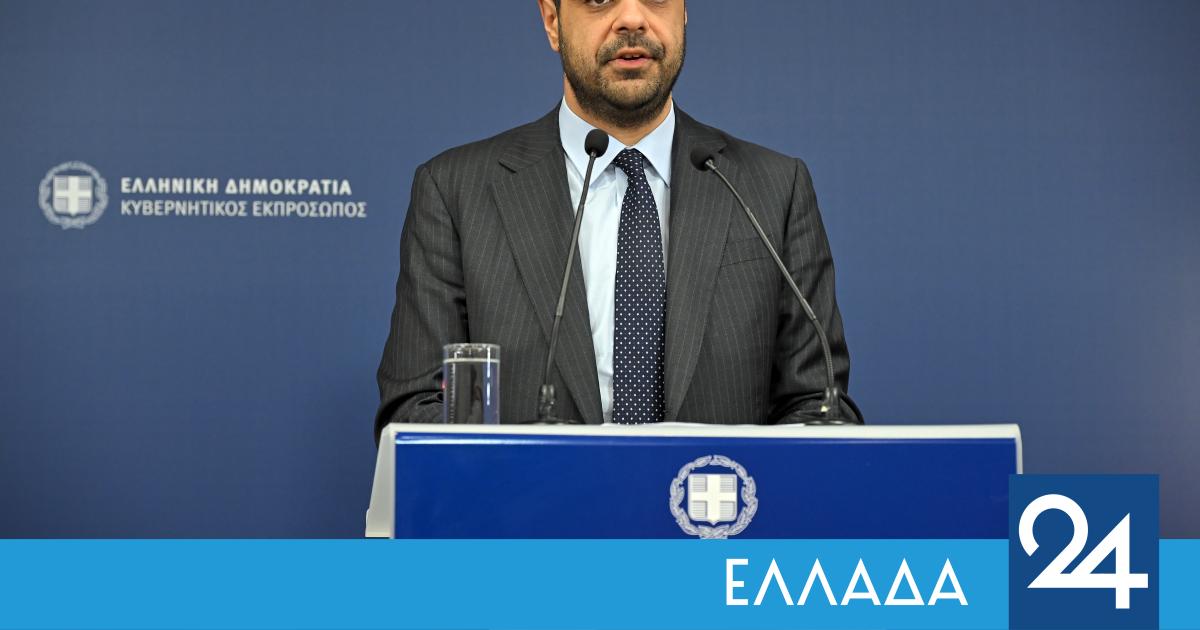
Emergency management is now “the new normal” and a key criterion for evaluating governments, government spokesman Pavlos Marinakis pointed out in an interview with SKAI television. The discussion focused on the international situation and the war, the effects of which are already visible in the economy and the daily life of citizens, with increased costs in the market and intense pressure for immediate interventions. At the same time, the question of available government “tools”, such as fuel measures and possible tax cuts or subsidies, was raised, with the government emphasising the need for fiscal balance and targeted interventions. At the same time, issues of European coordination, energy policy and geopolitical developments were raised, while the country’s position to avoid any involvement in military operations was reaffirmed.
Marinakis said of the measures already taken that “when these decisions were announced, they were preceded by a study of what had been happening in the previous months at petrol stations, so that petrol station owners would not be wronged by the new independent consumer protection authority. Indeed, it was a first set of measures. The hope is that no more will be needed, but as the crisis deepens and hostilities continue, it seems that many more plans need to be in place. The Prime Minister has been clear and now he will have to move much faster than he has moved in previous crises. And not to show that we are vindicated, but to follow the example and follow the proposals that we have made in previous crises, for example in 2022.”
He stressed that we must remember what happened in the past when we were an economy that was thrown out of the Eurogroup and now Kyriakos Pierrakakis is chairing the Eurogroup, “because now that the time comes to support the citizens, this support does not come from the sky, nor does it grow from nowhere, nor will it come from the ‘money trees’ of either PASOK or other parties.”
He added at this point that “the excise tax on oil every year brings several billion in revenue to the country. It is one of the taxes so obviously in Europe as a whole there should be a discussion on reducing excise duty and I would like to say, because I have no intention of being unpleasant, nor does the government, that in principle we all agree that taxes should be reduced. As much as possible. And because we have, I think, the ability to tell the world, compared to the other parties and the credibility, because everyone can say what they want, because we have abolished or reduced 83 direct and indirect taxes.”
He also stressed that “Europe can take a decision, I am not saying that it will take it, to have an escape clause so that while this crisis lasts, states can take some decisions, possibly the reduction of excise duty. If Europe does not take such a decision, those who are proposing such a decision will basically have to answer two things: firstly, where will this measure be financed from, unless they want our country to be put in a category, as Mr Filippides said, of countries that do not respect the expenditure ceilings and are going into a surveillance procedure (…) and the second argument has to do with who will benefit. To go to what you say, the opposition part. As you can understand a horizontal reduction in excise duty, I repeat, not that we are negative in principle, but targeted now, would benefit many more people who with larger vehicles have more ability to cover a point, hopefully not for a very long time, increase in petrol or diesel.”
Marinakis also stressed that there is “a ready plan for all eventualities, as we have proven in all previous crises and most importantly, -good words, but better actions- I don’t remember many governments and I don’t remember many governments intervening in the refineries to get all this to society. The Mitsotakis government has done it. And have intervened in energy companies to deal with the energy crisis. The Mitsotakis government has done it. All the others from this well-known space of ‘denounce and march’, all they know how to do is slogans.”
The government spokesman reiterated that “things at the moment are too critical. There has been a lot of discussion for too many years in this country, either in the face of crises or in a period of normality, about what each party will give. Unfortunately, there is no discussion at all, especially from the other parties, about how to give it. So what I can tell you is that Greece, as long as it has this government, will continue without increasing tax rates, reducing them, to create the conditions of stability and revenue to finance both emergency situations and permanent measures. Two months ago, the largest tax reform that has been implemented in the country in recent years began to be implemented. The increase of income in a stable and permanent way to everyone, pensioners, civil servants, public employees, private employees, freelancers in their next payroll and much more for those who have two, three, four children.” He also said that “on top of this great reform, even greater reforms will be added, for next year, as the country produces surpluses and gives them back.”
He stressed that if the crisis worsens, the government is ready to take support measures, stressing that citizens will not be left helpless. He pointed out that the support would be given either through permanent interventions, such as tax cuts, or through exceptional measures, with the main criteria being to benefit mainly those in greatest need and to ensure that the economy can bear the cost. At the same time, he clarified that the government’s policy is not based on the subsidy logic, but on reducing taxes and increasing revenues, without devaluing social benefits that are permanent in nature and support specific groups.
On foreign policy, he made clear that Greece will not engage further in military operations, ruling out sending a ship to the Strait of Hormuz. He stressed that the country maintains strong strategic alliances, but its position is clearly in favour of avoiding escalation. At the same time, he said that Greece’s participation is limited to the European operation “Shields” in the Red Sea and that there is, for the time being, no plan to expand the engagement, making it clear that the country’s stance remains firm.
Marinakis also said that the country’s energy deals, such as the one with Chevron and projects such as the Vertical Corridor, are not affected by the international crisis, stressing that they significantly strengthen Greece’s energy footprint and geopolitical position. At the same time, he pointed out that these agreements are strategic choices that upgrade the country’s role as an energy gateway and contribute to addressing geopolitical challenges.
At the same time, he criticized the opposition, noting that it did not support crucial points of the relevant contracts, which – he said – could deter important investments. He concluded that the political attitudes and choices of the parties have concrete consequences and produce tangible results for the country, which, he said, should be evaluated by the citizens.
Specifically, Marinakis said: “In principle, for example, PASOK voted, but the two crucial articles on the contracts south of Crete were not voted by PASOK,” adding that the deal with “Chevron and all these agreements double the country’s energy footprint”.
He also stressed that “Greece is becoming an energy gateway, along with the Vertical Corridor, and geopolitically it is the most resounding response, example, to the weakening of the illegal and unsubstantiated Turcolivian memorandum”, he added: “If the stance, for example, of PASOK, which was softer than the others but voted against two crucial articles, had been a majority in parliament, Chevron would have stood up and left. Those who denounce the surpluses and the tax revenues that we have, the more, with less taxes, are calling for more measures. Those who don’t vote for the critical articles on Chevron are asking for more support for energy. Those who do not vote, other parties, not PASOK, for defence spending, are happy that our country supports Cyprus. So, when parties position themselves in Parliament, their stance, their position, produces a political result. This is what the world should see.”
.