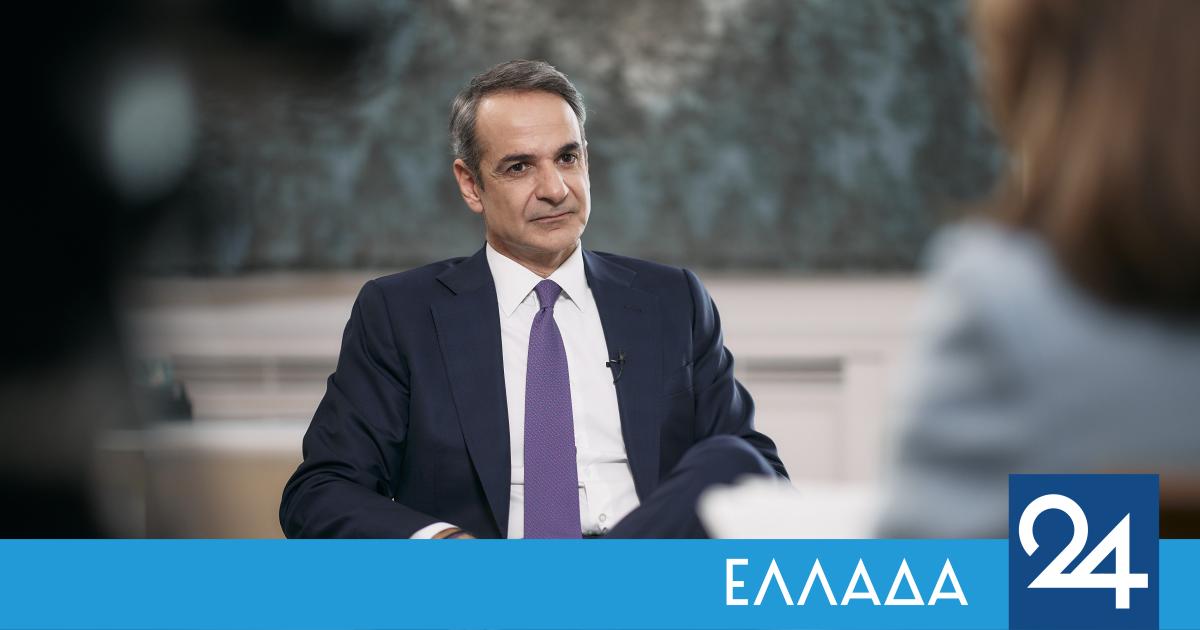
Prime Minister Kyriakos Mitsotakis, in an interview with the Australian expatriate newspaper Neos Kosmos, focused on the international situation, the role of Greece, expatriate Greeks, bilateral relations with Australia and the postal vote. He began by referring to the postponement of his visit to Australia due to developments in the Middle East.
“My decision to postpone this visit was not easy at all. We had planned it for many, many months. I was personally looking forward to it, both my wife and I, with great anticipation. But it was a decision of responsibility. As you know, the wider Middle East region is currently in the midst of an intense military conflict, and unfortunately it would have been impossible for me to be away from my office for about a week, while we are called upon every day to make critical decisions and to participate in European consultations on how to defuse this crisis.
I was not only very happy to be here, but I was also very happy to be involved in European consultations on how to defuse this crisis.
However, I would like again, through your kind hospitality that you have extended to me, to address the Hellenism of Australia, telling you that this visit is not cancelled, it is just postponed and very soon we will try to reschedule it, in consultation with the Greek community in Australia, but also in consultation with the Australian government. For me, Australia is not just a country where Greeks live, it is a part, a living part of global Hellenism”, he stressed.
Referring to the postal vote, he stressed that “we want Hellenism in Australia, global Hellenism, but now I am addressing you, to participate and co-shape developments in the motherland. And there is no better way than to involve as many Greeks as possible who have the right to vote in the next national election through postal voting.”
Ahead of the summit in Brussels tomorrow and the day after tomorrow, Mitsotakis stressed that Greece has been on Cyprus’ side from the very first moment of this conflict, sending two frigates, two pairs of armed F-16 fighter jets, in order to protect it from possible attacks from either Lebanon or Iran on its territory. “It was a move of very great strategic importance for global Hellenism.”
But it was also a move which highlighted the need for a wider European mobilisation to protect European territory under attack. And I am happy because I was in Cyprus with President Macron on a visit of great symbolic value, actively supporting Cyprus,” the Prime Minister said, noting that the debate on how Europe itself can assume a greater burden of responsibility in its defence, what we call “European strategic autonomy”, is coming back to the fore.
The European Council – he continued – will discuss European competitiveness with the effects of the Gulf crisis already visible. “I imagine you see them yourselves in Australia. We already have increases in fuel prices and it is very important, not only as a country but also as Europe, to build those ‘dykes’ so that at a time when our societies are being tested anyway, they are not also burdened by additional increases, whether we are talking about electricity or fuel,”
he said.
On the impact on tourism, the Prime Minister said there was no concern and urged Australian Greeks who want to visit home this summer to plan ahead. Returning to the postal vote, he said it was positive that it had passed with 201 votes. “I say this because a number of parties ultimately did not support this initiative and this is something that Greeks in Australia should take into account when they go to the ballot box, who actually in practice support the right to participate in the electoral process on an equal basis with Greeks overseas; at this point in time the major thing has been achieved.
And the major thing is that every citizen will be able to choose, first of all, whether to vote by mail or to go, and we will also create polling stations at local consulates. But I think that since there is the option of absentee voting, which Greeks abroad are generally familiar with, that this is what most people will choose.
We already did, after all, in the European elections. It is a very important achievement for the country and, I would say, a leap forward in political equality for Greeks abroad. Consider that in the past, if you wanted to vote, before 2019, you had to return to the country. Few did, only if they combined it with their regular visit to our country. Now, this is made much easier. The will of the government was to have a constituency of Hellenes Abroad-and this is something that will happen, it will just happen from the next election, it can’t be implemented immediately-so that there is also a creative rivalry, I would say, between the Hellenism of Australia, the Hellenism of Canada, the Hellenism of the United States.
That was not possible to do in this ballot box. So there will be, as the law currently provides, mandatory representation on the State ballot, in the first three seats, which for New Democracy are by definition elective seats, of a representative of the expatriate community. In other words, we will choose whether this representative will be from the Hellenism of Australia, the United States or Europe. I would have preferred this choice to be the choice of the citizens themselves, but unfortunately this has not been possible. But let’s keep the major point.
And the major thing right now is that those who are registered, those who are on the electoral rolls, with great comfort, with great security, because the system has already been tested, you will receive the relevant postal voting material, you will mail it at no cost and you will participate in the electoral process in this way,”
Mitsotakis also said that Greece has made great strides in recent years and referred, among other things, to the reduction of unemployment from 18.5% to 8%, the increase in investment, the strengthening of the Armed Forces. “The opposition feels that at all times they have to deconstruct the government in everything it does. I personally am not of that school, I am always looking for broader consensus,” he added. “Our strategy for ecumenical Hellenism is not limited to the self-evident right to participate in the electoral process on equal terms.
We have done many things. Specifically on Australia, I want to stress that my intention was, when I was coming, but I can tell you, to announce that we have practically agreed on the double tax avoidance convention, a long-standing pending issue. In any case, we will announce it as soon as it is ready, but in practice it has been agreed. We have a small exception only for shipping issues, which we will postpone to a later time, but the core of the convention has been practically agreed,” he said in the same interview.
“For us, the strengthening of global Hellenism also goes through the acquisition of citizenship,” he said elsewhere in the interview, while describing bilateral relations between Greece and Australia as excellent. At the same time, he referred to Greece’s intention to ban children’s access to social media, moving in a similar direction to Australia, while he stressed that there are also significant investment opportunities for funds from Australia to invest in Greece.
Giving an estimate of when it will finally be possible to make the now-postponed visit to Australia, the Prime Minister said it could possibly take place in the summer. “I regret that I will not be attending the March 25 celebrations, but I am sure that when I do come, the Greek community in Australia will ensure that I am given the opportunity to interact with them and experience once again their unparalleled dynamism,” he stressed.
.