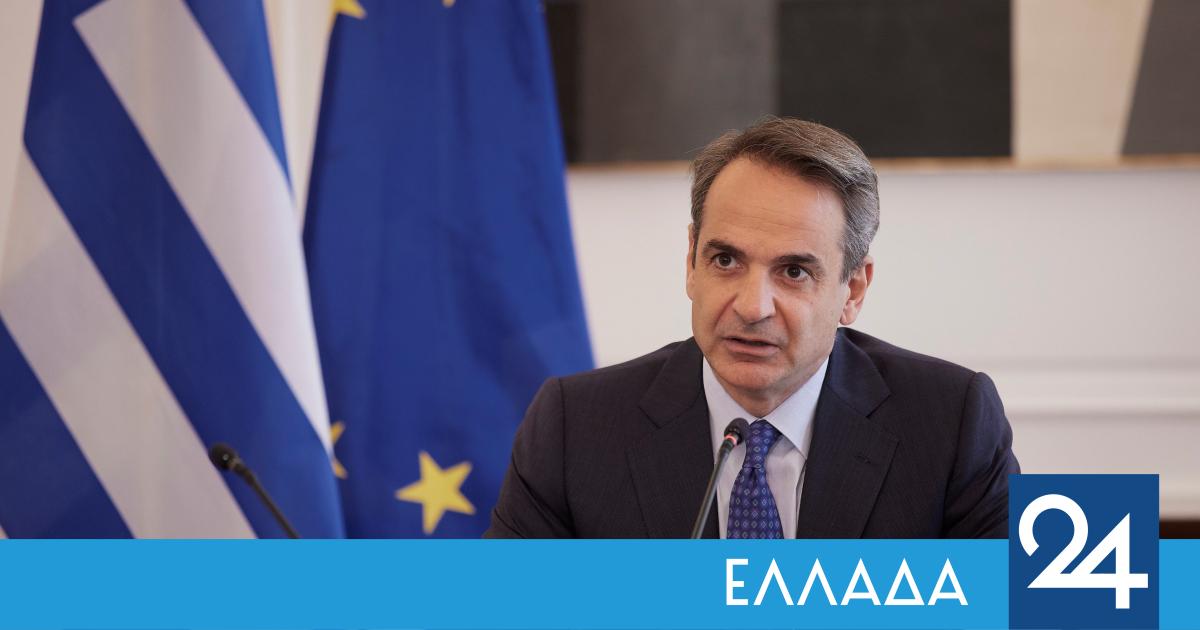
“Good morning to all. This March confirms the saying of our people, “March skinner”. Just when we thought spring was here, the weather has spoiled us a bit this week. But let’s get to ours, because the issues at hand are many and important,” Prime Minister Kyriakos Mitsotakis said in his weekly review post. In it, he underlines that developments happening thousands of kilometres away affect us directly: from geopolitical tensions and energy uncertainty to changes in the economy, work and the functioning of the state, everything is interconnected and shaping a new environment of challenges and opportunities. The new Collective Labour Agreement signed in the food service sector stands out as the important news of the week, as well as the new regulation that is imminent for those subject to the out-of-court mechanism.
“I start with the international one, as the prolonged geopolitical tension in the Middle East is not a distant crisis. It has already caused a major energy shock, with direct consequences for households and businesses across Europe. At the European Council in Brussels, we discussed the full spectrum of the crisis’ impact, on energy prices, on consumers and businesses, but also on migration. Targeted national interventions are needed. At the same time, Europe must have a specific toolbox capable of providing temporary and targeted support to households and businesses. This is the other side of competitiveness, which we discussed at length in the European Council, so that we do not face an energy crisis. The recent attacks on critical energy facilities in countries in the region are further straining the global supply chain and affecting energy prices internationally. In this context, Greece, together with France, supported the proposal for a moratorium on attacks on energy infrastructure as a key de-escalation step. At the same time, we are moving forward in shielding Europe. We discussed how to give meaningful content to the EU’s mutual assistance clause. The solidarity shown by Greece and other EU Member States towards Cyprus has shown that Europe can be united. But it must also be ready – to have a clear and workable roadmap in case European territory is attacked. At the same time, the Greek contribution from 2021 with a Patriot battery to Saudi Arabia strengthens the protection of critical infrastructure as part of our strategic cooperation. Greece continues to act responsibly, enhancing stability and security in the region.
From the very first day of the war, the Greek State has consistently and professionally stood by the Greeks who found themselves trapped in war zones. The Ministry of Foreign Affairs handled more than 10,000 requests and organised, in extremely difficult circumstances, a complex evacuation operation. More than 2,000 of our fellow citizens returned safely from countries in the region, using a combination of land assets, chartered flights and Air Force flights. In fact, on the last repatriation flight from Abu Dhabi, and despite the strict restrictions in the region, the Ministry of Foreign Affairs secured special conditions for pets to be allowed on board. As a result, 45 pets returned with their owners. This is the only flight from a war zone involving a large number of pets. Our country, pioneering once again, has set a new example of the value of every life.”
He stresses that “this ability of the state to operate with planning, speed and empathy in crises is the same ability that we want to govern our daily operations. Because the international credibility that we gain outside must go hand in hand with a state that is becoming faster and more efficient every day at home. And this can be seen in practice by the way our economy is now attracting capital. Since 2019, our country has improved dramatically in the area of investment acceleration. But we need more. With the new framework of the Ministry of Development, we are concentrating all the relevant responsibilities in one place, the General Secretariat for Private Investment, so that there is speed and, above all, more transparency and less bureaucracy. Another important change is the control of state aid, which will now be carried out from the beginning of the process, increasing predictability for investors. The new framework incorporates proposals from the business community and, in the coming days, additional interventions to support industry and address energy costs will follow.”
The Prime Minister added that “along with ‘cutting back’ on investments, we are also continuing to ‘cut back’ on our finances. Our goal is that by 2030 Greece will not have the highest public debt in Europe. That is why we are proceeding with the early repayment of the instalments of the €52.9 billion loan that the country received in 2010 from the Eurozone countries. Next June, an additional €7 billion of the remaining €26.3 billion will be paid next June, while the remaining instalments will be covered with around €5 billion per year over the next four years. Thus, the debt is falling not only as a percentage of GDP, but also in absolute terms: from 364.95 billion in 2024, we are down to 362.8 billion at the end of 2025.”
At this point, he says that he considers that “the most important news of the week is the new collective labour agreement signed, this time in the food service sector, covering about 400.000 workers in a wide range of activities from hotels to restaurants and bakeries. It has a two-year duration and provides for increased pay from 6% to 25% for all specialities. Basic wages will be between €930 and €1,100 gross depending on the speciality and will be affected upwards by bonuses for three-year, marriage, study, unhealthy work and seasonal employment. Another important agreement in the workplace.
I also consider the new regulation we are going to pass for those subject to the out-of-court mechanism to be particularly important. What are we going to do there? For the first time, we will enable a debtor to separate his or her main home from the rest of his or her property, thus enabling a larger ‘haircut’ and a lower monthly payment. Let me give an example: if a debtor with a loan of 200 000 has a house worth 120 000 and a holiday home worth 80 000, until now the value of both properties was taken into account and the algorithm would produce a zero haircut and several instalments. With the new arrangement, by declaring that you wish to save only the main house, only the value of 120,000 euros will be taken into account and the debt will be “cut” immediately, liquidating the holiday home. The aim is a more efficient and functional procedure, which will give a real possibility of debt adjustment and protection of the main house,”
.
“This week we also presented the roadmap for the universal implementation of the ban on the sale of tobacco products and alcohol to minors. The ban becomes universal and the responsibility for age verification now passes to the seller, with the help of a new digital verification system through the Gov.grWallet and Kids Wallet apps. Violation of the framework is a criminal offence and violations are punishable by three years in prison and a fine. The central tool of the new framework is the Digital Register for the Control of Tobacco, Alcohol and other Non-Tobacco Products (alto.gov.gr), in which all natural and legal persons selling these products at all points of sale throughout the country are compulsorily registered, while market surveillance is strengthened by a special department of the EODY. It is also prohibited for minors to enter and stay in unlicensed bars and nightclubs. Private events will be allowed only under certain conditions, provided they have been previously registered on the online platform events.gov.gr,” he said.
Turning to another issue, the Prime Minister said: “We also signed a donation contract worth 3.8 million euros for the supply of a new communication system for air traffic control, which will be used at the Athens and Macedonia control centres. In order to save time for the acquisition of this key system, we appealed to the private sector, which responded immediately and thus the cost will be covered entirely through a donation from Athens International Airport, Fraport Regional Airports of Greece A, Fraport Regional Airports of Greece B, GEK TERNA, Aegean Airlines and Sky Express.
There was more to come though.
Like, the launch of the Local Government Performance Monitoring Hub. For the first time, the state stops hiding behind generalities and collects, processes and publishes in a systematic way comparable data for almost all municipalities in the country. Every citizen – and I urge you to do so – can go to deiktesota.gov.gr, compare and see the truth about their municipality: how clean is the city? How fast are digital services? How is social policy doing? The performance of municipalities such as Thessaloniki, Trikala, Volos, Ampelokipi-Menemeni and Peristeri show that progress is possible when there is planning, consistency and accountability. Of course, this is only the beginning. For the first year has also highlighted real difficulties: in property registration, in infrastructure mapping, in monitoring energy data. But it is precisely this mapping that is the basis for getting better. By using modern data infrastructures and the cooperation of the relevant agencies, we are building a new model of administration: a state that measures to improve and compares to progress.
This digital revolution is not only about administration, but now reaches directly to the value of our property itself, by piloting the Digital Land Bank. You will understandably ask me what this is, and I will answer: it is a new digital platform at https://www.gov.gr/ that enables owners who cannot make use of their property, for example because it is listed, to transfer this right elsewhere, instead of losing it. This is a tool that contributes both to the protection of the environment and common spaces, and to a more organised spatial planning, through a transparent and reliable framework. At the same time, the Cadastre launched a new digital service on maps.ktimatologio.gr, which, through an interface with the Technical Chamber of Greece and the Unified Digital Map, integrates for the first time cadastral and urban planning data in a single environment, allowing citizens, engineers and investors to directly view basic building conditions (such as land use, building factor, coverage, height and plot integrity) for each land parcel.”
Special mention is then made of the social policy sector, noting that the Greek proposal for the use of the Social Climate Fund resources, amounting to 5.3 billion euros, has been submitted to the European Union. “We have planned 25 interventions for 1.5 million households and 70,000 micro-enterprises to tackle energy costs, strengthen construction and improve buildings, protect the environment and modernise public transport. The focus is on families, people with disabilities, households struggling to cope with energy and transport, and small businesses. This Fund is one of the key tools for the next day of the economy and is an opportunity we will take full advantage of without delay.
We are expanding the School Meals Program in six other municipalities across the country – Orestiada, Soufli, Grevena, Peony, Istias-Aidipsos and Aegina. In practice, this means 4,680 additional children will have a quality meal at school every day, from a programme that already supports 179,000 pupils across the country. I believe it is a simple but very effective intervention that reaches from the most remote locations to the islands and areas where the need is greatest.”
The Prime Minister concluded by referring to cultural prescription. “The term may be alien, but its essence is simple: culture as therapy. And I am particularly proud that our country is moving forward with this practice. From now on, a doctor will be able to prescribe through HICC for participation in theatre, museums or concerts as part of mental health care, with reimbursement from the EOPYY. It is an approach that has been tried and tested internationally and shows that mental health is not just about treatment, but also about participation, expression and connection to society.
This is, after all, the goal of all the efforts I have described: a state that is modernizing, that is housekeeping and that is growing, not for the numbers, but to return this progress in every way possible to the daily lives and quality of life of every citizen. Happy Sunday to all!”
.