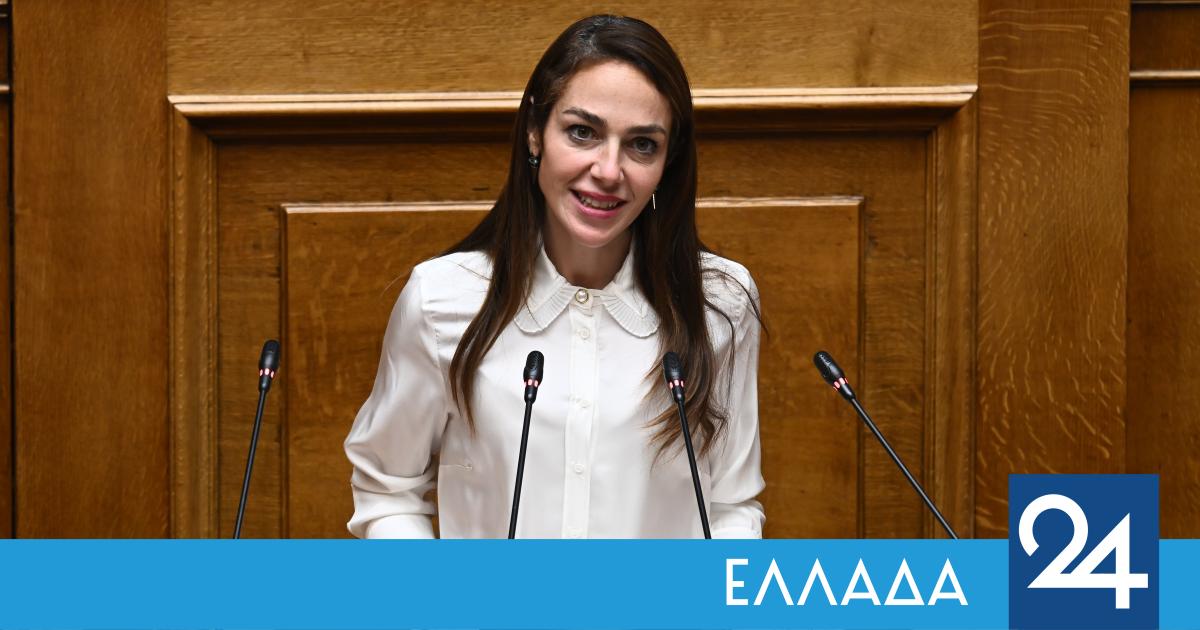
My House II and the deadlines for applications and contracting, child protection with emphasis on foster care, as well as policies for persons with disabilities, was mentioned by the Minister of Social Cohesion and Family, Domna Michaelidou, speaking today on the MEGA television station.
For the “My House II” programme, Michailidou noted that applications for inclusion in the programme will be completed at the end of May, while the contracting of already approved loans can proceed until the end of August. As she explained, because the programme is financed by the Recovery Fund, there are specific European deadlines that must be met.
The approved loans amount to around 14,000, of which 11,000 have already been contracted. For those beneficiaries who have advanced the process but face delays in individual stages beyond their control, it is envisaged that they will be able to complete the contracting process by the end of August, through Hellenic Development Bank resources, so that their access to the programme is not lost.
“My House II gives thousands of young people access to a first home on favourable terms. Applications close at the end of May and contracts can be signed by the end of August. The state must protect those who have already been approved and have taken the necessary steps to ensure that the opportunity to acquire a home is not lost for reasons beyond their control,”
Describing child protection policies, she noted that for many years the basic answer for abused or neglected children was institutional care, which now exists as a solution, but should be a last resort.
Michailidou recalled that in 2019 the country did not even have a picture of the number of children in institutions, nor a single operating framework for all structures, presenting data showing that the approximately 2,200 children in institutions at the time have now been reduced to 1,100. The children who remain in institutions are often older or disabled, making the transition to a family environment even more difficult.
“Institutions should be a last resort. There is the process of foster care and emergency foster care, so that every child grows up in a family environment with stability, care and security,”
On fostering, he noted that anyone wishing to become a foster parent can apply on the anynet platform and then follow the prescribed training, while he made special reference to the institution of emergency fostering, which operates dynamically in the region and enables children who need immediate protection to move quickly to a family environment.
Then he spoke about the Early Childhood Intervention Programme for children with autism and developmental difficulties, which involves 2,500 children, with support of up to 800 euros per month, and covers services such as occupational therapy, speech therapy and other specialised interventions, in addition to those covered by the National Health Insurance Fund. Early support for children under 6 in a family-centred environment can be crucial to the child’s progress, the minister said.
As for the Assisted Living Homes (ASH) for children and persons with disabilities, Ms Michaelidou noted that from 48 ASH in 2019, 158 are currently operating, in which about 2,000 people live. These are shelters within the urban fabric, with organised staffing and daily support, so that children and adults with disabilities do not live in institutions, but in an environment that enhances their autonomy and social participation.
Finally, on Personal Assistant, the minister stressed that it is a basic policy of independent living for persons with disabilities and is now being strengthened with 34.8 million euros in funding from the NSRF, which gives the programme continuity, stability and the possibility of further expansion. Already, more than 1,800 beneficiaries have joined the programme, more than 5,000 personal assistants have been trained and 2,664 agreements have been signed.