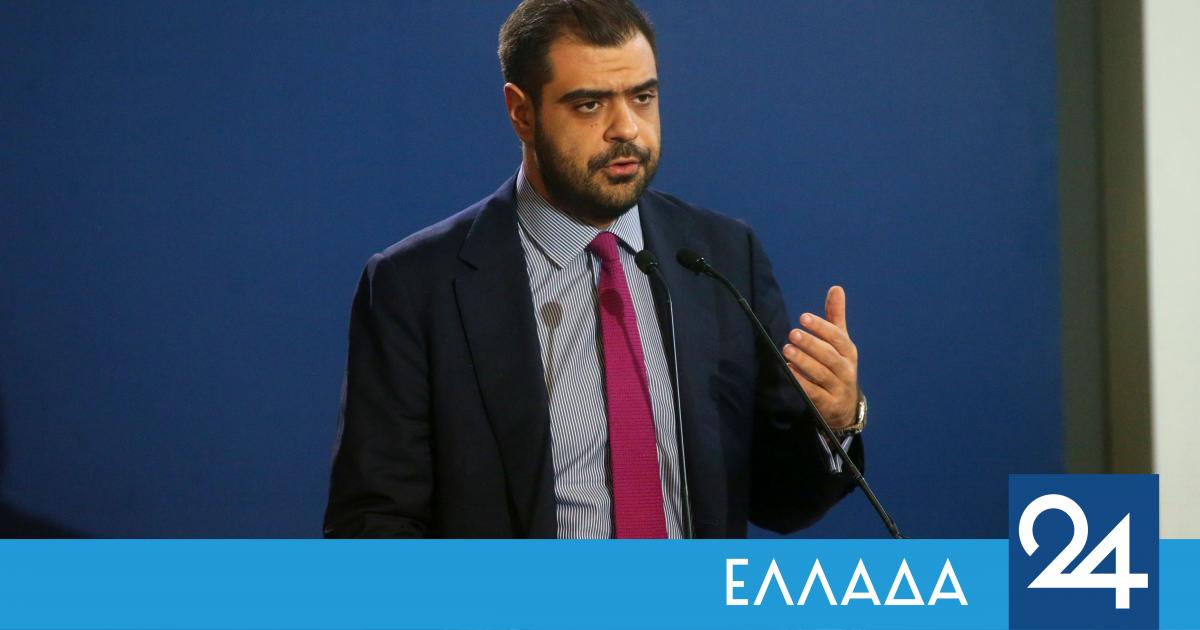
Government spokesman Pavlos Marinakis in a full-blown interview on nea.gr, responds to accusations of undermining press freedom and categorically rejects the “scandals”, citing European reports that record an improvement in the rule of law. It defends reforms on transparency and the protection of journalists, while criticising the opposition and the media for misinformation and “tele-tribunals”. At the same time, he stresses that the final judgment is up to the citizens, while defending satire with limits and underlining that politics is a constant test of accountability and endurance.
“What we are and what we are not will be decided by the world, by the people, by the citizens, by the Greek people every four years and collectively, namely New Democracy, the ruling party, but also individually. That’s why I think that at the end of the day in politics you should stay in politics as long as they vote for you.”
As for the comparison with the other opposition parties, Mr. Marinakis says he considers it a big mistake “to simply seek to be better than others and especially than the previous government of ours, which is now somewhere between 3 and 5%.”
He said the only reliable and commonly accepted indicator of the rule of law is the European Commission’s annual report, according to which Greece is not in the bottom ranks, but shows improvement, with fewer recommendations than in the past. In fact, it points to progress especially in press freedom and the safety of journalists, attributing it to specific reforms such as the abolition of simple defamation, the strengthening of transparency in advertising and the introduction of measures to protect journalists. “Greece currently has fewer recommendations than 15 European member states, so it is certainly in a better situation than 15. So it is not the last one. They say we are last and 15 member states of Europe have more recommendations than us. We had seven recommendations before we took over the governance of the country. Because this has been going on since 2020. So it counted for a start in the period before us and now we are down to four. But let’s go to the most interesting one. This one which is my portfolio, where I have the honour to represent, of the press, of the safety of journalists from January 2024, because I took over as Deputy Minister a few months after I took over as Government Spokesperson. Europe’s two best reports on freedom of the press and journalist safety issues are 2024 and 2025.”
On the contrary, it rejects as unreliable some NGO reports, which it describes as subjective and inaccurate. At the same time, he says that there is no problem with satire, but distinguishes it from ‘character assassination’, which he denounces as a distortion of reality and a hypocritical practice. “It’s one thing to have satire, which has harsh criticism in it, but to provoke laughter – and for us, when you have a basic sense of humour, it provokes laughter for yourself, because you have to have a sense of self-mockery – and it’s another thing to have ‘character assassination’. That’s a red line that some people have crossed,”
The government spokesman says that recourse to justice should not be feared when a criminal offence is being committed, that is, when there is evidence of false and defamatory allegations, clarifying that an out-of-court hearing is preceded by an out-of-court hearing and that everyone is equal before the law, with no exceptions for journalists or politicians. At the same time, he strongly criticises Zoe Konstantopoulou, accusing her of instrumentalising the tragedy of Tempi for political gains, through provocative rhetoric and delays in the judicial process. “We do not hide our words, Mrs Konstantopoulou has tried to make a political career of a different level, that is, not just of a party that is marginally entering Parliament, by investing on a tragic accident. I know that this is the most tragic thing anyone can say, the saddest thing for a politician to say, that is, to try to make a career on the pain of the relatives of the victims of a tragedy, on the pain of the relatives of 57 dead people. That is the truth. And what is Mrs Konstantopoulou’s pattern? To insult, to provoke, to play with the boundaries of her colleagues in Parliament, because they are human too, we are human.”
He also refers to the spread of illegal cargo theories, noting that their influence has diminished, while denouncing the operation of “tele-courts” and the spread of misinformation. It also blames opposition parties, claiming that they have exploited social sentiment for justice, fostering a climate of polarisation. “There is no person, whether he votes for New Democracy or votes for anything else, who does not want justice for a tragic accident. They took advantage of that and played their game,” he says.
Marinakis also talks about the polls, partnerships, the electoral outlook and internal criticism. He attributes the figures of the Eleftherias Party to the fact that there is a public that identifies with its rhetoric, but stresses that the government must appeal to all citizens, even those who are hard to convince. On PASOK and its statements about not cooperating with New Democracy, he points out that each party decides autonomously, but criticises its stance, considering it contradictory to rule out cooperation with ND, while he does not keep a similar distance from other political forces, arguing that it has moved politically. “The PASOK of Nikos Androulakis, to tell the truth and not to embellish things and let the truth bother, the PASOK of Nikos Androulakis has evolved into a party, which “plays” in the field of people, which the same PASOK executives went to jail,” he points out.
He expresses the view that the self-reliance of New Democracy is possible, noting that elections differ from polls, as there are no undecideds and programmes and accounts are compared, while he considers it indicative that in 2023 a more realistic programme prevailed over more “generous” promises.
With regard to criticism of former prime ministers, he expresses respect for their persons and acknowledges that the government must accept and make use of criticism, admitting that mistakes have been made. At the same time, he defends the work of the government, particularly in foreign policy and defence, considering it to be of particular importance.
Regarding the criticism of Kostas Karamanlis, he avoids to refute it directly, noting that politicians are judged by the citizens as a whole, while he reiterates that, despite the room for improvement in the rule of law, the current situation cannot be compared to past pathologies. “History records politicians and especially political leaders based on what they did and what they did not do and, at the end of the day, they are evaluated by the citizens. Whether we do well or not in the elections, I don’t underestimate the reactions of former prime ministers, it will be judged by the voters, the citizens, the Greek people,”
On the issue of surveillance and the rule of law, he stresses that it is not an indifferent issue and is being examined by the judiciary. There is a criminal dimension (with decisions of the Supreme Court and first instance convictions of private individuals) and the government does not comment on pending cases. It also points out that Greece has institutionally complied with European recommendations.
.
On the briefings, he argues that they are open, with no restrictions on questions, but accuses some journalists of “activism” and attempts to distort answers. “There are issues where if I went beyond what a ministry would tell me, I would not be doing my job well. Excuse me for trying to inform people, because that’s where I inform people. I am informing journalists, but I am also informing citizens, based on what the relevant ministries officially say. Especially, on foreign policy and defence issues,” he stresses.
He describes his daily routine: morning briefings, meetings (“morning coffee”), family moments and constant communication with government officials.
On the role of government spokesperson, he conveys the Prime Minister’s advice to remain authentic, recognizing that the position has pressure, exposure and toxicity, but is a great honor and responsibility. “‘Let me tell you something. I’m making you the government spokesman. So I want it to be you. I don’t want you to play a role. You’re going to put yourself in the ‘shoes’ of the government spokesman, but you’re going to talk the way you’ve been talking. Both publicly and privately’ – the Prime Minister had told him. I was 35 years old in 2023. I’ve been in this, as they say, ‘electric chair’ for almost three years. But I will tell you something. In life we can’t have everything. There are many important and positive things and just the honour of being in this position and being in this position and being close to the Prime Minister and overall serving in a role that is a very big responsibility. At the same time, there are the difficult ones, which is the pressure, the toxicity, the fact that you’re often called upon to answer for things or justify things. Or to prove that ‘you’re not an elephant,’ or to justify something a situation that you’re not responsible for, but again, government is a group, a set of people.”
On online anonymity, he suggests that platforms should know the identity of users (not remove pseudonyms), mainly to address offending behaviour and protect children. There are upcoming measures specifically for minors.
For his family, he points to the influence of his grandfather (a lawyer) and the family environment.
He talks about his experience with autoimmune disease, the difficult period of diagnosis and the importance of prevention and testing.
Finally, he mentions time with family and the simple moments of everyday life as ways to de-stress.