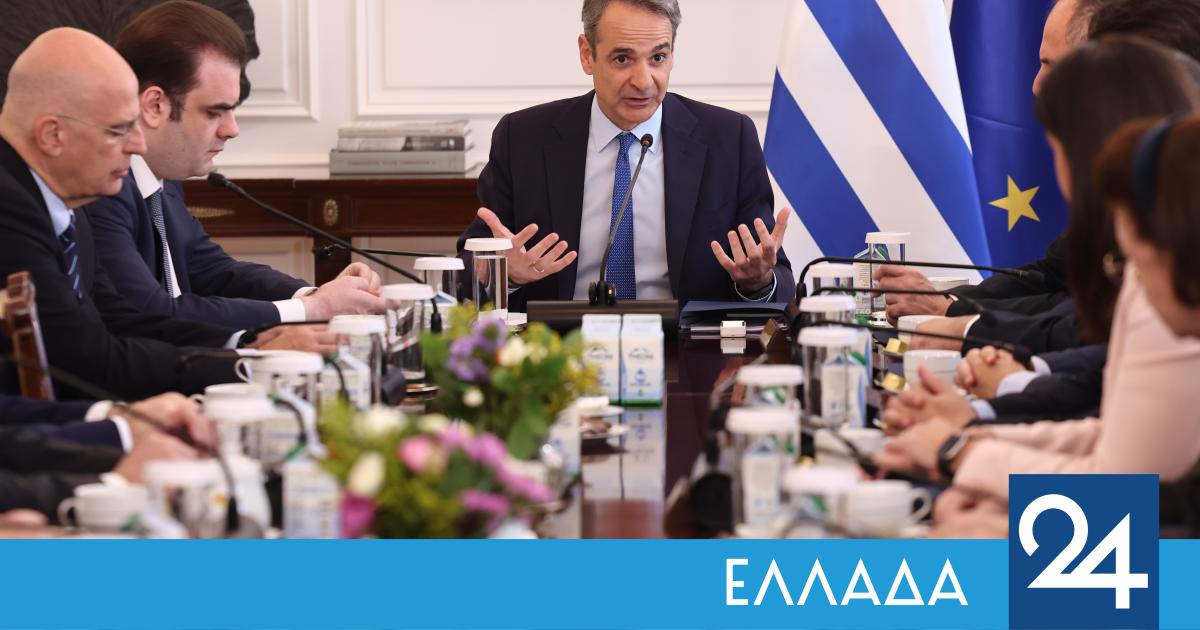
The new minimum wage of 920 euros was announced at the Council of Ministers by Prime Minister Kyriakos Mitsotakis.
This is the sixth increase in the minimum wage from 2022, which will take effect from April 1, while the target remains for a minimum wage of 950 euros (gross) in 2027.
The minimum wage has gradually increased from 650 euros in 2019 to 880 euros, a 35.4% increase. This equates to 3,220 euros gross annually, meaning that those currently paid the minimum wage, before the upcoming new increase is factored in, are putting an extra five basic wages in their wallets for 2019.
Considering the inflation trajectory, sources in the economic staff point out that the increases that have been made exceed the corresponding inflationary pressures. Notably, the target for an average salary of 1,500 euros announced by Mitsotakis in the 2023 elections has almost been reached.
The new increase in the minimum wage is of course also to be taken into account with the changes in the tax scale, while for workers under 30 years old the financial benefit is even greater due to the large discounts or the tax-free allowance. And of course the increase in the minimum wage affects a number of social benefits, but also the three-year minimum wage in the public and private sectors.
In detail the Prime Minister’s introductory statement
.
“Obviously I would have liked my introduction to today’s meeting to be somewhat more optimistic, but unfortunately the global conflict in the Middle East continues to keep the global environment uncertain, with fluctuations in fuel prices fuelling inflation and this in turn causing chain reactions that have an impact not only on our country but on every economy, on every society,” the Prime Minister said at the start of his introduction to the cabinet meeting.
“I think uncertainty is now the only certainty and that obviously requires a constant vigilance on our part. So after the first measure that we took, which was the cap on the profit margins on fuel prices, as you know, four new measures were launched at the national level.
Our purpose here is very clear. On the one hand, we want to curb the rise in diesel prices, because this is a significant burden on transport and on the production costs of businesses. We want to strengthen in a targeted way, and we are doing this for the majority of Greek households through a two-month card, we are strengthening households against increases in petrol prices. We have our farmers in mind and we are essentially giving a subsidy on fertilisers which will be in force from 15 March. And of course a major intervention on ferry tickets to ensure that their prices, at least for Easter, will be close to last year’s prices. These are four buffers against this exogenous crisis, so as to avoid, as far as possible, their transformation into a source of horizontal price increases, which will ultimately be paid by the consumer,” the prime minister added.
Then Mitsotakis announced the new increase in the minimum wage that will take effect on April 1. “And now we come to the agenda of the cabinet, because in the measures to support society, today we will co-decide on the new increase of the minimum, the basic wage, from April 1. I want to remind you that this is the sixth consecutive increase in the minimum wage, which we had received in 2019 at 650 euros. The minister’s recommendation, and she will explain in detail the rationale behind this recommendation later on, is that the minimum wage be raised to 920 euros. It is a monthly increase of 40 euros from last year. In other words, the cumulative increase in the minimum wage from 2019 is more than 41%. It’s more than 3,780 euros a year,” he said.
“And of course, we must remember that the increase in the minimum wage does not only concern our fellow citizens who are at this salary level, it involves upwards the three-year terms, the scales in the public sector and of course many benefits,” he added.
Also referring to unemployment, he noted: “It is always worth remembering that in 2019 our central commitment was to reduce unemployment and create many new jobs. Today, taking stock, this last six years, 563,000 new jobs have been added in our country.
I repeat, 563,000 new jobs. We’ve taken unemployment down to 18%. In January it is at 7.7%. And add to this, I think very successful, policy the fact that we are now protecting workers through the digital job card, which fully safeguards their rights.
We’re even extending it to five more sectors, from private healthcare to telecoms and cleaning companies. The perimeter will now exceed 2,300,000 workers. And I think that this initiative has also been vindicated by the actual data that we see, with a significant increase in declared overtime and a much better protection of the worker against any potential employer arbitrariness.”
Finally, referring to developments in the Iran war, he said: “At such a complex juncture, I think that this national power that is emanating beyond our borders should be forged by internal stability and unity, and I think it is important to have the strength to distinguish the big and serious things of a world that is changing with developments that directly affect us from the small and less important things of our party microcosm.”
@ellada24gr Mitsotakis: Our central commitment in 2019 was to reduce unemployment and create new jobs. We created 563,000 new jobs, delivered unemployment at 18% and today it is at 7.7%. We introduced the digital job card. #news #greeknews #ellada24 #tiktokgreece #foryou #tiktoknews #fyp #greektiktok #foryoupagе #tiktokgreek #tiktokgr #politics #politiki #mitsotakis ♬ original sound – Ellada24