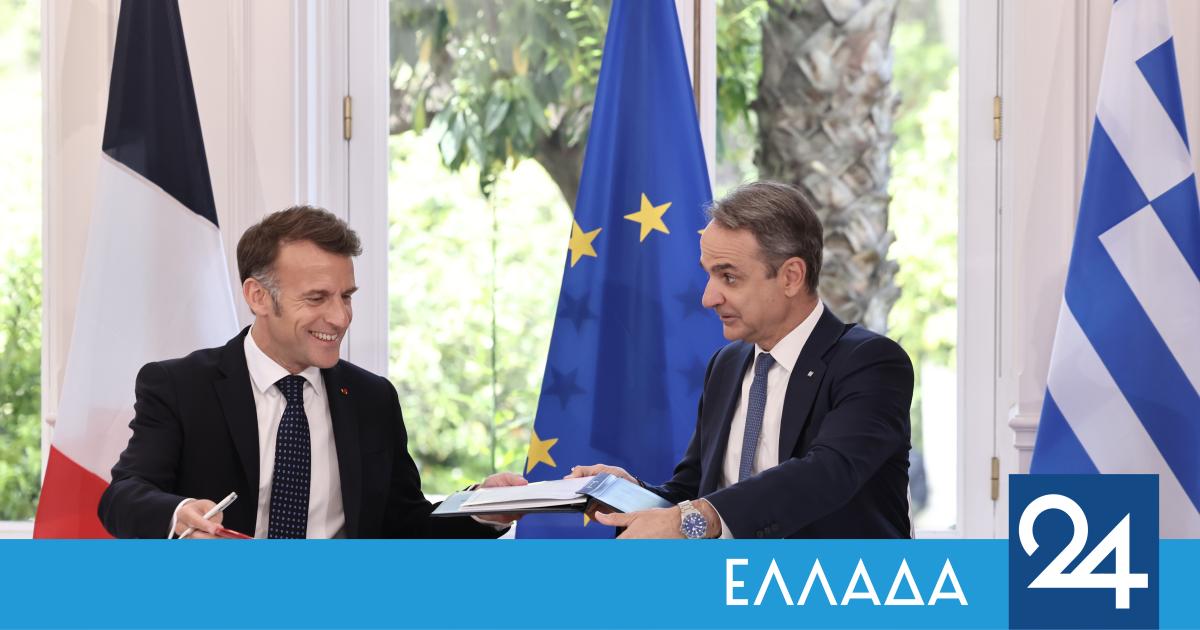
Greece and France are now focusing on the transition from transnational agreements to substantial industrial cooperation in the defence sector, as highlighted at the Greece-France Economic Forum held in Athens during the visit of the President of the French Republic, Emmanuel Macron.
The discussion on defence was not limited to geopolitical findings, but focused on the practical requirements for the creation of a strong European defence industry, with an emphasis on joint programmes, co-productions and unified supply chains.
The focus was on the need to overcome the fragmentation that characterises the European market. It was pointed out that despite high levels of expertise, the lack of coordination and common standards limits Europe’s ability to develop competitive defence systems at scale.
Christian Hadjiminas, head of THEON International, highlighted the issue clearly, stressing that the challenge is not technological but organisational. As he noted, European defence dominance can only be achieved through joint procurement and strategic partnerships, with equal sharing of industrial work. He stressed that partnerships between Greek and French companies have already led to exports of defence products worth hundreds of millions of euros, showing that there is an operational model that can be extended.
From the French side, Pierre Éric Pommellet, head of the Naval Group, stressed the long-term dimension of cooperation, noting that the involvement of Greek industry in armaments programmes – such as shipbuilding projects – is steadily expanding. He stressed that the aim is to develop joint projects that will create added value for both sides, while strengthening the European defence base.
In the same context, Nicolas Groult from KNDS France stood on the importance of transnational partnerships as a key tool for the unification of European defence. As he said, programmes such as Philoctetes show that partnering with Greek industry can meet operational needs and at the same time strengthen the European technology base.
From the Greek side, Evangelos Mytilineos of METLEN stressed that Greece can act as an equal industrial partner, noting however that in some large programmes – such as the frigates – the activation of domestic industry could have been done earlier to further enhance domestic added value.
The next phase of Greek-French cooperation appears to be shifting from simple procurement to more complex co-production and co-development schemes. This means that Greek companies are invited to become more actively involved in European value chains, not only as subcontractors but also as technology partners.
This perspective is directly linked to wider European developments. The increase in defence spending, the need for strategic autonomy and the acceleration of joint European programmes create a new context in which countries with a credible industrial base – such as Greece – can claim a greater role.
At the same time, strengthening cooperation between Greece and France acts as a “pilot” for wider European synergies. The key issue, as the interventions have shown, is the transition to a model where defence investment is combined with industrial development, technological development and export dynamics.
The conclusion that emerged is that defence cooperation is no longer just a security tool, but also a driver of economic and industrial policy. And in this new environment, the Greek-French partnership is attempting to acquire more permanent and productive characteristics.