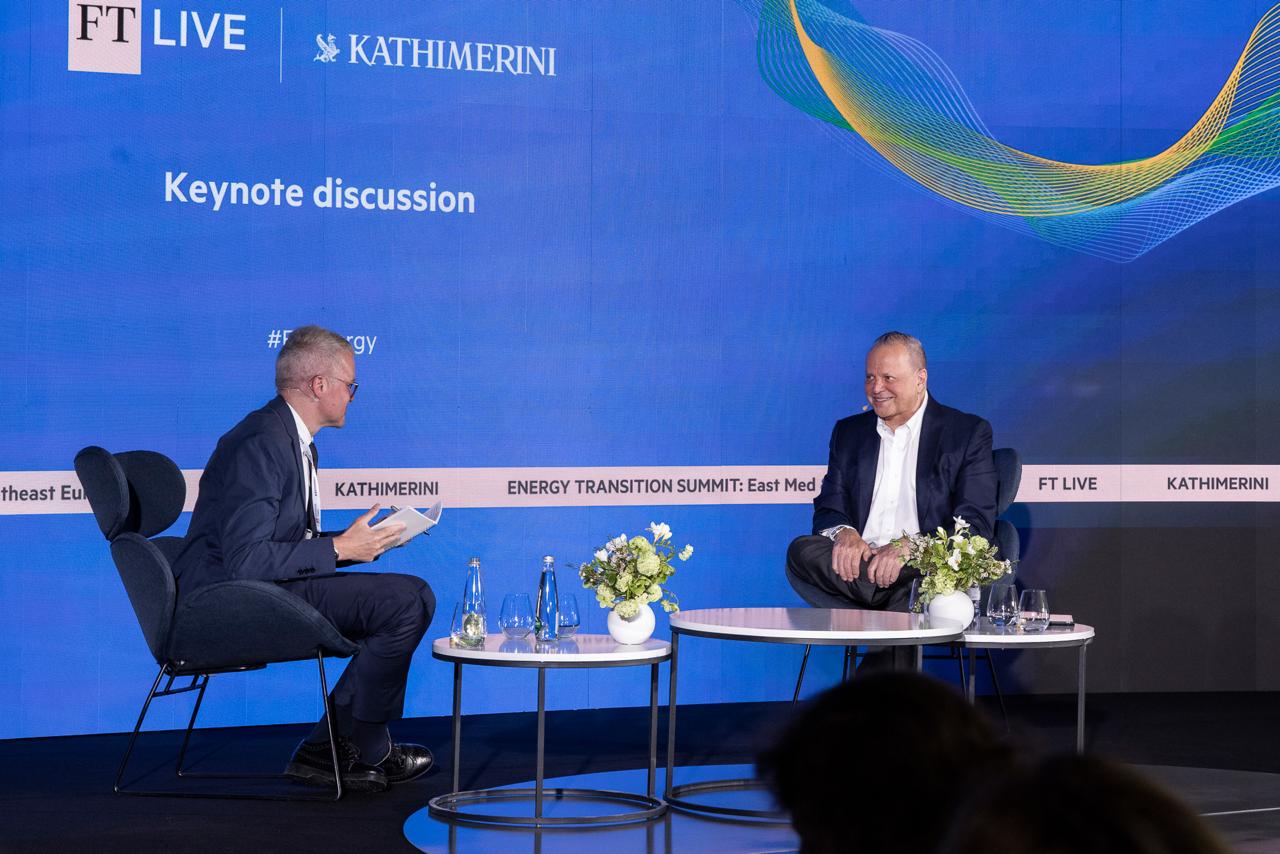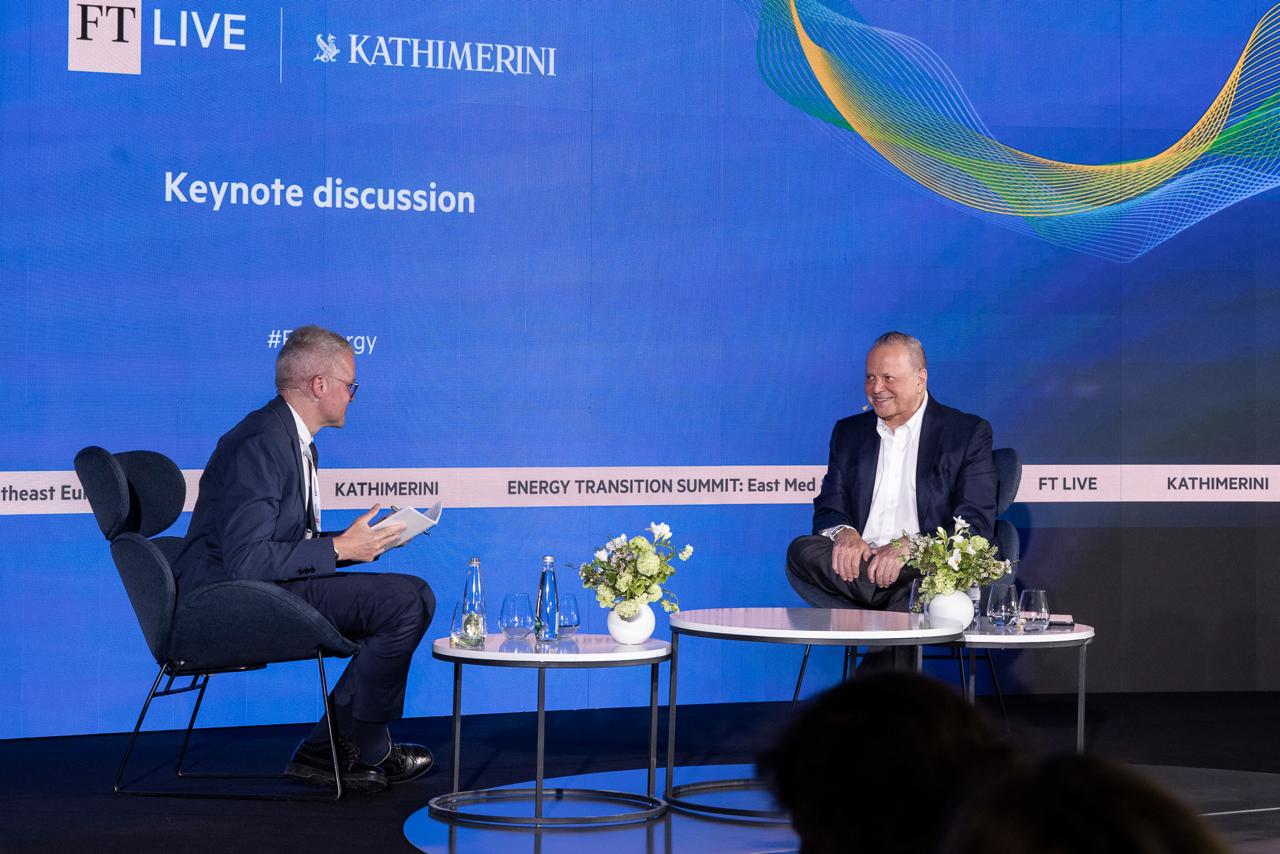
At the “Energy Transition Summit: East Med & Southeast Europe” of the Financial Times and Kathimerini, Evangelos Mytilineos, Executive Chairman of METLEN, participated in a discussion with Ben Hall, Europe Editor of the Financial Times, referring to an environment of increased energy and geopolitical uncertainty, with a focus on the developments in Hormuz and their impact on the markets.
Referring to the commodity market, he highlighted that aluminium prices are recording a significant rise as much of the world’s production is concentrated in the Gulf. At the same time, natural gas – which he described as the most critical raw material for his industry – has risen by 40-50%, putting a significant burden on production costs, although he noted that the company has already entered into hedges for 2026 and 2027.
Mytilineos also pointed to the fact that Europe is at risk of replacing one dependence with another, on Russian pipeline supplies of liquefied natural gas (LNG), mainly of US origin, which now covers about 80% of the company’s imports via Revithusa. It also warned that the US use of energy as a geopolitical tool would have much wider implications for transatlantic relations.
In the same context, he stressed the issue of the competitiveness of European industry, noting that for an industry that competes internationally with electricity prices of around 30 euros/MWh, survival is becoming extremely difficult at current costs. As he said, the European industry has been trying for years to explain the problem to Brussels, without any substantial result.
At the same time, he criticised the EU’s strategy towards heavy industry, noting that for years the perception prevailed that Europe no longer needs energy-intensive industries.
For Europe, he warned that low gas storage capacity compared to previous years is creating additional pressure, while a shift in demand to Asia could push up prices. He said markets believe the Gulf tension will be short-lived.
In relation to the transition to clean energy, he stressed that it is not evolving linearly but in “waves”, with current priorities shifting from carbon and climate to energy security. He noted that countries with limited access to cheap energy are accelerating investments in renewables and infrastructure to achieve self-sufficiency, while Europe is also redefining its strategy under the weight of geopolitical instability.
He placed particular emphasis on energy storage, stressing that the new push for renewables will come less from climate and more from the need for energy security. However, he pointed out, the key issue remains storage, especially meeting night-time demand, as without affordable 6-10 hour batteries, full decarbonisation from fossil fuels is not possible. “The problem we need to solve as an energy community as a whole is what we do during the night,” he said.
In this context, he referred to METLEN’s major new 330 MW energy storage project, which is being built and will be delivered in the next few months, noting that even one of the largest batteries in Europe today provides only about two hours of domestic demand.
Finally, on electricity prices, he said that linking them to gas creates a serious competitiveness problem for the industry, as average prices remain very high.