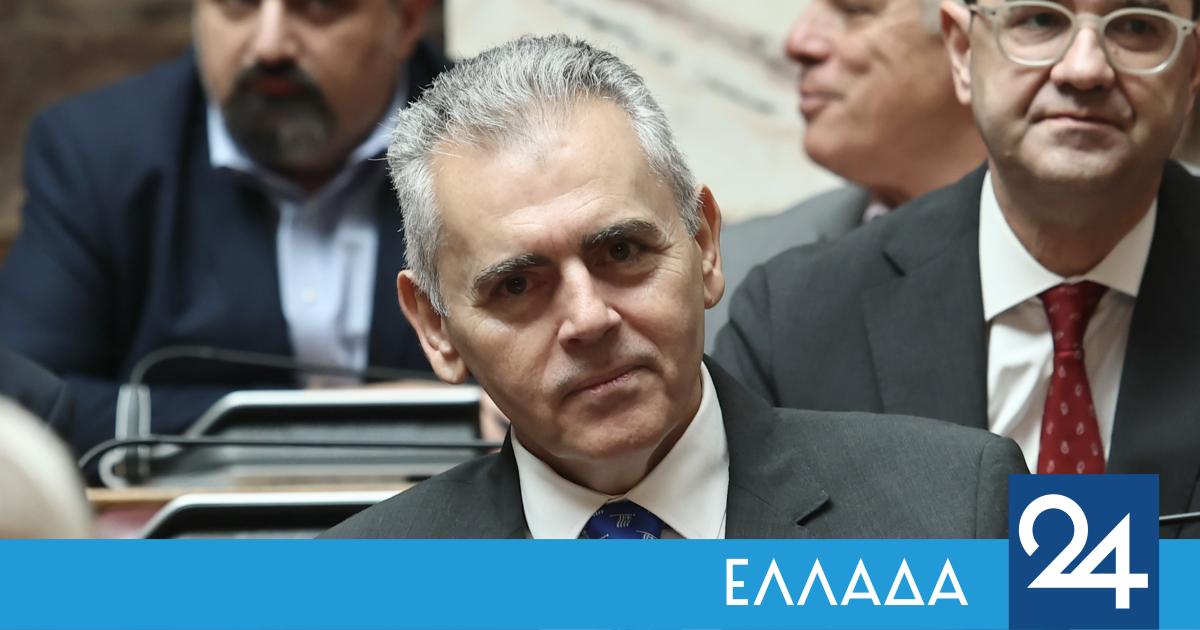
I am with you today not to talk to you, but to listen to you in my capacity as a member of the Parliamentary Inter-Party Committee, which was set up for the first time since the post-war period to make proposals for the formulation of a national strategy for the agricultural sector that will bind future governments. The chronic problems of primary production cannot be solved within the framework of a single government term and this is an opportunity to correct what you consider to be bad texts. This was underlined by the Secretary General of the Parliamentary Group of the New Democracy, MP for Larissa and member of the Parliament’s Interparty Committee for Rural Reconstruction, Maximos Charakopoulos, addressing farmers, livestock farmers and professionals of the primary sector of Farsala.
The event, which lasted three hours, saw a substantial exchange of views, the identification of pathologies and the submission of proposals for the solution of problems by representatives of cooperatives, TOEBs, farmers and livestock farmers.
The Thessalian politician was introduced by the chairman of the DIMTO of Farsala, Yannis Arzoumanidis, while the mayor of Farsala, Iordanis Eskioglou, addressed the meeting. Charakopoulos said that he looks forward to “the proposals of the people in the field, who live and know the problems first hand. The national dialogue may be the last chance to come up with realistic proposals that will bind all those who believe in the European orientation of the country”. He then set out the main themes of the agricultural issue. More specifically, he touched on, among other things, the role of the agricultural profession in halting the desertification of the countryside, the ageing of the rural population and the importance of ownership of agricultural land for the future of primary production, and the need for continuous training of farmers and stockbreeders, the possible restructuring of crops in order to increase productivity and reduce losses due to climatic phenomena, the reform of the ELGA regulation, the strengthening of cooperatives, the distribution of subsidies, addressing the increasing costs of production and the major water problem of the region and Thessaly in general.
Subsidies – compensation
The farmers and livestock farmers present took the floor and stressed the great financial strain created by the combination of climate disasters (Daniel etc.) and delays in compensation and aid. They also pointed out the complexity and inefficiency of the model of eco-vehicles and the application of advisory services to the producer, which also create problems in payments and drain rather than add resources to the real producer.
They suggested that aid should be paid to those who produce, and called for a framework for the payment of aid that takes into account farmers’ seasonal needs for labour and resources, and for action to be taken to ensure that compensation is paid more promptly, as this plays a key role in getting farms back on track more quickly after damage.
With production costs affected by international circumstances, such as the war in the Middle East, producers have called for faster responses. As in the case of the collapse of their incomes due to animal diseases, the extraordinary financial “breathing space” from the state must be immediate, otherwise the essence of the aid is lost and it cannot be used in retrospect, since they are caught in a vicious circle of debt to grow crops.
In addition, they put the high cost of inputs (inputs, fertilizers, etc.) in contrast to other countries. With regard to agricultural oil, they pointed out that in many villages there are no longer any petrol stations. Thus, the measure of reimbursement at the pump is not practically feasible for many farmers and should be revised by allowing them to be able to store on their own premises without losing the tax refund.
As cotton is a staple crop in Farsala province there has been much concern about the future, with farmers pointing to the need to extend the “nitrate pollution” programme. They also referred to the delays in payments for farmers’ programmes (young farmers, improvement plans, certification and quality systems) and asked for payment schedules to be announced, otherwise no planning for the future can be implemented in practice. Finally, they called for more generous funding schemes for farmers to buy farmland.
Livestock – zoonoses
On the subject of zoonotic diseases and the future of livestock farming, they argued that a programme should be designed immediately to rebuild the livestock population, as farmers who have lost their animals are in dire straits. Many will leave the profession and it is crucial to eradicate zoonoses, which should be prevented in the early stages before they spread geographically and become devastating. They also focused on looking at work and insurance solutions to enable those without livestock to survive who do not know when they will be able to restart their business.
They stressed the importance of the quality of Greek production, strict controls at every level to ensure it, as well as protection from “cartels” which, they argued, monopolize the setting of milk prices.
Several people raised the issue of poor implementation of the Gaia programme for rural electricity, complaining of charges when there was no proven consumption due to the absence of a transformer that had been stolen or the stage of the crop not requiring irrigation. They pointed out the weakness of the existing system so that they could pay their debts, prove the errors in the charges and make the appropriate corrections. Given the importance of irrigation for production, they demanded that the existing system be made fairer.
They also stressed the importance of carrying out irrigation projects such as the Skopias Dam and the need for special funding programmes for drip irrigation.
Finally, on the issue of electronic documents, they pointed out the difficulties of familiarising the ageing farming population with modern technology, as well as other practical peculiarities per crop and asked for a meaningful dialogue with the competent tax authorities to avoid the imposition of high fines where compliance is de facto not possible.