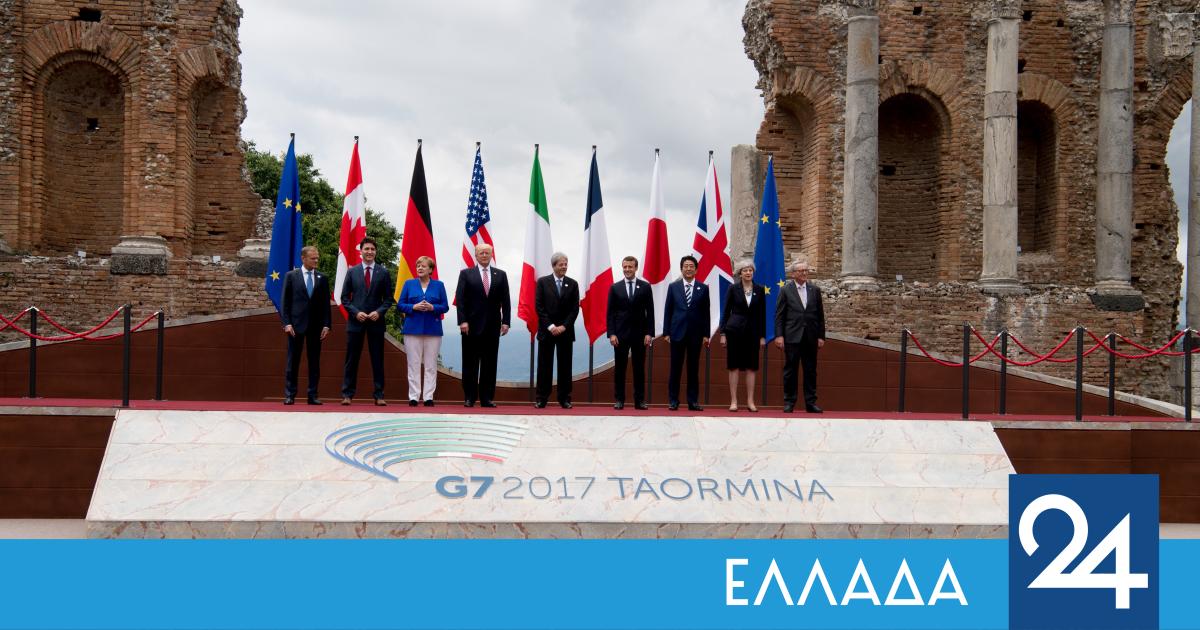
The leaders of the Group of Seven (G7), comprising the world’s seven wealthiest nations (G7) are meeting from today through June 17 in the city of Evian, France, shortly after the announcement by the U.S. and Iran of an agreement aimed at ending the war.
The G7 agenda will include, starting today, “the consequences of this agreement, support for Lebanon, the opening of the Strait of Hormuz in the long term, and, obviously, the conclusion of an agreement on Iran’s nuclear and ballistic missile programs,” French President Emmanuel Macron wrote on Instagram.
These issues will also be discussed tomorrow, Tuesday, in the presence of leaders from Egypt, the United Arab Emirates, and Qatar, he added.
Trump is expected to hold talks with his French counterpart today at 5:00 p.m. (local time, 6:00 p.m. Greek time). The two presidents will then attend the opening dinner of the summit, which will be attended by the leaders of Germany, Canada, Italy, Japan, and the United Kingdom.
Many G7 members have been directly affected by Trump’s actions on the global stage, which have caused turmoil in the Middle East, global trade, and diplomacy.
“Crisis Summit”
The French President, hosting the G7 for the second time since 2019 in Biarritz, looks forward to his final participation in this group of powerful industrial nations, before leaving the Élysée Palace in May 2027, to give him the opportunity for a diplomatic success.
“It will be a crisis summit and a summit with concrete results,” the French presidency promised.
The key word will be “convergence”—between Donald Trump and the Europeans, who are diametrically opposed on many issues, and between the G7 countries and the invited countries (Brazil, India, Kenya, South Korea, and Egypt).
Beyond the Middle East, Macron hopes to secure from Trump a stance that is more positive toward Kyiv and less so toward Russian President Vladimir Putin, in order to end the war in Ukraine.
Moreover, the U.S. President will participate tomorrow, Tuesday, in a meeting on Ukraine attended by his Ukrainian counterpart Volodymyr Zelenskyy.
“Bad idea”
Will Macron achieve another diplomatic success, as he did at the G7 summit in Biarritz, where he managed to bring in then-Iranian Foreign Minister Mohammad Javad Zarif, when relations between Donald Trump and Iran were already at a breaking point?
Expectations are high. “The G7 must establish itself as a functioning body before the U.S. takes over the presidency in 2027,” warned a European source.
Another challenge Macron has set for himself is addressing “major global macroeconomic imbalances.”
In this context, he is expected to tell the Americans that tariffs “were a bad idea and must be phased out” and China “to be more responsible with corporate subsidies and to strengthen its domestic market,” rather than engaging in massive exports, Macron noted.
Moreover, the French presidency has invited many “leaders of the global technology industry,” including Americans Sam Altman and Dario Amodei, heads of OpenAI and Anthropic respectively, for a lunch on Wednesday that will focus on creating a regulatory framework for artificial intelligence and restricting children’s access to social media.