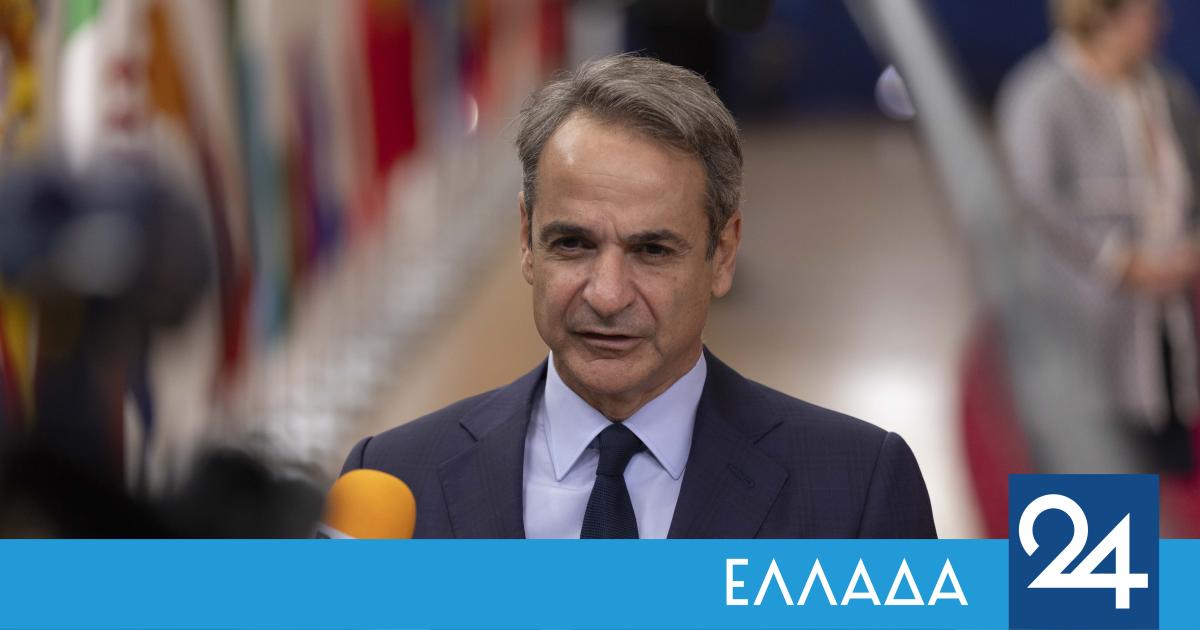
“The government is ready within its fiscal capabilities to deal with the impact of the fuel price increases,” Prime Minister Kyriakos Mitsotakis said after the European Council in Brussels.
He said there was an extensive discussion on the economic impact of the prolonged geopolitical crisis and the war unfolding in the Middle East. “I think it is common ground that the longer the conflicts continue, the more negative the consequences will be for the global, for the European, and consequently for the Greek economy,”
the Prime Minister said.
Mitsotakis said that a wording in the European Council conclusions “opens the door for more flexibility in taking national and European measures to deal with this extraordinary crisis”. He added that he is not yet ready to say anything more at this time, but reiterated that “the government is ready within its fiscal capacity to deal with the impact of increases in fuel prices and possibly the price of electricity.”
In response to a question about reports in Turkey that it has sent letters to NATO, the EU and the US expressing its displeasure over the movement of the Greek Patriot battery to Karpathos, the Prime Minister said: “These allegations are legally unsubstantiated, but I would say that they are also completely untimely given the wider geopolitical context.” He also added that “Greece is not negotiating with anyone the disposition of its defence forces at the operational level.”
Greece is not negotiating with anyone the disposition of its defence forces at the operational level.
About the Greek Patriots in Saudi Arabia, the Greek Prime Minister noted that they are there from 2021, by decision of the Kysea, as part of a broader effort to protect critical infrastructure, which has to do with the security of fuel supply. “Today’s interception was a strictly defensive action, which is part of this agreement that we have made with Saudi Arabia” – a country that has been a strategic partner of Greece for several years, the prime minister said. As he said: “one should acknowledge that in practice, the Greek Armed Forces have also demonstrated in a very complex exercise their operational readiness”.
To those who wonder how Greece benefits from such an initiative, the Prime Minister replied that “if these refineries – a critical Saudi refinery – had indeed been hit, then the price of oil today would be much higher than it is, because the protection of critical energy infrastructure on both sides should be a top priority at this time.”
He also said that Greece and France had taken the lead in the European Council on the need to formulate a proposal for a moratorium that would exclude any strike against energy facilities, whether they are in Iran or in the Gulf countries.
In regard to the EU’s mutual assistance clause, Mr. Mitsotakis described as “extremely positive” the fact that in the case of the attack on Cyprus, many European countries, with Greece leading the way, rushed to assist Cyprus by offering air support, so that Cyprus feels completely safe. As he said, this “was essentially a de facto, if not de jure, activation of Article 42 (7) TEU, the European Union’s mutual assistance clause”. He also stressed that the need was recognised “to move quickly some steps further” – that is, to draw up a “clear roadmap with a horizon of months, not years, so that we can have a clear operational plan in case we need to trigger this clause, what would be the steps we would take depending on the type of threat”. The Prime Minister said that “this is a very important achievement for our country and for Cyprus”. He said that he had spoken extensively about the need, in the context of strategic autonomy, to give content and depth to this very important mutual assistance clause, but that it had rather fallen by the wayside in the public debate. “The Cyprus adventure is an opportunity for both Greece and Cyprus to urgently move the debate forward in a direction that undeniably serves national interests,” he said.
“Greece protects its borders and the borders of the EU”
“Greece protects its borders and EU borders,” the Prime Minister said in response to a BBC question about allegations of migrant refoulement from Evros to Turkey.
The Greek Prime Minister’s full response is as follows:
“I have no knowledge of these allegations, but I would like to make one point, which is indeed reflected in today’s conclusions: that the European Union as a whole will not repeat the mistakes it made in 2015. Greece is protecting its borders. It is my duty to ensure that the borders of the European Union are protected. I will not apologise for these policies. And I would like to let you know that all members of the European Council, through the conclusions, have made it absolutely clear that we will not allow a massive influx of migrants and refugees into the European Union and that we will not repeat the mistakes of 2015.”
@ellada24gr Mitsotakis: Government ready to deal with the impact of fuel price hikes #politiki #greecetiktok #tiktokgreek #foryou #ellada24 #ellinikotikok #fyp #tiktokgr #mitsotakis #kyriakosmitsotakis #brussels #greece #petrelaio #koinoniaoramega #politics ♬ original sound – Ellada24