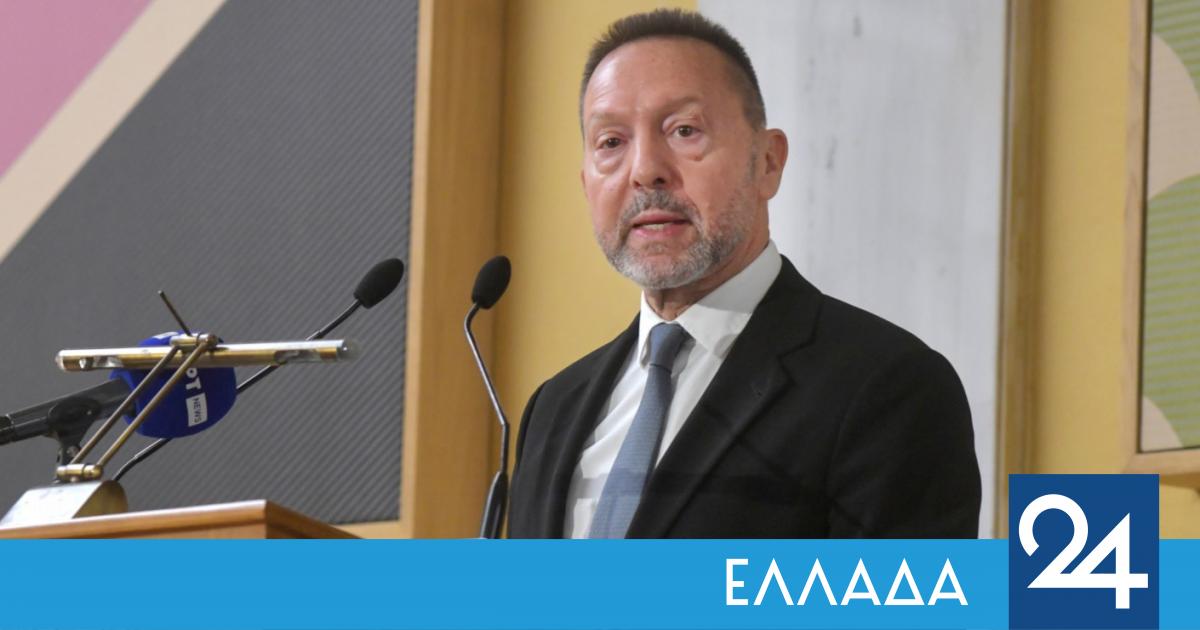
Yannis Stournaras, Governor of the Bank of Greece, stresses that the war is an additional adverse supply shock to the global and eurozone economy, with a potentially large macroeconomic impact if the conflict continues or spreads to all countries.
In a speech at an American Hellenic Educational Progressive Association (AHEPA) event in Frankfurt, Yannis Stournaras says that the lessons learned from recent Greek economic history are relevant in the current context of war, because periods of conflict tend to bring fiscal stress, energy disruption and wider uncertainty, making good fiscal governance and coordinated crisis management particularly important.
The Governor of the BoE spoke about Greece’s success in exiting the debt crisis, the Memoranda, the strengthening of banks and the economic performance the country is achieving today.
He spoke about the lessons learned from the Greek crisis and the outlook for the Greek economy. He said that since 2019, Greece’s GDP growth has been consistently outpacing the euro area average, putting the country back on a convergence path towards European income levels after many years of divergence. In 2025, real GDP grew by 2.1%, the same as in 2024, significantly above the euro area average growth rate of 1.4%.
Economic growth in 2025 was supported by both private consumption and investment, contributing 1.4 and 1.5 percentage points respectively to GDP growth. Net exports also made a positive contribution, adding 1.2 percentage points as they grew by 1.7%. Overall, private consumption grew by 2 percent in 2025 while investment growth accelerated to 8.9 percent mainly due to RRF financing.
The economic outlook for the Greek economy remains positive, according to Yannis Strournaras, despite strong external headwinds.
If the conflict in the Middle East does not last more than a few weeks and if energy prices decelerate, real GDP growth in 2026 is expected to be broadly in line with 2025, exceeding the euro area average, thus further supporting the further catching up of European income levels. Consumption is expected to be the main driver of growth, while investment should continue to make a positive contribution. In the short term, investment will be supported by the remaining available RRF resources.
Most importantly, the resilience of the Greek economy has not been underpinned by short-term stimulus measures, but rather by strong fundamentals: stable public finances, resilient household consumption, strong recovery of RRF-supported investment and excellent export performance – particularly in tourism, supply chain, digital services and innovation-intensive sectors such as pharmaceuticals. Meanwhile, the labour market has strengthened, with unemployment falling to single-digit levels for the first time since the start of the crisis.
Greece continues to achieve strong primary surpluses without reverting to restrictive fiscal policy measures. Public debt is steadily declining as a percentage of GDP, and is expected to reach around 138% of GDP in 2026. Sound fiscal policies have created room for targeted tax cuts, protection of vulnerable households and investment in digital, green actions. International rating agencies have responded with upgrades to sovereign debt and bank ratings, helping to attract renewed foreign capital to Greek assets.
However, the external environment remains very fragile, according to the Governor of the BoE. Geopolitical instability and the escalation of the war in the Middle East, a new, major energy crisis arising from that war, protectionist pressures, economic policy uncertainty, financial fragmentation and climate change are sources of significant downside riskss. The war, if it continues, is bound to cause stagflationary effects, i.e. higher inflation and lower growth.
According to Yannis Stournaras, Greece has shifted its focus from recovery to “strategic acceleration”. Its central economic objective is now to ensure long-term real convergence with the euro area without recreating past macroeconomic imbalances. Achieving this objective requires a faster closing of the remaining investment gap with the euro area, sustaining productivity gains through investment in new technologies, continued implementation of reforms, effective mobilisation and allocation of domestic resources, EU structural and RRF funds, and foreign direct investment, especially in sectors producing internationally tradable goods and services, in a world increasingly shaped by technological progress and geopolitical competition.</
Macroeconomic, fiscal and financial stability must remain the key driver. Strict adherence to EU rules and accelerated debt reduction have been and continue to be necessary to maintain credibility, but stability is not enough. The fiscal strategy must become pro-growth, redirecting spending towards infrastructure, education, innovation and demographic support, while further modernising the tax system to enhance competitiveness and fairness.
The decisive battleground is mobilising investment. Utilization of the remaining RRF funds must be fast and efficient, but external financing alone is not sufficient. Private capital must be attracted through faster procedures, deepening the capital market and developing non-bank financing.
Finally, Greece must address the green and digital transitions not as liabilities but as strategic opportunities for competitiveness.
The new energy crisis is a stark reminder that Greece should maximise its efforts to reduce its dependence on (imported) fossil fuels.
If political stability, fiscal responsibility, financial stability, institutional credibility and reform momentum are maintained, according to the Governor of the BoE, Greece is in a position not only to sustain the recovery, but also to enter a phase of permanently higher investment, productivity growth and economic resilience.